
Key Takeaways
- Precision Advantage: CNC pipe bending achieves tolerances as tight as ±0.025 mm compared to traditional methods’ 1-3 mm tolerance range, with servo-driven systems reaching ±0.001-inch repeatability for critical aerospace and automotive applications.
- Automated Efficiency: Modern CNC benders support continuous 24/7 operation with automatic material feeding, quick tool changeover, and seamless integration with robotic systems that reduce labor costs while increasing throughput.
- Waste Reduction: Optimized nesting software and precise programming minimize material waste by maximizing sheet utilization and eliminating setup errors, directly reducing production costs per part.
- Complex Geometry Capability: Multi-stack tooling enables multiple bending radii in a single cycle without repositioning, creating intricate shapes and tight bends previously unattainable with manual methods.
- Quality Consistency: Real-time feedback systems and advanced CNC controllers automatically adjust for material variability and springback, ensuring consistent results across thousands of production cycles without manual intervention.
CNC pipe bending machines have transformed tube fabrication from a manual craft into a precision manufacturing process. These computer-controlled systems deliver tolerances as tight as ±0.025 mm while eliminating the inconsistencies inherent in traditional bending methods. Modern manufacturers rely on CNC tube bending for complex geometries, repeatable accuracy, and production speeds that manual operations cannot match.
This guide examines the core features, operational advantages, and selection criteria for CNC pipe bending technology. Whether you’re evaluating equipment for aerospace components, automotive exhaust systems, or construction applications, understanding these machines’ capabilities determines your production efficiency and product quality.
The right CNC bending solution impacts material waste, labor costs, and competitive positioning in precision-driven markets.
What Are CNC Pipe Bending Machines and How Do They Work?
CNC pipe bending machines automate tube and pipe fabrication through computer-controlled precision. These systems eliminate manual calculation errors while delivering consistent results across high-volume production runs.
What Is CNC Pipe Bending Technology?
CNC pipe bending technology uses computer numerical control to automate the bending process. The system controls machine movements with exact precision, ensuring each bend hits the correct angle, depth, and position. This computer control makes the process highly repeatable—program once, produce thousands of identical parts. The technology removes human variability from the equation, delivering consistent quality regardless of operator skill level.
How Do CNC Pipe Benders Operate in Production Environments?
CNC pipe benders rely on advanced software to program bend angles, rotations, and distances before production begins. Real-time feedback systems use sensors to monitor each bend as it happens, providing instant data on bend angle accuracy. The machines compensate for springback and material behavior automatically, making on-the-fly adjustments during the bending process. Modern systems detect material variability—changes in thickness or hardness—and adjust parameters automatically to maintain consistent results across different batches.
What Makes CNC Bending Machines More Efficient Than Traditional Methods?
Traditional bending methods work with tolerances of 1-3 mm, while CNC systems achieve ±0.025 mm precision. CNC bending produces exceptionally smooth, clean edges that minimize post-processing needs. The non-contact thermal process eliminates the rough edges and burrs common in traditional methods, reducing secondary operations and cutting production time.
What Are the Key Features of Modern CNC Pipe Bending Machines?
Modern CNC pipe benders combine precision controls, automation capabilities, and integration features that transform production efficiency. These machines deliver repeatability and accuracy that manual methods cannot match.
How Does CNC Tube Bending Improve Precision and Consistency?
CNC tube bending achieves tolerances as tight as ±0.025 mm, with electric press brakes using servo motors reaching ±0.001 inches repeatability. Servo motors provide quick response times that enable faster cycle speeds without sacrificing accuracy. Once you program a design, the machine produces thousands of identical parts with consistent precision—eliminating variation between first-run and thousandth-run parts.
What Role Does CNC Tubing Bender Technology Play in Product Development?
CNC tubing benders create intricate shapes and complex geometries that were previously unattainable with traditional methods. High repeatability eliminates human error and enables design complexity that manual bending cannot achieve. This precision proves critical in aerospace, automotive, and electronics industries where minor deviations compromise product functionality and safety standards.
How Does CNC Pipe Bending Integrate with CNC Machining for Optimal Results?
CNC pipe bending services integrate seamlessly with robotic loaders, unloaders, and other CNC machines to create fully automated production cells. This integration increases production efficiency while reducing labor costs and improving workflow. Automated cells eliminate manual material handling between operations, reducing cycle time and minimizing handling damage.
What Are the Advantages of Using CNC Bending in Large-Scale Manufacturing?
CNC bending systems support continuous 24/7 operation with minimal human intervention through automatic material feeding that reduces manual labor and accelerates cycle times. Quick tool changeover systems enable rapid transitions between jobs, cutting downtime between production runs. These features make CNC bending ideal for high-volume manufacturers running multiple product lines.
How Does CNC Pipe Bending Improve Production Efficiency?
CNC pipe bending eliminates inefficiencies that plague traditional fabrication methods. Automated controls, optimized material usage, and reduced error rates combine to accelerate production while cutting costs.
How Does CNC Pipe Bending Reduce Material Waste in Production?
Optimized nesting software maximizes material utilization by arranging parts for efficient cutting and bending sequences. Parts can be programmed closely together to minimize waste between components. This optimization results in less scrap material and lower production costs per part—critical advantages in high-volume manufacturing where material costs significantly impact profitability.
In What Ways Does CNC Bending Speed Up the Manufacturing Process?
Automated CNC systems dramatically reduce production time and increase overall throughput compared to manual bending operations. Manufacturers searching for advanced tube benders near me benefit from high-speed operation combined with minimal human intervention, creating efficient manufacturing processes that maintain consistent quality. The elimination of manual measurement, setup, and adjustment steps accelerates cycle times while reducing the labor hours required per part.
How Does CNC Tube Bending Minimize the Need for Rework and Errors?
Advanced CNC controllers automatically adjust for material variability, ensuring consistent results across different batches without operator intervention. Programmable controls provide high repeatability that eliminates human error in the bending process. The ability to perform multiple bending radii in a single cycle removes the need for multiple setups—each setup change introduces potential for error and adds non-productive time to the manufacturing process.
What Are the Applications of CNC Pipe Bending Machines in Various Industries?
CNC pipe bending serves industries where precision directly impacts safety, performance, and regulatory compliance. The technology’s versatility makes it essential across manufacturing sectors requiring complex tubular components.
How Is CNC Pipe Bending Used in Industries Like Aerospace, Automotive, and Construction?
CNC pipe bending proves critical in aerospace, automotive, and electronics industries where minor deviations compromise product safety and functionality. These sectors demand parts that meet strict tolerances for hydraulic lines, exhaust systems, structural tubes, and cooling circuits. The ability to produce high-quality, complex parts uniformly and repeatably makes CNC bending essential for manufacturers facing rigorous quality standards and certification requirements.
What Types of Products Benefit from CNC Tube Bending Services?
Complex tubular components requiring exceptional precision and efficiency benefit most from CNC tube bending. Products needing multiple bending radii in a single setup—achieved through multi-stack tooling—see the greatest advantages. This includes roll cages, handrails, heat exchangers, exhaust manifolds, furniture frames, and hydraulic systems where multiple bend angles and radii create the final component geometry.
How Does CNC Pipe Bending Handle Complex Design and Tight Tolerances?
CNC pipe bending technology excels at producing complex geometries that demand exacting specifications. Advanced controls and real-time monitoring systems maintain precision across extended production runs.
What Makes CNC Tubing Benders Capable of Achieving Tight Bends and Complex Shapes?
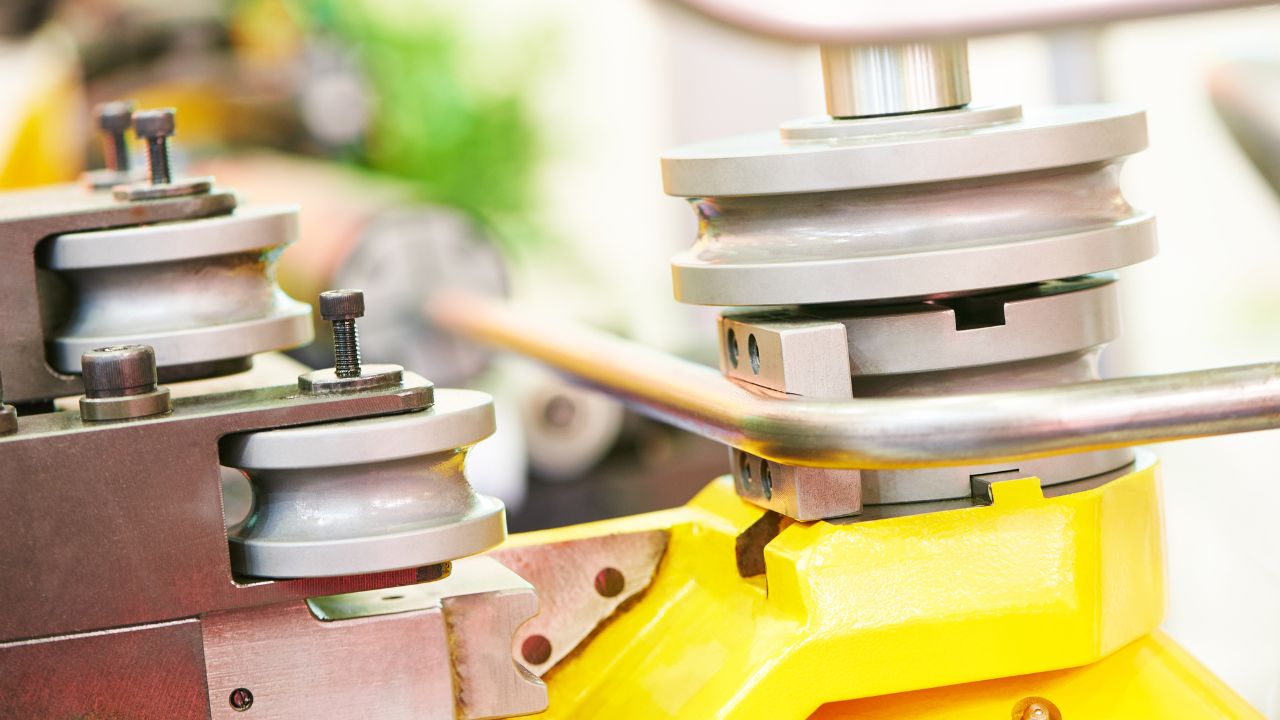
Advanced CNC controllers enable precise programming of bend angles, flange lengths, and material properties before production begins. Multiple bending radii capability increases design freedom while improving accuracy—manufacturers can create complex parts without repositioning or multiple setups. Multi-stack tooling reduces setup times while maintaining precision, allowing different bend radii within a single cycle without tool changes that introduce positioning errors.
How Does CNC Pipe Bending Ensure the Consistency of Product Quality Over Time?
Precise control proves crucial for producing complex parts with tight tolerances where slight deviations compromise final product quality and functionality. Servo-driven motors provide extremely precise ram positioning that maintains consistency across thousands of production cycles without degradation. Real-time feedback systems monitor each bend and ensure consistent results across production runs—detecting and correcting micro-variations before they accumulate into quality issues.
How to Choose the Right CNC Pipe Bender for Your Manufacturing Needs?
Selecting the right CNC pipe bending equipment or service provider requires evaluating technical capabilities, quality systems, and business factors. The right match ensures production efficiency and part quality while controlling costs.
What Should You Look for When Selecting a CNC Pipe Bender?
Start by assessing machine capabilities—verify the equipment handles your required tube diameters, wall thicknesses, and bend radii. Look for advanced features like multi-stack tooling and variable radius bending that expand design possibilities. Evaluate the provider’s tooling inventory and customization capabilities, as comprehensive tooling reduces lead times and costs while enabling unique or complex bends.
Quality assurance matters critically—ISO 9001:2015 certification indicates a robust Quality Management System. Ask about quality control checks, inspection processes, and traceability systems that ensure consistent results. Verify the provider’s experience in your specific industry through customer references and case studies. Consider lead times, production capacity, and rush order accommodation based on your volume requirements. For high-volume production, prioritize providers offering automated systems like robotic loading and unloading to improve efficiency. Evaluate technical support offerings including engineering assistance, design optimization advice, and material selection guidance. Weigh cost against quality, reliability, and overall service—the lowest price rarely delivers the best value.
How Does the Material Type Affect the Choice of CNC Tube Bending Machine?
Material compatibility drives machine selection since different alloys require specific bending approaches. Ensure the provider has proven experience with your specified materials—stainless steel, aluminum, titanium, or specialized alloys each present unique challenges. Systems must automatically adjust for material variability including changes in thickness or hardness to maintain consistent quality across production batches without manual intervention.
The Future of CNC Pipe Bending: Innovations on the Horizon
Emerging technologies promise to push CNC pipe bending beyond current precision and efficiency benchmarks. AI integration and advanced automation represent the next evolution in tube fabrication capabilities.
How Is AI Technology Changing the Future of CNC Pipe Bending Machines?
AI technology is transforming CNC pipe bending through predictive maintenance that identifies potential failures before they occur, reducing unplanned downtime. Machine learning algorithms optimize bending parameters by analyzing thousands of production cycles, automatically adjusting for variables that human operators cannot detect. Adaptive control systems use AI to predict springback and material behavior more accurately, making real-time adjustments that improve first-pass yield rates. Quality prediction algorithms analyze sensor data to flag potential defects before they occur, enabling immediate corrective action.
What New Advancements Are Expected in CNC Bending to Improve Efficiency and Precision?
Advanced sensor technology will provide more granular data on material properties and bending forces, enabling tighter process control. IoT integration will connect CNC benders to factory-wide networks for better production planning and real-time monitoring across multiple machines. Enhanced software capabilities will simplify complex bend sequence programming and enable virtual simulation that catches errors before production begins. Improved automation systems will reduce manual intervention further, with autonomous material handling and tool changing becoming standard features. These advancements will drive tolerances tighter while increasing production speeds and reducing per-part costs.
Why CNC Pipe Bending Machines Are Crucial for Modern Manufacturing
CNC pipe bending machines have become indispensable for manufacturers competing in precision-driven industries. The technology delivers tolerances traditional methods cannot achieve while reducing waste, accelerating production, and eliminating human error. From aerospace components requiring ±0.001-inch repeatability to high-volume automotive production demanding 24/7 operation, CNC bending meets the demands modern manufacturing places on tube fabrication.
The competitive advantages are clear: consistent quality across thousands of parts, complex geometries that expand design possibilities, seamless integration with automated production cells, and reduced labor costs through minimal human intervention. As AI and advanced automation push capabilities further, CNC pipe bending will remain central to manufacturing operations where precision, efficiency, and reliability determine success. Manufacturers still relying on traditional bending methods face mounting disadvantages in quality, cost, and production speed.
Partner with CRD MFG, Inc. for Precision CNC Pipe Bending Solutions
CRD MFG, Inc. delivers precision CNC pipe bending services backed by advanced equipment, ISO 9001:2015 certification, and proven expertise across aerospace, automotive, and industrial applications.
Our state-of-the-art CNC bending machines handle complex geometries with tight tolerances while maintaining consistent quality across high-volume production runs. From prototype development to full-scale manufacturing, we provide engineering support, material selection guidance, and rapid turnaround times that keep your projects on schedule.
Our comprehensive tooling inventory and automated systems ensure cost-effective production without compromising precision—whether for industrial applications or certified food grade tube fabricators. Contact CRD MFG, Inc. today to discuss your tube bending requirements and discover how our CNC capabilities can optimize your manufacturing process.
