
Key Takeaways
- Integrated tube fabrication consolidates multiple operations into single-setup processes, eliminating traditional manufacturing challenges and delivering up to 52% reduction in production time and 26% reduction in overall costs through CNC tube bending and robotic welding.
- Laser cutting achieves tolerances of ±0.003 inches with 83% better microfeature accuracy than traditional methods, while fiber lasers cut up to 5x faster than CO2 systems and reduce material waste from 8-12% to just 3-5%.
- Lead times for complex tube assemblies range from 8+ weeks total, with 20-40% variation between suppliers due to material procurement, tooling requirements, and capacity—making early engagement and clear communication critical for project success.
- Robotic welding and automation reduce labor costs up to 40% through “lights-out” production while creating self-fixturing joints that cut manpower requirements by 50% and accelerate downstream welding by 30-50%.
- Industry certifications including AS 9100D and NADCAP verify manufacturing capabilities for mission-critical applications in aerospace and medical devices, where tight tolerances and rigorous quality control are non-negotiable for welded tube assemblies.
Manufacturing complex tube assemblies demands precision, advanced technology, and systematic problem-solving across aerospace, medical, and industrial applications. The process integrates CNC tube bending, robotic welding, and laser cutting to achieve tight tolerances while managing material constraints, timeline pressures, and design complexity.
Traditional manufacturing challenges—including production delays, material sourcing, and quality control—require integrated tube fabrication solutions that consolidate operations and reduce costs. This guide examines the end-to-end process for tube assemblies manufacturing, identifies key obstacles in producing welded tube assemblies, and details proven solutions including automation, strategic sourcing, and advanced quality assurance.
Understanding these factors enables informed partner selection and successful project execution in complex tube assembly production.
What Does the End-to-End Process for Manufacturing Complex Tube Assemblies Look Like, and How Are Common Challenges Solved?
Manufacturing complex tube assemblies requires a structured, multi-phase approach that addresses precision, efficiency, and quality at every step. The process spans from initial design review through final delivery, with integrated tube fabrication techniques solving traditional manufacturing challenges through automation and advanced technology.
Overview of the Tube Assemblies Manufacturing Process
Tube assemblies manufacturing follows five sequential phases: Quoting and Design Review, Material Procurement, Tooling and Prototyping, Manufacturing and Post-Processing, and Quality Assurance and Delivery. Total lead time typically runs at least 8 weeks for custom metal fabrication, though complexity and material availability drive significant variation.
Step 1: Initial Design and Engineering of Complex Tube Assemblies
Initial engineering establishes project feasibility and timeline. CAD modeling review requires files in usable formats like STEP or IGES, while Design for Manufacturability (DFM) analysis adds days to a week but prevents major production delays downstream. Responsive suppliers deliver quotes within 24-48 hours. Missing details in customer specifications cause immediate delays, making complete initial documentation critical.
Step 2: Integrated Tube Fabrication Techniques
Integrated tube fabrication consolidates operations that traditional methods spread across multiple machines. Traditional fabrication requires separate saw, drill press, punch, and mill operations with multiple setups and transfers. Modern laser cutting performs all operations on a single machine with one setup, eliminating manufacturing challenges related to part handling and setup time.
Step 3: Tube Cutting and Preparation: Laser Cutting and CNC Machining
Laser tube cutting utilizes high-powered laser beams guided by CNC systems for precision preparation. Laser cutting achieves tolerances of ±0.003 inches, with advanced systems reaching ±0.001 inches versus ±0.01 inches for traditional saw cutting. Positional tolerances reach ±5µm, delivering 83% better microfeature accuracy than traditional CNC machining.
Fiber lasers cut up to 5x faster than CO2 lasers. A 6kW fiber laser cuts 1mm mild steel at 779 IPM, 3mm at 351 IPM, and 6mm at 192 IPM, compared to 3kW systems operating at 254 IPM, 150 IPM, and 43 IPM respectively. Smart nesting software reduces material waste 15-20%, while scrap metal drops from 8-12% to 3-5%. Narrow kerf width minimizes waste, and clean cuts eliminate deburring, producing assembly-ready parts. Single-setup operations create intricate cuts, complex geometries, bevels, slots, and holes.
Step 4: CNC Tube Bending: Customizing Tube Shapes with Precision
CNC tube bending customizes tube shapes through Rotary Draw Bending and Ram Bending techniques. Spring-back presents the primary challenge—metal attempts to return to its original shape after bending, opening the bend angle. Compensation through “overbending” requires deep knowledge of material properties and behavior. Photogrammetric inspection validates complex bends against precise specifications.
Step 5: Robotic Welding: Enhancing Consistency and Accuracy
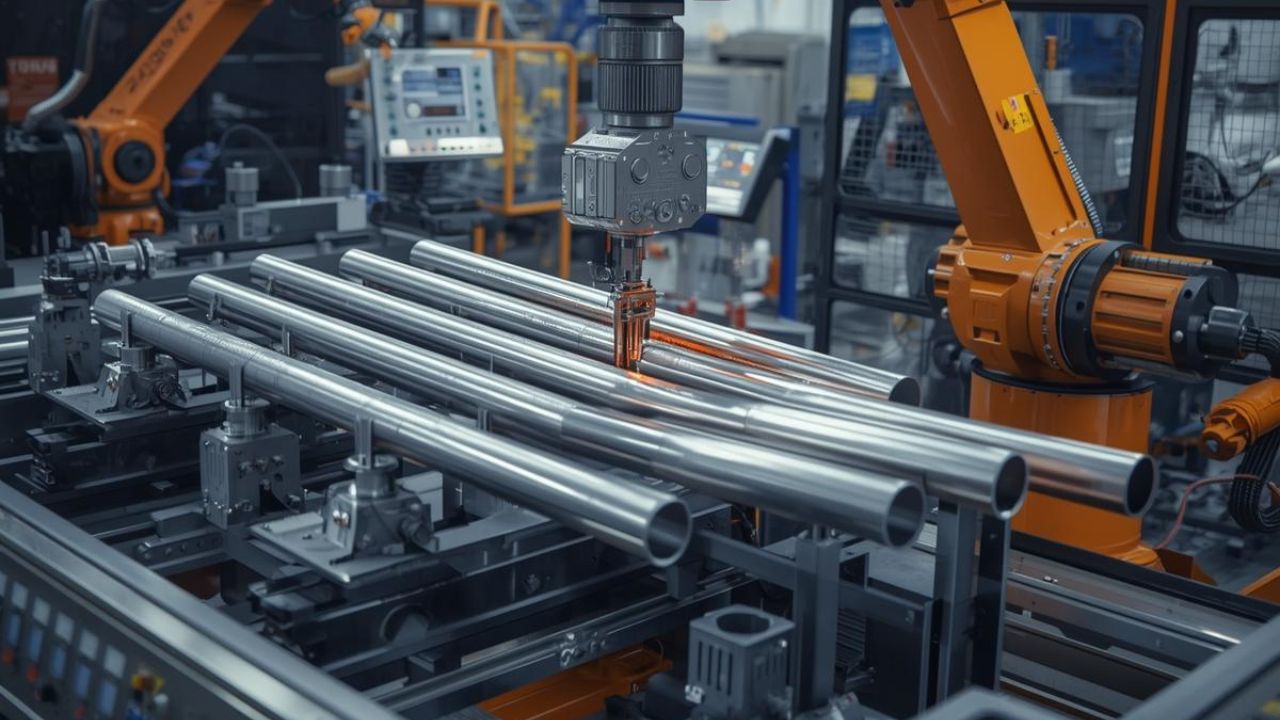
Robotic welding delivers consistent, high-quality joints in welded tube assemblies. TIG welding and Orbital Welding provide superior precision for thin-walled complex assemblies compared to faster methods like MIG welding. Laser Welding and Friction Stir Welding address dissimilar materials joining, though variations in thermal expansion, melting points, and chemical composition create challenges including cracking, porosity, and reduced joint strength.
Careful filler metal selection based on the lower-strength material mitigates these risks. The exactness of laser-cut miters and joints accelerates downstream welding by 30-50%. Critical applications require non-destructive testing (NDT) adhering to API 1104 or ASME B31.1 standards.
Step 6: Final Assembly, Inspection, and Quality Assurance
Final inspection validates dimensional accuracy and quality standards. Coordinate Measuring Machines (CMM) and Tube Vector Measurement systems verify specifications for complex tube assemblies. ISO 9001:2015 Quality Management System standards govern production processes. Control of documented information prevents errors, while identification and traceability systems tag and track raw material through all processing steps. Integrated quality checks verify dimensional tolerancing, material condition, and aesthetic requirements throughout production.
What Are the Key Challenges in Manufacturing Complex Tube Assemblies?
Manufacturing challenges in complex tube assemblies span precision requirements, material constraints, timeline variability, communication gaps, and technology limitations. Understanding these obstacles allows manufacturers and customers to implement targeted solutions that maintain quality while controlling costs and schedules.
High Precision and Tight Tolerances in Welded Tube Assemblies
Achieving extremely tight tolerances represents the most crucial aspect of complex tube assembly manufacturing. Mission-critical applications in aerospace and medical devices demand precision that exceeds standard fabrication capabilities, requiring specialized equipment and rigorous quality control throughout production.
Material Selection and Sourcing for Complex Tube Assemblies
Material choices directly impact all subsequent manufacturing steps, including CNC tube bending and robotic welding. Alloy selection—stainless steel, aluminum, or specialized alloys—must account for tensile strength, ductility, and corrosion resistance. Sensitive materials like stainless steel require special handling to prevent contamination. Specialty alloys, non-standard sizes, or high market demand can extend lead times by several weeks, making early material procurement critical.
Overcoming Production Delays and Lead Time Challenges
Lead times vary dramatically based on complexity. Simple parts require 3 business days, while complex assemblies need 10-25 days. Core fabrication typically consumes 1-2 weeks after pre-production steps complete. Suppliers show 20-40% variation in lead times due to material delays or capacity changes, making material procurement the major source of timeline variability.
Prototyping validation takes 2-10 days for comparable processes like 3D metal printing. Transitioning from validated prototype to full-scale manufacturing adds days or weeks for final tooling and design modifications, creating additional manufacturing challenges in complex tube assemblies production.
Communication and Transparency in Custom Manufacturing Projects
Clear communication prevents costly misunderstandings in tube assemblies manufacturing. Lead time definitions must specify whether timelines reflect time to ship versus time to receive. Staged timeline breakdowns for each phase—procurement, production, finishing, shipping—establish realistic expectations and enable proactive problem-solving throughout the project lifecycle.
Managing the Complexity of Advanced Technologies in Fabrication
Advanced technologies like integrated tube fabrication systems require significant initial investment, though long-term operational savings deliver faster ROI. Tube laser cutting machines represent substantial capital expenditure. Highly reflective materials including copper and brass challenge some laser systems by reflecting laser energy and reducing efficiency, requiring specialized equipment or alternative processing methods for welded tube assemblies.
How Can These Manufacturing Challenges Be Solved?
Solving manufacturing challenges requires strategic integration of advanced technologies, optimized workflows, and proactive communication. CNC tube bending, robotic welding, and integrated tube fabrication systems address precision and efficiency demands, while strategic sourcing and project management minimize delays and costs.
Leveraging Advanced CNC Tube Bending Techniques for Consistency
CNC tube bending ensures high repeatability with minimal human intervention, reducing errors through automation. Dedicated production tooling optimizes efficiency, volume, and repeatability across complex tube assemblies. Automated control systems maintain consistent bend angles and radii, eliminating the variability inherent in manual operations.
The Role of Robotic Welding in Improving Quality and Efficiency
Robotic welding reduces labor costs up to 40% for high-volume orders through “lights-out” automation. CNC machines enable batch production of welded tube assemblies with exceptional repeatability and minimal human intervention. Automated systems create high-quality, low-distortion joints that meet tight tolerance requirements, addressing critical manufacturing challenges in precision fabrication.
Streamlining Communication through Direct Project Management
Direct project management eliminates costly delays in tube assemblies manufacturing. DFM lock-in—finalizing design early—prevents redesign delays post-prototype. Turnkey solutions from a single provider for end-to-end services (fabrication, assembly, fulfillment) reduce handoffs and compress overall timelines, streamlining complex tube assemblies production.
Real-Time Monitoring and Feedback to Address Production Delays
Building flexibility buffers into project timelines accounts for the 20-40% typical variation in lead times. Real-time monitoring identifies bottlenecks early, allowing corrective action before delays cascade through production schedules. Proactive feedback loops between manufacturer and customer maintain alignment on progress and expectations.
Ensuring Material and Cost Management Through Strategic Sourcing
Strategic sourcing minimizes material procurement delays in integrated tube fabrication. Kanban or Just-In-Time (JIT) inventory strategies reduce ordering delays and carrying costs. Advanced nesting software delivers 20% material cost reduction through optimized cutting patterns and reduced waste. Combined process improvements achieve 26% overall production cost reduction, as demonstrated in documented case studies.
The Role of CNC Tube Bending and Robotic Welding in Achieving Precision in Tube Assemblies
CNC tube bending and robotic welding form the precision foundation of modern tube assemblies manufacturing. Advanced custom pipe bending services leverage these integrated technologies to eliminate common defects, ensure repeatability, and dramatically reduce production time when combined effectively in complex tube assemblies production.
How CNC Tube Bending Optimizes Tube Fabrication for Custom Designs
CNC tube bending delivers precise control that prevents defects including wrinkles and flattening during forming operations. High-quality, regularly maintained tooling ensures consistent results across production runs. Automated control systems adjust for material characteristics and spring-back, maintaining tight tolerances on custom geometries without manual intervention.
Robotic Welding: Ensuring Consistent and High-Quality Welded Tube Assemblies
Robotic welding produces consistent, high-quality joints in complex tube assemblies. Emerging techniques like Laser Welding and Friction Stir Welding enable reliable joining of dissimilar materials, addressing traditional manufacturing challenges in multi-material assemblies. Secondary operations including machining and cleaning follow welding to prepare assemblies for final use, ensuring proper fit and surface finish specifications.
Combining CNC Tube Bending and Robotic Welding for Seamless Tube Assembly Production
Integrated tube fabrication combining CNC tube bending and robotic welding delivers measurable efficiency gains. Case studies demonstrate 52% reduction in production time through process integration. Self-fixturing joints created by precision bending reduce manpower requirements by 50%, as components align naturally without complex jigs. This seamless integration eliminates traditional handoffs between operations, compressing timelines while maintaining precision in welded tube assemblies.
Why Are Integrated Tube Fabrication and Welding Techniques Crucial for Complex Tube Assemblies?
Integrated tube fabrication and welding techniques eliminate traditional manufacturing bottlenecks that slow production and increase costs. Consolidating operations into unified workflows addresses the core manufacturing challenges facing complex tube assemblies production, delivering speed, precision, and design flexibility.
Benefits of Integrated Tube Fabrication for Streamlined Production
Integrated tube fabrication eliminates multiple machining operations, reducing production costs through process consolidation. High-speed production efficiency combines automation capabilities with high-powered lasers for faster throughput. Single-setup operations that once required separate sawing, drilling, punching, and milling now complete on one machine, compressing timelines while maintaining precision in tube assemblies manufacturing.
Enhanced Design Flexibility and Precision with Integrated Welding
Integrated welding enables complex connections, slots, and teeth that simplify assembly and improve structural integrity in welded tube assemblies. Self-fixturing components significantly reduce the need for complex welding jigs and manual alignment during assembly, accelerating production while maintaining accuracy.
Design freedom extends to innovative product configurations impossible with traditional methods. Systems process various tube shapes—round, square, rectangular, oval—and custom profiles, accommodating diverse engineering requirements in complex tube assemblies without workflow disruptions.
How Integrated Techniques Address Manufacturing Bottlenecks
Integrated techniques reduce production steps and compress lead times by consolidating operations. Technology proves effective across a wide range of materials including steel, aluminum, and various alloys, eliminating material-specific equipment changes. CNC tube bending and robotic welding within unified systems address traditional manufacturing challenges by removing handoffs, reducing setup time, and maintaining consistent quality throughout tube assemblies manufacturing processes.
What Are the Best Practices for Selecting a Manufacturing Partner for Complex Tube Assemblies?
Selecting the right manufacturing partner determines project success in complex tube assemblies production. Evaluate expertise, technology capabilities, certifications, and communication practices to ensure your partner can deliver precision, quality, and reliability throughout the manufacturing process.
The Importance of Expertise and Innovation in Tube Assemblies Manufacturing
Manufacturing expertise directly impacts quality in CNC tube bending and robotic welding operations. Experience with material properties proves crucial for spring-back compensation through “overbending” techniques that maintain dimensional accuracy. Thorough evaluation of material properties enables successful dissimilar metals joining in welded tube assemblies, preventing defects from thermal expansion mismatches and composition incompatibilities.
Evaluating Technology and Equipment for Precision Fabrication
Advanced equipment capabilities separate capable partners from limited fabricators. Integrated tube fabrication systems must handle various tube shapes and profiles—round, square, rectangular, oval—without workflow disruptions. Partners serving high-reliability industries including aerospace, medical device production, and jewelry design demonstrate proven precision capabilities. Modern equipment operates more energy-efficiently than traditional cutting equipment while generating less material waste, delivering cost and environmental benefits in tube assemblies manufacturing.
The Value of Industry Certifications and Quality Control Standards
Industry certifications verify a partner’s commitment to quality in complex tube assemblies production. AS 9100D (Aerospace Quality Management System) certification demonstrates aerospace-grade process control. NADCAP (National Aerospace and Defense Contractors Accreditation Program) accreditation for welding and non-destructive testing confirms advanced capabilities in welded tube assemblies. These certifications enforce meticulous process control and documentation standards that contribute to efficiency and error reduction, addressing core manufacturing challenges through systematic quality management.
Long-Term Partnership and Transparency in the Manufacturing Process
Partnership quality indicators emerge early in engagement. Responsive quote turnaround—ideally 24-48 hours—demonstrates supplier reliability and capacity. Clear communication on all production phases (procurement, production, finishing, shipping) establishes realistic expectations and enables proactive problem-solving. Transparency in integrated tube fabrication processes builds trust and facilitates continuous improvement across complex tube assemblies projects.
Advancing Manufacturing Solutions for Complex Tube Assemblies
The future of tube assemblies manufacturing lies in continuous technology advancement and intelligent automation. As CNC tube bending, robotic welding, and integrated tube fabrication systems evolve, manufacturers gain greater capability to address manufacturing challenges while reducing costs and timelines in complex tube assemblies production.
Future Trends in Complex Tube Assembly Manufacturing
Industry evolution focuses on three key areas: continuous adoption of CNC-driven processes, advanced welding techniques development, and sophisticated metrology systems evolution. These trends converge to enhance precision in welded tube assemblies while expanding design possibilities. Emerging technologies address traditional manufacturing challenges through process integration, enabling manufacturers to tackle increasingly complex geometries and tighter tolerances in tube assemblies manufacturing.
The Role of Automation and AI in Enhancing Manufacturing Efficiency
“Lights-out” production capabilities reduce labor requirements while maintaining precision in complex tube assemblies. Real-world applications demonstrate these advances—the Zumwalt Destroyer Missile Tube requires machining to extremely tight tolerances on large-scale machinery, showcasing integrated tube fabrication at the highest difficulty level.
The industry’s solution to overcoming inherent manufacturing challenges relies on technology integration across CNC tube bending, robotic welding, and quality control systems. Automation and AI drive continuous improvement in efficiency, quality, and capability, positioning advanced manufacturers to meet evolving demands in aerospace, medical, and other high-reliability sectors requiring precision welded tube assemblies.
Partner with CRD MFG, Inc. for Precision Complex Tube Assemblies
CRD MFG, Inc. delivers precision-engineered complex tube assemblies through advanced CNC tube bending, robotic welding, and integrated tube fabrication capabilities. Our experienced team manages every phase—from initial design and material procurement through final quality assurance—ensuring tight tolerances and on-time delivery for aerospace, medical, and industrial applications. With industry certifications including AS 9100D and state-of-the-art equipment, we solve manufacturing challenges that others can’t handle—from precision aerospace tube fabrication services to complex industrial assemblies. Our turnkey approach reduces production time, minimizes costs, and eliminates the complexity of managing multiple vendors. Contact CRD MFG, Inc. today to discuss your welded tube assemblies project and discover how our expertise transforms challenging specifications into reliable, high-quality components.
