
Key Takeaways
- Tolerance drives technology selection: Laser delivers ±0.1-0.25 mm for precision applications; plasma ±0.4-1.0 mm (HD: ±0.25-0.51 mm) suits structural work where fit-up flexibility exists.
- Thickness determines economic crossover: Laser excels up to 20 mm; plasma dominates 30-80 mm+ where high-power arc cuts 2-3x faster than laser.
- Feature complexity separates capabilities: Laser cuts holes down to 0.5 diameter-to-thickness ratio and produces threading holes; plasma’s wide kerf prevents small features and precision slots.
- Secondary operations compound savings: Laser’s 80%+ reduction in deburring/grinding time often outweighs the higher capital cost in total processing time across welding, assembly, and inspection.
- Total Cost of Ownership extends beyond capital: Model cost per part including consumables (laser low, plasma high), labor (laser skilled programming vs. plasma 5-20 min/part cleanup), and scrap/rework rates across production volumes.
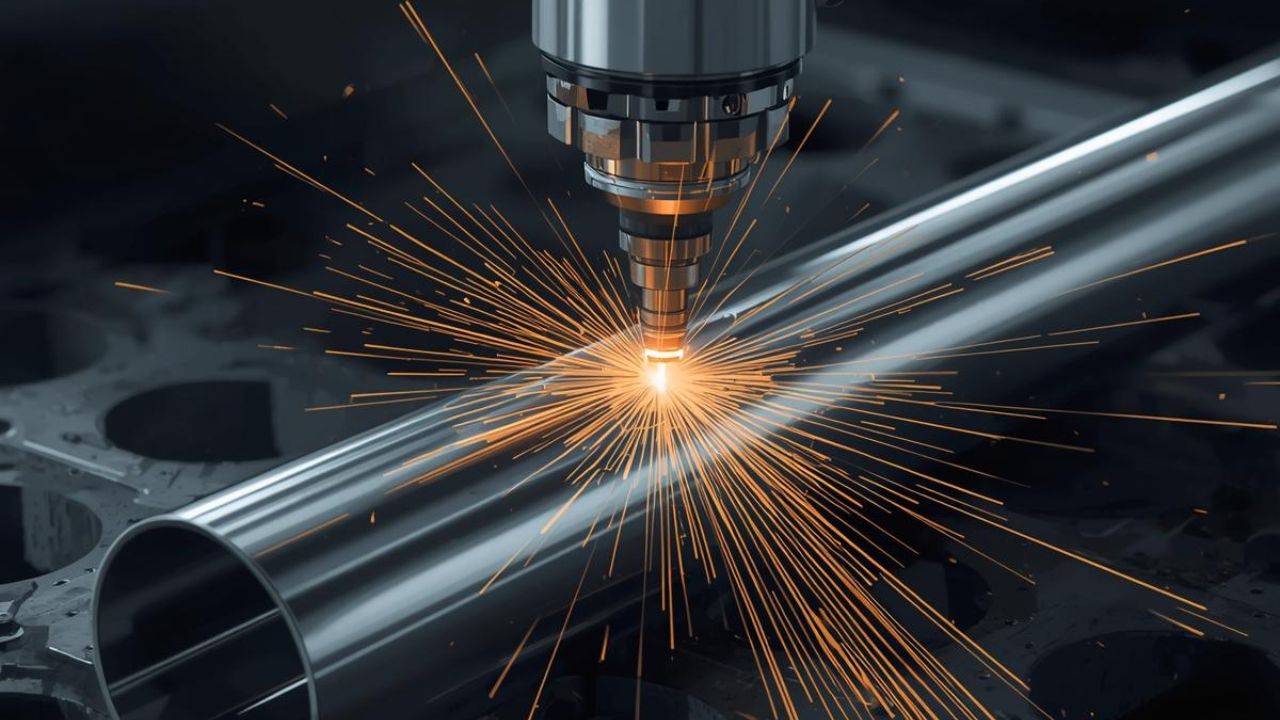
Choosing between tube laser cutting and plasma cutting represents a critical capital investment that shapes production efficiency, part quality, and profitability for years. While both manufacturing cutting methods cut tubular profiles, they operate on fundamentally different principles and excel in distinct applications. Laser tube cutting delivers precision and automation for complex, thin-to-medium wall components. Plasma cutting dominates thick material fabrication, where speed and lower capital costs matter more than tight tolerances.
This laser cutting comparison provides manufacturing engineers, operations managers, and sourcing professionals with a practical decision framework based on thickness ranges, tolerance requirements, feature complexity, and Total Cost of Ownership across the complete production workflow.
Learn when each technology delivers optimal ROI based on thickness distribution, feature requirements, and total processing time across cutting, cleanup, welding, and assembly.
What Decision Are Manufacturers Really Making?
Selecting between tube laser cutting vs plasma optimizes six critical trade-offs: tolerance requirements (±0.1-0.25 mm laser vs. ±0.4-1.0 mm plasma), thickness range (laser optimal up to 20 mm; plasma excels 30-80 mm), feature complexity (laser cuts holes with diameter-to-thickness ratio down to 0.5; plasma cannot), secondary operations (laser 80%+ reduction in cleanup vs. plasma 5-20 min/part deburring), capital investment (laser higher upfront; plasma lower), and consumable costs (laser minimal; plasma high electrode/nozzle replacement).
The right choice depends on material thickness, production volume, and tolerance demands.
What Is Tube Laser Cutting?
Tube laser cutting uses focused fiber laser beams to cut round, square, rectangular, and open section profiles from 12 mm to 610 mm in diameter. Modern systems produce weld-ready components with holes, slots, notches, miters, and threading holes in a single operation, eliminating drilling and grinding steps. The technology delivers complex geometries with minimal heat-affected zones and clean, oxide-free edges suitable for immediate welding or bending.
| Material | Thickness Range | Tolerance | Edge Quality | Key Constraints |
| Carbon Steel | Up to 40 mm | ±0.1-0.25 mm | Excellent (N₂ oxide-free; O₂ faster but oxidized) | HAZ 0.2-0.4 mm; weld seam detection required |
| Stainless Steel | 10-20 mm | ±0.1-0.2 mm | Excellent (N₂ bright finish) | Requires fiber laser; 304L/316L for welding |
| Aluminum | ~20 mm | ±0.1-0.3 mm | Good (N₂ required) | Very high reflectivity needs 6 kW+ with back-reflection protection |
What Is Plasma Cutting?
Plasma cutting excels at thick conductive metals (30-80 mm) in robust fabrication environments. Heavy industrial HD systems achieve ±0.25-0.51 mm tolerance on steel gauge to 50 mm thick with near-square edges and bolt-ready holes. Standard systems range ±0.4-1.0 mm. Not suitable for tubes <25 mm diameter (scrap collects on inner wall) or small features (wide kerf prevents precision holes/slots). The technology produces larger heat-affected zones and typically requires secondary deburring and grinding before welding.
| System Type | Tolerance | Thickness Band | Edge Quality | Typical Use |
| Entry-Level CNC | ±0.77 mm | Thin-moderate | Slight variations normal | Low-volume, hobbyists |
| Light Industrial | ±0.38-0.64 mm | Moderate | Relatively square, good holes | General fabrication |
| HD Plasma | ±0.25-0.51 mm | Gauge to 50 mm | Near-square, bolt-ready holes | Multiple-shift thick material |
Head-To-Head Technology Comparison
The following table consolidates performance metrics across precision, throughput, cost, and manufacturability. Use thickness distribution, tolerance requirements, and total processing time (cut + cleanup + weld prep) to determine the optimal technology for your production mix.
| Factor | Tube Laser | Plasma | What Matters for Decision |
| Precision | ±0.1-0.25 mm | ±0.4-1.0 mm (HD: ±0.25-0.51 mm) | Fit-up requirements per ISO 9013:2017 |
| Thickness Sweet Spot | Up to 20 mm optimal | 30-80 mm+ | Your typical wall thickness distribution |
| Feature Capability | Holes diameter-to-thickness 0.5; complex joints | Cannot cut small holes/slots | Smallest features in your parts |
| Edge Quality | Weld-ready, minimal dross | Requires 5-20 min/part deburring | Track cleanup labor hours |
| HAZ | 0.2-0.4 mm carbon steel | Larger due to high heat | Distortion risk on thin walls |
| Speed | Faster on thin (<6-8 mm); 500 in/min theoretical | Faster on thick (>6-8 mm) | Total processing time including handling |
| Capital Cost | Higher | Lower | ROI depends on volume and secondary ops savings |
| Operating Cost | Lower consumables (long nozzle/lens life) | Higher consumables (frequent electrode/nozzle replacement) | Calculate cost per operating hour |
| Secondary Ops | 80%+ reduction in post-processing | Significant grinding/deburring typically required | Minutes per part across deburr, weld prep, fit-up |
When To Choose Laser vs. Plasma
Technology selection among tube cutting technologies hinges on thickness range, tolerance requirements, and whether eliminating secondary operations justifies higher capital investment. The decision framework below identifies clear selection criteria based on production realities.
Laser Is The Right Choice If:
- Wall thickness primarily <20 mm and you need ±0.1-0.25 mm tolerance
- High feature density: holes down to 0.5 diameter-to-thickness ratio, threading holes, complex interlocking joints
- Weld-ready edges critical (N₂ assist gas produces oxide-free edges; robotic welding requires consistency)
- Eliminating secondary operations justifies higher capital (80%+ cleanup reduction compounds across welding/assembly/inspection)
- High-volume production where automation and repeatability maximize throughput (camera-based quality checking ~0.5 sec vs. touch sensing 5-7 sec)
Plasma Is The Right Choice If:
- Primary thickness range 30-80 mm where plasma’s high-power arc outperforms laser 2-3x on cutting speed
- Simple profiles without small features (plasma kerf prevents precision holes/slots)
- “Good enough” tolerance acceptable (±0.4-1.0 mm standard; HD ±0.25-0.51 mm approaches laser but depends on machine class, consumables, operator practice)
- Secondary operations already established (dedicated deburring stations, automated grinding)
- Lower capital investment critical and post-processing 5-20 min/part is baked into cost model
Hybrid Strategy For Mixed Needs
In-house laser for thin-to-medium high-feature work + outsource thick simple profiles to plasma job shop, OR in-house plasma for heavy fabrication + outsource precision thin-wall to laser cutting services. Justify with cost-per-part math across total processing time (load, cut, deburr, weld prep), not just cut speed.
How To Build A Decision Model
Total Cost of Ownership extends beyond capital investment to consumables, labor, scrap, and throughput. Model cost per part across the complete tube fabrication processing chain to identify the true economic crossover point between technologies.
ROI Inputs Checklist:
- Capital + facility upgrades (electrical, gas infrastructure, ventilation, floor space for 24-foot tube handling)
- Consumables: Laser nozzles/lenses long life + N₂/O₂ gas vs. Plasma frequent electrode/nozzle replacement
- Maintenance: Laser minimal (clean chiller, air filters) vs. Plasma more intensive
- Labor: Laser requires skilled programmers; Plasma 80%+ more cleanup time (5-20 min/part deburring)
- Scrap/rework: Higher for plasma due to tolerance variations and edge quality issues
- Utilization: Bundle loading efficiency, weld seam detection methods, handling 2″-15′ parts consecutively
Process Time Comparison (Minutes per Part)
Track across cut time + load/unload + deburr/cleanup + weld prep/fit-up + inspection/rework. Laser’s total processing time advantage comes from eliminating secondary operations, not just raw cutting speed.
Sensitivity Checks:
- Volume swings (laser better at high volume; plasma lower capital for prototypes)
- Thickness creep (if specs trend >20 mm, plasma advantage grows)
- Tighter tolerance requests (automotive/aerospace moving toward ±0.1-0.25 mm bands)
- Labor cost changes (80%+ secondary ops reduction multiplies value as labor becomes expensive)
Vendor Trial Validation Plan
Demonstrations should validate claims with your actual parts, materials from your suppliers, and measurable acceptance criteria. Define pass/fail metrics before the demo to avoid post-hoc rationalization of results.
Sample Parts To Test:
- High-feature-density tube (holes, slots, threading holes where laser diameter-to-thickness 0.5 vs. plasma cannot execute)
- Thin-wall prone to distortion (compare HAZ: laser 0.2-0.4 mm vs. plasma larger with high heat input)
- Near-upper-thickness (laser at 20-40 mm limits vs. plasma 30-80 mm sweet spot)
- Production batch with tubes from different mills (natural bows, weld seam variations, dimensional inconsistencies)
Acceptance Criteria To Define Before Demo:
- Tolerance per ISO 9013:2017 (not just “good enough”)
- Edge quality in cleanup minutes per part (deburr + grind time)
- Hole quality: cylindricity for threading, bolt-ready capability
- Repeatability across runs with modern controls (auto-adjust at weld seam vs. manual parameter tuning)
Get in Writing vs. Best-Case Claims:
- In writing: Uptime/service commitments, consumable life data, warranty, training, software capabilities (weld seam detection, CAD/CAM integration)
- Treat as claims: Speed numbers (500 in/min theoretical ≠ real total processing time), maximum thickness marketing, ideal-condition tolerances
Common Decision Mistakes To Avoid
Most capital equipment failures stem from optimization for the wrong metric. These four errors create costly mismatches between equipment capabilities and actual production requirements.
Focusing On Cut Speed Alone
500 inches/minute theoretical ignores total part-processing time (load, index, pierce, cut, unload) and secondary operations. Time saved eliminating 5-20 min/part cleanup often outweighs the raw cutting speed advantage.
Ignoring Fit-Up And Rework Compounding
Laser ±0.1-0.25 mm vs. plasma ±0.4-1.0 mm seems small until multiplied across welding (fit-up gaps from taper), assembly (parts don’t mate), and inspection (rework loops). One bad cut becomes 10 min deburring + 15 min re-fitting + 5 min re-inspection, especially when integrating with CNC machining for final component assembly.
Not Defining Specs Early
Comparing “tolerance” without ISO 9013:2017 classifications or edge quality per AWS D1.6/D1.6M means the vendor demonstrates best-case on perfect material, then production reality hits with tube bows and weld seam variations.
The Decision Framework
Choosing between a tube laser and a plasma ultimately comes down to your thickness distribution, tolerance requirements, and whether the benefit of eliminating secondary operations is worth the higher upfront capital investment. In practical terms, tube laser is the better fit when you need tight tolerances (about ±0.1–0.25 mm), complex features, and want to remove as many downstream steps as possible, while plasma is typically the right choice for thicker material (roughly 30–80 mm), simpler profiles, and more flexible tolerances (around ±0.4–1.0 mm). If your work spans both ends of the spectrum, a hybrid approach often makes the most sense: keep the primary technology in-house and outsource the edge cases, validating the decision with cost-per-part calculations based on total processing time and a 3–5 year sensitivity analysis covering volume, thickness, and tolerance.
To make the choice with confidence, run trials using your actual tubes—not “perfect” vendor demo samples—set clear acceptance criteria aligned with industry standards, and track minutes per part across the full workflow from raw tube to welded assembly. If you’d like to talk through your tube cutting requirements, contact CRD Manufacturing to review your specifications and identify the optimal cutting technology for your production mix.
Ready to discuss your tube cutting requirements? Contact CRD Manufacturing to review your specifications and identify the optimal cutting technology for your production mix.
