
Key Takeaways
- Integrated manufacturing reduces risk. Single-source tube assembly fabrication eliminates handoffs between vendors, compresses timelines to 3–5 weeks, and maintains tighter process control from design through final inspection.
- Design decisions lock in downstream costs. Center Line Radius, material grade, and tolerance specifications established during product development determine tooling requirements, machining rates, and quality control complexity for the entire production run.
- Process selection must match application requirements. Mandrel bending prevents thin-wall defects, robotic welding delivers under 2% defect rates, and cold working maintains dimensional precision—each method serves specific performance demands.
Quality control runs parallel to production. In-process inspection using CMMs and NDT methods catches deviations early, preventing compounded rework costs and rejected assemblies at final verification. - Documentation enables compliance and traceability. Cradle-to-grave records linking finished assemblies to raw material melts, welding logs, and inspection results are mandatory for aerospace, pressure vessel, and other regulated applications.
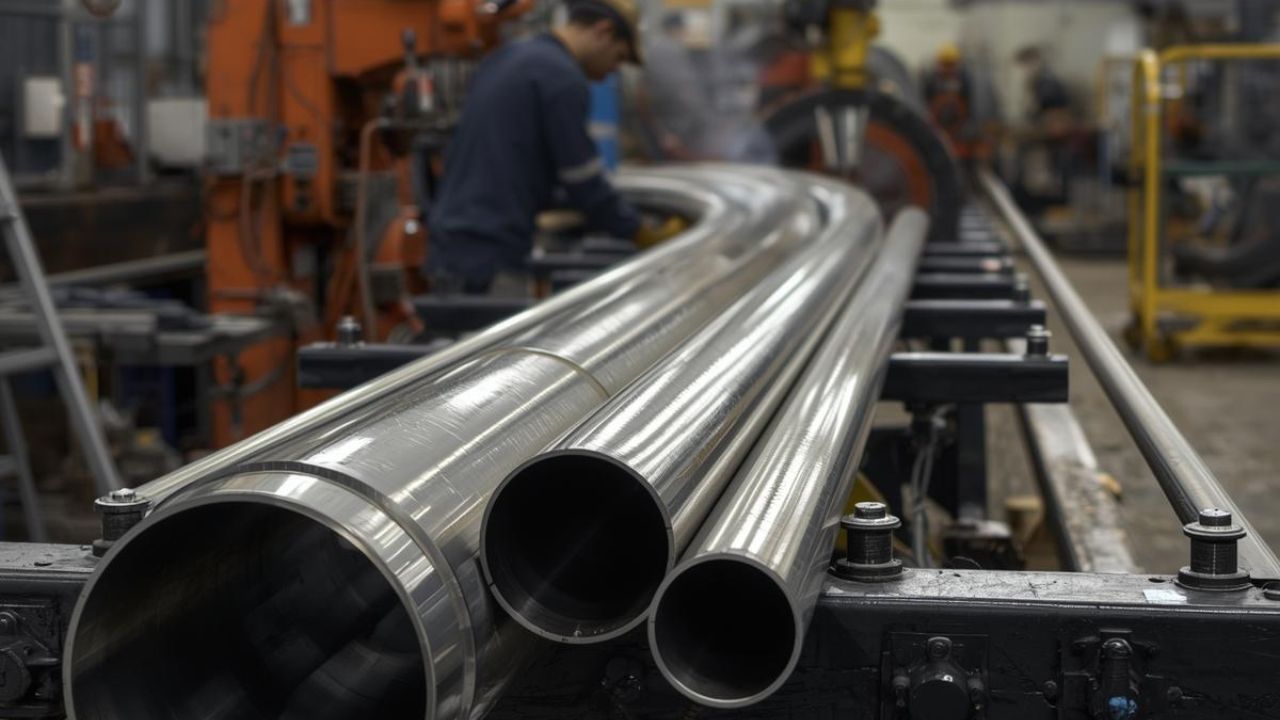
Tube assembly fabrication transforms raw tubing into precision components through a controlled sequence of cutting, forming, welding, and inspection operations. The design-to-inspection workflow determines quality outcomes—decisions made during product development lock in material costs, tooling requirements, and quality control parameters that carry through production.
Integrated tube manufacturing consolidates these operations under single-source accountability. This approach reduces handoffs, shortens timelines, and tightens process control compared to multi-vendor supply chains. From CNC machining and robotic welding to final dimensional verification, each stage builds toward assemblies that meet specifications.
This guide covers the complete process: design translation, component preparation, assembly methods, quality control, and final inspection criteria.
What Is Tube Assembly Fabrication and How Does Integrated Tube Manufacturing Work?
Tube assembly fabrication combines cutting, forming, welding, and inspection into a controlled design-to-inspection workflow. Integrated tube manufacturing consolidates these steps under one roof, reducing variables and streamlining delivery.
What Does Tube Assembly Fabrication Mean in an Integrated Manufacturing Environment?
Tube assembly fabrication is a multi-stage, precision-intensive process that transforms raw tubing into finished components for automotive, aerospace, HVAC, and industrial applications. An integrated approach keeps every operation—cutting, bending, welding, machining, and quality control—within a single facility. This consolidation eliminates supplier coordination gaps and maintains tighter process control from start to finish.
Cost structures reflect this complexity. Material costs typically account for 45–55% of a project budget, with labor adding another 20–40%. Aerospace assemblies run 5:1 to 10:1 higher than commercial equivalents due to specialized alloys, rigorous inspection protocols, and extensive documentation requirements.
How Does Integrated Tube Manufacturing Reduce Handoffs and Process Risk?
Single-source manufacturing shortens timelines and limits quality exposure. Typical fabrication cycles run 3–5 weeks when all operations stay in-house. Each handoff between vendors introduces variability; fewer handoffs mean fewer opportunities for error.
Automated processes drive consistency gains. Robotic welding and orbital welding systems achieve defect rates under 2%—critical for pressure-rated assemblies. The equipment investment is substantial (orbital systems start around $190,000), but the payoff is repeatable weld quality that manual methods cannot match at volume.
Why Do Engineering and Procurement Teams Prefer End-to-End Assembly Services?
End-to-end assembly services simplify sourcing and accountability. Engineers specify requirements once; a single supplier manages material selection, fabrication sequencing, CNC machining, and final inspection. Procurement benefits from consolidated purchasing, fewer POs, and single-point project ownership.
Material decisions drive downstream performance. Seamless tubing delivers superior pressure integrity for critical systems. Welded tubing offers cost efficiency where pressure ratings allow. Common selections include ASTM A269 Grade 316L stainless for corrosion resistance and 6061-T6 aluminum for weight-sensitive structural applications. Matching material to application demands—pressure, temperature, mechanical properties—prevents costly rework during product development.
How Does Product Development Shape the Design-to-Inspection Workflow for Tube Assemblies?
Product development decisions set the trajectory for every downstream operation. Choices made during design lock in tooling requirements, material costs, and quality control parameters that carry through the entire design-to-inspection workflow.
How Are Functional Requirements Translated Into Manufacturable Tube Assembly Designs?
Design engineers convert performance specifications into fabrication-ready geometry. Every curve requires a defined Center Line Radius (CLR) and Degree of Bend (DOB). These parameters determine tooling selection, machine setup, and cycle time. Get them wrong, and production stalls for retooling.
The Bill of Materials (BOM) and fabrication drawings become the master reference for the entire production run. Material grade and temper must balance two demands: sufficient ductility to survive bending without cracking or excessive thinning, and mechanical properties that meet end-use performance requirements. This balance is non-negotiable—compromise either side, and assemblies fail in production or in service.
How Do CAD Models and Engineering Reviews Support Early Product Development Decisions?
Specialized CAD platforms drive modern tube assembly fabrication. Software like Bend-Tech PRO and TubeWorks (integrated with SOLIDWORKS) generates 3D models, defines bend radii, and outputs cutting lists and bending instructions directly to CNC machining centers. This digital thread eliminates manual translation errors between engineering and the shop floor.
Model complexity directly influences cost and timeline. Simple geometries move quickly from design to production. Complex multi-bend assemblies require advanced simulation to predict material behavior, identify potential defects, and validate manufacturability before cutting metal.
Why Does Early Design Alignment Prevent Downstream Assembly and Quality Issues?
Design parameters that ignore manufacturing limits create expensive problems. The CLR-to-OD ratio governs what’s feasible: 3D bends (CLR equals 3x tube OD) are standard. Tighter 2.5D bends demand specialized equipment and are constrained by wall thickness and material ductility. Specify beyond capability, and you force costly tooling changes or supplier requalification.
Material behavior adds another variable. Springback—the tube’s tendency to partially return to its original shape—must be compensated in bend programming. Stainless steel springs back more than carbon steel; ignoring this produces out-of-spec parts. High-purity applications add surface finish requirements (Ra ≤ 0.8 μm) that influence process selection. Aligning these details early prevents rework, quality control rejections, and schedule delays during assembly.
How Are Tubes Fabricated and Prepared Before Assembly Begins?
Component preparation determines assembly quality. Cutting, forming, and CNC machining transform raw tubing into precision parts ready for joining. Each operation builds toward the final assembly.
How Do Cutting, Forming, and CNC Machining Prepare Components for Assembly?
Precision cutting establishes dimensional accuracy from the start. High-speed saws handle standard cuts. Laser and plasma cutters deliver tighter tolerances and cleaner edges for critical applications. Every tube must hit exact length specifications before downstream operations begin.
End preparation follows cutting. Deburring removes sharp edges and burrs that would compromise weld quality or contaminate fluid systems. Flaring and threading create connection interfaces. For high-integrity welds, facing or beveling tube ends establishes correct joint geometry for full penetration. Skip these steps, and quality control catches the defects later—or worse, the field does.
How Does CNC Machining Support Precision Interfaces and Assembly Features?
CNC machining adds features that tubes cannot achieve through forming alone. Drilling, milling, and slotting create mounting points, flow passages, and interface geometries. Threading operations cut NPT, BSP, and other standard connections directly into tube ends or fittings.
Machining rates reflect capability requirements. Three-axis work runs $60–120/hour. Multi-axis operations for complex geometries cost $120–200+/hour. Aerospace tube assembly fabrication demands the tightest tolerances—±0.005 inch on bend angles, plane of bend, and end-to-end length. These specifications require advanced equipment and skilled operators, driving costs accordingly.
When Are Secondary Operations Completed Prior to Tube Assembly Fabrication?
Surface treatments and finishing operations occur after machining but before final assembly. Timing matters—some processes must happen pre-weld, others post-weld.
Passivation treats stainless steel with nitric or citric acid to dissolve ferrous contaminants and strengthen the chromium oxide layer. This step is essential for corrosion resistance in service. Other protective treatments include electroplating (zinc, nickel), powder coating, and anodizing for aluminum components. Material selection also factors in: Grade 321 stainless steel resists weld decay through titanium stabilization, preventing chromium carbide precipitation at elevated temperatures. This makes it the preferred choice for high-temperature exhaust manifolds and similar applications.
What Does the End-to-End Process Look Like for Building and Inspecting Tube Assemblies?
Assembly services transform prepared components into finished tube assemblies through sequenced forming, joining, and verification operations. Process selection at each stage balances speed, precision, and cost against application requirements.
How Are Tube Components Sequenced and Fixtured During Assembly Services?
Bending method selection depends on geometry requirements. Rotary Draw Bending (RDB) handles tight radii from 1.5x to 3x tube OD. It runs faster with lower tooling costs for thick-walled tubes and larger bend radii. Mandrel bending becomes essential when thin walls meet tight radii (less than 2x diameter)—the internal mandrel prevents collapse, wrinkling, and ovalization that would otherwise scrap the part.
Tube rolling serves a different purpose. Large-radius bends (10x OD and up), gentle sweeps, arcs, and coils require rolling rather than draw bending. Tooling costs run significantly lower than RDB, making it economical for architectural and heat exchanger applications where geometry permits.
How Do Robotic Welding and Mechanical Joining Methods Affect Assembly Consistency?
Joining method determines weld quality, throughput, and cost. TIG (GTAW) welding delivers precision for exotic alloys, thin materials, and applications demanding low defect rates. Deposition runs slower at 0.15–0.5 kg/h, but quality justifies the time. MIG welding trades some precision for speed and cost efficiency on general fabrication and thicker materials.
Robotic welding and orbital systems push consistency further. Orbital welding—automated TIG—produces highly repeatable, high-integrity welds for aerospace and semiconductor applications where manual variation is unacceptable. Material-specific parameters matter: 4130 Chromoly with thick walls requires 400°F preheat and 600°F post-weld stress relief to maintain mechanical properties and prevent cracking.
How Is Dimensional Control Maintained Across Multi-Stage Assembly Operations?
Bending operations stress material in predictable ways. Industry limits hold ovality to 10% of tube diameter and wall thinning to 15% of nominal thickness. Exceeding either compromises structural integrity and fails quality control inspection.
Process selection manages these deformation modes. Rotary draw bending concentrates stress at the bend, causing wall thinning at the extrados (outer radius) and ovality at the bend zone. Mandrel and wiper dies control these effects but add tooling complexity. Roll bending distributes deformation gradually across longer sections, reducing localized thinning and ovality. Cold working maintains tighter dimensional control and better surface quality than hot forming, making it the default for precision tube assembly fabrication.
How Is Quality Control Applied Throughout Tube Assembly Fabrication?
Quality control runs parallel to production, not after it. Integrated tube manufacturing embeds inspection points at each stage, catching deviations before they compound into rejected assemblies or field failures.
What In-Process Quality Control Checks Occur During Fabrication and Assembly?
In-process inspections verify conformance at every fabrication stage. Waiting until final assembly to check dimensions wastes material and machine time when earlier operations drift out of spec.
Dimensional verification uses Coordinate Measuring Machines (CMMs), laser scanners, and specialized tube inspection arms. These systems confirm length, wall thickness, diameter, and spatial coordinates of tube ends against engineering specifications. Catching a deviation at bending costs minutes to correct. Finding it at final inspection scraps the entire assembly.
How Are Weld Integrity, Alignment, and Tolerances Verified in Real Time?
Non-Destructive Testing (NDT) validates weld quality without destroying the part. Radiographic Testing (RT) reveals internal weld defects. Ultrasonic Testing (UT) detects material flaws and wall thickness variations. Dye Penetrant Testing (PT) identifies surface-breaking cracks and porosity. Method selection depends on defect types most likely for the material and process.
NDT programs require rigor. Acceptance criteria demand 95% statistical confidence to ensure inspection reliability. Personnel certifications follow SNT-TC-1A guidelines with recertification every 3 years. Welding codes dictate qualification requirements: AWS D1.1 covers steel structures, D1.2 governs aluminum, and D1.6 applies to stainless steel. These aren’t optional—they’re prerequisites for qualified assembly services.
Why Is Process Documentation Critical for Traceability and Compliance?
Documentation links every finished assembly back to its origins. Material traceability requires cradle-to-grave records connecting the final part to the original melt, plus all intermediate processing: heat treatment cycles, welding parameters, inspection results. Without this chain, parts cannot ship to regulated industries.
Code compliance adds documentation layers. ASME Boiler and Pressure Vessel Code Section IX governs welding qualification for pressure systems. AWS D1.1 covers fabrication, erection, inspection, and qualification for structural applications. Aerospace work demands AS9100 Rev D certification—a 3–6 month implementation process costing $10,000 to $100,000+ depending on organization size. A 100-person company typically invests around $20,000. The investment validates that quality control systems meet industry-mandated standards throughout the design-to-inspection workflow.
What Happens During Final Inspection Before Tube Assemblies Are Approved for Use?
Final inspection is the last gate before tube assemblies ship. This stage verifies that every specification—dimensional, structural, and cleanliness—meets acceptance criteria established during product development.
What Inspection Criteria Determine Acceptance or Rework of Tube Assemblies?
Pressure testing proves structural integrity under load. Hydrostatic testing subjects assemblies to 1.5x design pressure, confirming they handle worst-case operating conditions with margin. Pneumatic testing applies to gas systems where liquid contamination is unacceptable. Aerospace hydraulic assemblies face demanding validation—these systems operate at 3,000–5,000 psi with temperature ranges spanning -65°F to +275°F for titanium and corrosion-resistant steel tubing.
Cleanliness standards apply where contamination causes system failure. KSC-C-123J defines precision cleaning levels for critical fluid systems. Final acceptance requires no visible contamination or fluorescence under UV inspection. Quantitative assessment follows ISO 14644-1 particle count classifications, measuring contamination at particle sizes >4μm, >6μm, and >14μm. Assemblies failing these criteria return for recleaning before release.
How Are Non-Conformances Identified, Documented, and Corrected?
Non-conformances are inevitable; response systems determine whether they become recurring problems. Quality control programs track every deviation, categorize severity, and drive corrective action.
Industry data reveals the scope: AS9100 audits reported 17,184 total non-conformances in 2019. Of these, 1,886 were major non-conformances requiring immediate action. The remaining 15,298 minor non-conformances required documented corrective action plans. Stage 2 audit findings allow 6 months for correction. Organizations that treat non-conformances as improvement opportunities strengthen their design-to-inspection workflow. Those that simply fix symptoms repeat the same failures.
When Is a Tube Assembly Cleared for Delivery, Integration, or Production Release?
Release authorization requires verified conformance to all engineering requirements. First Article Inspection (FAI), documented via the AS9102 form, provides formal verification that the first production part meets every specification. This baseline confirms that tube assembly fabrication processes produce conforming parts before volume production proceeds.
Application-specific testing adds final validation. Roll cages and chassis undergo static load tests or FEA-based dynamic impact simulations to confirm the structure withstands crash and rollover forces without failure or excessive deformation. Final inspection procedures verify compliance with drawing specifications across all dimensions and features. Only after passing these gates does an assembly clear for delivery, system integration, or production release.
Partner with CRD MFG, Inc. for Your Next Tube Assembly Project
CRD MFG, Inc. delivers integrated tube manufacturing from design through final inspection. Our assembly services combine precision CNC machining, robotic welding, and rigorous quality control under one roof—eliminating handoffs and compressing timelines.
Whether your application demands aerospace-grade tolerances or high-volume production efficiency, our team translates your functional requirements into manufacturable designs that perform. We maintain full material traceability, certified welding programs, and in-process inspection protocols that catch deviations before they become costly problems.
Ready to streamline your tube assembly fabrication—from industrial applications to reliable aerospace component fabrication services? Contact CRD MFG, Inc. today to discuss your project requirements and request a quote.
