
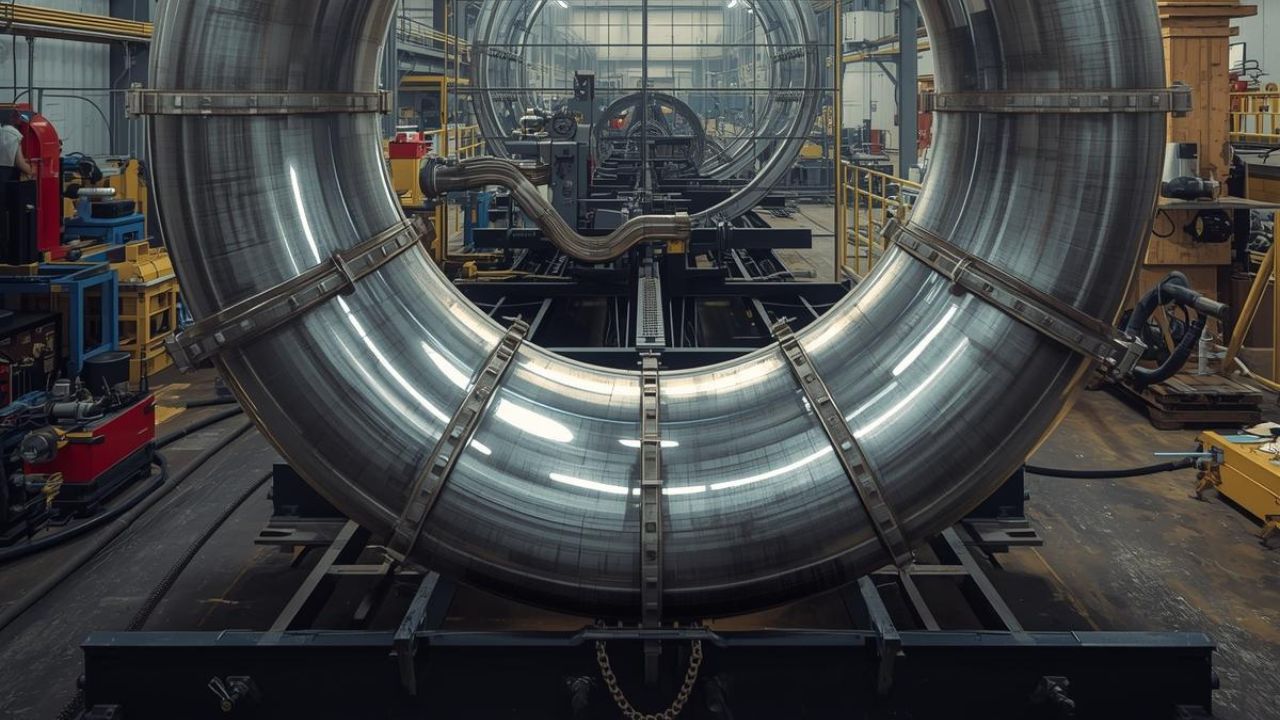
Multi‑axis CNC bending enables manufacturers to produce complex tube shapes that standard bending equipment cannot handle in a single setup. By coordinating multiple linear and rotational axes simultaneously, these systems deliver tighter tolerances, lower scrap rates, and faster cycle times across aerospace, automotive, and industrial applications. This guide covers how advanced bending technology works, what advantages it offers over conventional methods, how it integrates with CNC machining and laser processing, and what design considerations engineers should evaluate before production begins.
Key Takeaways
- Multi‑axis CNC bending coordinates five or more axes simultaneously, producing complex tube shapes in a single setup that would require multiple fixtures on conventional equipment.
- CNC tube bending achieves angular tolerances of ±0.1° to ±0.25° and reduces scrap rates from 7% to 1–2% compared to older NC systems.
- Automated tool changers and intelligent control systems cut cycle times by 30% to 60% on complex parts.
- Design changes caught during the CAD phase cost around $500 versus $50,000 or more after tooling is produced — front-loading DFM review eliminates the most expensive rework.
- A full-service domestic partner with integrated bending, laser cutting, and CNC machining consolidates communication, shortens lead times, and gives manufacturers supply chain control that fragmented or offshore alternatives cannot deliver.
What Is Multi-Axis CNC Bending and How Does It Expand Traditional CNC Tube Bending Capabilities?
Multi‑axis CNC bending goes beyond standard three-axis motion by adding rotational axes that reposition the workpiece mid-cycle. This advanced bending technology lets operators produce complex tube shapes in a single setup that would otherwise require multiple fixtures and manual repositioning.
How Do Modern CNC Pipe Bending Machines Control Multiple Axes Simultaneously?
Modern CNC pipe-bending machines coordinate linear movement along X, Y, and Z with additional rotational axes to manipulate tube orientation in real time. The evolution from 3-axis to 5-axis-and-beyond systems means the tube can rotate, feed, and bend simultaneously without breaking the cycle.
This simultaneous control is what separates modern CNC tube-bending capabilities from earlier equipment. Features like programmable collet rotation, multiple bend heads, and multi-stack tooling allow different bend radii within a single program. The result is fewer setups, less handling, and tighter process control across every part in a run.
Why Is Multi-Axis Control Critical for Precision Tube Forming Applications?
Multi-axis control is critical because precision tube forming demands angular and positional accuracy that fixed-axis machines cannot reliably deliver on compound geometries. Aerospace hydraulic lines, medical device frames, and automotive exhaust systems all require complex tube shapes held to tight tolerances across multiple bend planes.
Without multi-axis CNC bending, fabricators must split these parts across several operations, introducing cumulative error at each re-fixturing step. Consolidated tubing bender capabilities eliminate that stacking effect, holding dimensional integrity from the first bend to the last. For engineering teams specifying parts that feed into CNC machining or welded assemblies downstream, this single-setup accuracy is not optional — it is a baseline requirement.
What Advantages Does Multi-Axis CNC Bending Offer for Complex Tube Geometries?
The primary advantages of multi‑axis CNC bending are measurable gains in accuracy and consistency. When complex tube shapes require compound bends across multiple planes, these systems deliver tolerances and scrap rates that conventional methods cannot match.
How Does Multi-Axis Motion Improve Accuracy in Complex Tube Shapes?
Multi-axis motion improves accuracy by controlling every variable — angle, rotation, feed distance — through servo-driven axes that execute simultaneously. CNC tube bending machines achieve angular tolerances as tight as ±0.1° to ±0.25°, a four-fold improvement over the ±1° typical of manual bending. Positional tolerances tighten from ±0.030″ down to ±0.010″.
For precision tube forming applications where parts feed into welded assemblies or mate with machined components, that level of dimensional control eliminates the fit-up problems that slow production. Every bend lands where the CAD model says it should.
How Does Advanced Bending Technology Reduce Rework and Dimensional Variation?
Advanced bending technology reduces rework by removing the operator-dependent variables that cause dimensional variation. Scrap rates on complex bends run as high as 7% on older NC systems. CNC automation consistently holds that number between 1% and 2%.
That difference compounds fast. Lower scrap means less wasted material, fewer re-runs, and shorter lead times on every order. The reduction in material waste alone can recover the initial CNC investment within 12 to 24 months. For shops producing complex tube shapes at volume, upgraded tubing bender capabilities pay for themselves not through marginal efficiency gains but through direct cost elimination on every production run.
Choose multi-axis CNC bending when scrap rates on complex geometries exceed 3–5% or when rework cycles are extending lead times beyond customer tolerances. Choose conventional bending when parts involve simple, single-plane bends with no compound geometry requirements.
How Do Tubing Bender Capabilities Influence the Quality of Complex Tube Shapes?
Machine capability is the ceiling on part quality. The tubing bender capabilities built into a system — radius control, rotational precision, feed accuracy — directly determine whether complex tube shapes come off the machine in spec or require rework.
What CNC Tube Bending Capabilities Determine Radius Control and Rotational Precision?
The CNC tube bending capabilities that govern radius control and rotational precision come down to servo-driven axis accuracy, tooling rigidity, and closed-loop feedback. CNC bending machines deliver very high precision, absolute repeatability, high speed, total automation, minimum waste, and fast configuration. Traditional systems offer medium precision, variable repeatability, partial automation, and significantly higher waste.
That gap matters most on parts with tight-radius bends, compound rotations, or multiple radii in a single tube. Advanced bending technology holds each bend to programmed values regardless of run length, where traditional equipment drifts as tooling wears and operators fatigue.
How Do Feeding Mechanisms and Bending Heads Coordinate in Multi-Axis CNC Bending?
Feeding mechanisms and bending heads coordinate through synchronized servo control, where the CNC program sequences feed length, clamp pressure, bend angle, and rotation as one continuous motion. Multi‑axis CNC bending systems integrate operations like end-forming, punching, and cutting into a single automated workflow, eliminating manual handling between steps.
This consolidation is where cycle time drops. Automated tool changers and intelligent control systems reduce cycle times by 30% to 60% on complex parts. Fewer discrete operations also mean fewer opportunities for positional error. For precision tube forming work, that coordination between feeding and bending is what separates a machine that can bend tube from one that can hold tolerance on complex tube shapes at production speed.
How Does Multi-Axis CNC Bending Support High-Tolerance Precision Manufacturing Projects?
Multi‑axis CNC bending supports high-tolerance projects by holding dimensional accuracy across entire production runs, not just the first few parts. That consistency depends on both machine capability and the maintenance discipline behind it.
How Does Precision Tube Forming Maintain Repeatability Across Production Runs?
Precision tube forming maintains repeatability through programmed process control paired with structured preventive maintenance. Without it, tooling wear introduces progressive quality drift. Worn mandrels cause wall thinning. Wiper die degradation produces surface marks. Clamp die wear leads to slippage and dimensional variance. Each defect mode is predictable and preventable.
The economics favor CNC over older equipment here as well. Annual maintenance costs for CNC benders average 2% to 4% of equipment value, compared to 4% to 7% for NC machines. Lower maintenance burden and higher part consistency mean advanced bending technology delivers better results at lower operating cost over the life of the equipment.
Why Do Engineering Teams Rely on CNC Tube Bending for Aerospace and Industrial Assemblies?
Engineering teams rely on CNC tube bending because aerospace and industrial assemblies demand verified repeatability across every unit — not sample-based quality checks on variable output. When hydraulic lines, structural frames, or exhaust assemblies must meet spec at installation, the upstream bending process cannot introduce uncertainty.
Modern CNC tube bending capabilities reinforce this with IoT and predictive maintenance integration. Facilities using these systems report a 39% improvement in maintenance efficiency, a 52% reduction in error rates, and a 43% drop in quality rejection rates. For engineering teams specifying complex tube shapes in safety-critical applications, those numbers translate directly into fewer field failures and lower total project risk.
How Does Multi-Axis CNC Bending Integrate with CNC Machining and Secondary Operations?
Multi‑axis CNC bending rarely stands alone. Most complex tube shapes require secondary operations — machining, laser cutting, welding — to reach final form. How these processes sequence and integrate determines whether an assembly comes together efficiently or stalls in rework.
How Does CNC Machining Complement Multi-Axis CNC Bending in Complex Assemblies?
CNC machining complements multi‑axis CNC bending by adding precision-machined features — holes, slots, flats, threads — to bent tube components. The critical consideration is manufacturing sequence. Designing features like holes before bending causes distortion at the bend zone. Best practice is to perform drilling and slotting after bending so finished dimensions hold to spec.
When both processes share the same digital model, tolerances stack predictably and parts mate at assembly without manual fitting. This is where advanced bending technology and CNC machining deliver the most value together — not as separate operations, but as a coordinated workflow.
How Does Combining Laser Processing and CNC Tube Bending Capabilities Reduce Assembly Time?
Combining laser processing with CNC tube bending capabilities eliminates setup bottlenecks and tooling costs that slow conventional fabrication. CNC laser cutting setup takes 5 to 30 minutes versus 30 to 120 minutes for mechanical methods. There is zero tooling cost, compared to $500 to $5,000 for hard tooling and upwards of $15,000 for complex progressive dies.
The precision matches the speed. Laser cutting holds tolerances of ±0.005″, produces kerf widths of 0.004″ to 0.020″, and cuts at 100 to 500 inches per minute with edge finishes of Ra 125 to 250 microinches. Nested cutting optimization further reduces material waste by 15% to 30%. Pairing these capabilities with precision tube forming means tubes arrive at bending already cut, notched, and prepped — compressing total assembly time significantly.
What Design and Engineering Considerations Should Be Evaluated Before Using Multi-Axis CNC Bending?
The most expensive problems in precision tube forming start in the CAD file, not on the shop floor. Evaluating design and material factors before production begins is the fastest way to eliminate rework, tooling waste, and schedule delays.
How Should CAD Models Be Structured for Multi-Axis CNC Bending Efficiency?
CAD models should be structured around manufacturability from the first revision. A design change that costs $500 during the CAD phase can escalate to $50,000 or more once tooling has been produced. Front-loading that review pays for itself many times over.
A DFM checklist for tube fabrication should cover material selection for suitability, availability, and cost; bend geometry with consistent and manufacturable radii; tolerances that are functionally necessary without being overly restrictive; manufacturing sequence optimized for order of operations; and developed length calculated to maximize material yield from standard stock. When CAD models account for these variables upfront, multi‑axis CNC bending programs run cleaner and CNC tube bending capabilities are used efficiently rather than compensating for design oversights.
Invest in a formal DFM review when your project involves compound bends, multi-radius geometries, or tolerance stacks that feed into welded or machined assemblies. Skip formal DFM when producing simple single-plane bends from proven, previously validated designs.
What Material Properties and Springback Factors Affect Complex Tube Shapes?
Material properties and springback directly determine whether complex tube shapes hold their programmed geometry after the tooling releases. Every alloy, temper, and wall thickness springs back differently, and failing to account for it produces out-of-spec parts.
DFM reviews catch these issues early by flagging unrealistic tolerances, improper material specifications, inadequate bend relief, and features that conflict with the manufacturing sequence. Early collaboration between designers and manufacturing engineers transforms these potential challenges into optimization opportunities. Advanced bending technology can compensate for springback programmatically, but only when material behavior is characterized before the first bend — not discovered during a failed production run.
Why Should Manufacturers Choose a Full-Service Partner with Advanced Multi-Axis CNC Bending Capabilities?
Equipment capability only delivers results when it is backed by communication, accountability, and supply chain control. Choosing a full-service partner with advanced bending technology consolidates those variables under one roof.
How Does a Single Project Manager Improve Communication and Reduce Manufacturing Risk?
A single project manager improves communication by eliminating the departmental handoffs where information gets lost. Industry research confirms the problem is widespread — inefficient communication ranks as the top pain point with custom manufacturers. Over half of respondents reported learning about production delays or errors after it was too late, missing their project deadlines entirely. Nearly half said fewer than 25% of the rapid quotes they received were accurate.
A dedicated point of contact who manages the project from quoting through delivery closes those gaps. For precision tube forming and CNC machining work involving complex tube shapes, that continuity means tolerances, material specs, and schedule commitments stay aligned from first contact to final shipment.
How Do Domestic CNC Tube Bending Capabilities Improve Lead Times and Supply Chain Control?
Domestic CNC tube bending capabilities improve lead times by keeping production, communication, and logistics within the same time zone and supply chain. That matters — 42% of manufacturing professionals cite long lead times as a top supply chain pain point.
A domestic partner with multi‑axis CNC bending and integrated laser cutting also offers economic flexibility across order volumes. The break-even point where traditional stamping becomes more cost-effective is often above 3,000 units. For batches of 1 to 50 pieces, laser cutting provides a clear cost advantage with annual consumables running $1,500 to $2,000 versus $10,000 or more for mechanical tooling. That combination of tubing bender capabilities, shorter logistics chains, and scalable production economics gives manufacturers supply chain control that offshore alternatives cannot match.
Choose a domestic full-service partner when order volumes range from 1 to 3,000 units, lead time predictability is critical, or Buy American Act compliance is required. Choose offshore when cost is the sole decision driver, tolerances are permissive, and extended lead times and communication lag are acceptable trade-offs.
What Makes CRD MFG Different — and When Are We the Right Fit?
CRD MFG, Inc. integrates multi‑axis CNC bending, laser tube cutting, CNC machining, and robotic welding in a single 22,500-square-foot facility in Placentia, California. Every project is assigned one dedicated project manager from quoting through delivery — no departmental handoffs, no communication gaps. Choose CRD MFG when your project requires complex tube shapes with tight tolerances, compound geometries, or multi-process assemblies that demand coordinated quality control. We are not the right fit for high-volume commodity tube runs where price is the only variable and tolerances are permissive. If your project demands precision, accountability, and domestic manufacturing, we are built for it.
Partner with CRD MFG, Inc. for Your Next Precision Tube Fabrication Project
CRD MFG, Inc. combines multi-axis CNC bending, laser cutting, CNC machining, and robotic welding under one roof with a dedicated project manager on every job. From prototype to production, our team delivers complex tube shapes on spec and on schedule — whether the application calls for structural assemblies, sanitary food-grade tube fabrication services, or high-tolerance automotive components. Request a quote today and see how our advanced CNC tube bending capabilities can streamline your next project. Contact us to get started.
