
Key Takeaways
- AS9100 certification is the industry standard for aerospace tubing fabrication, incorporating ISO 9001 requirements plus over 100 aerospace-specific provisions that correlate directly to FAA Part 21 and EASA Part 21 regulatory requirements.
- Titanium and Inconel dominate aerospace tubing applications due to their exceptional strength-to-weight ratios, with material specifications governed by AMS standards (4942, 4943, 4944) and ASTM standards (B338, B861) that define chemical composition and mechanical properties.
- Tight tolerance tube bending requires adherence to ISO 12573 and PFI ES-24 standards, which specify maximum allowable ovality and wall thinning to maintain structural integrity and pressure-bearing capacity in critical aerospace systems.
- Comprehensive NDT protocols including Ultrasonic, Eddy Current, Radiographic, Magnetic Particle, and Liquid Penetrant Testing verify component integrity without causing damage, with AWS D17.1 Class A inspection requiring zero tolerance for defects in load-bearing structures.
- Complete material traceability from raw material to final installation is mandatory under AS9100, requiring detailed documentation including chemical composition verification through PMI testing, production records, and inspection results for every component throughout the aerospace manufacturing process.
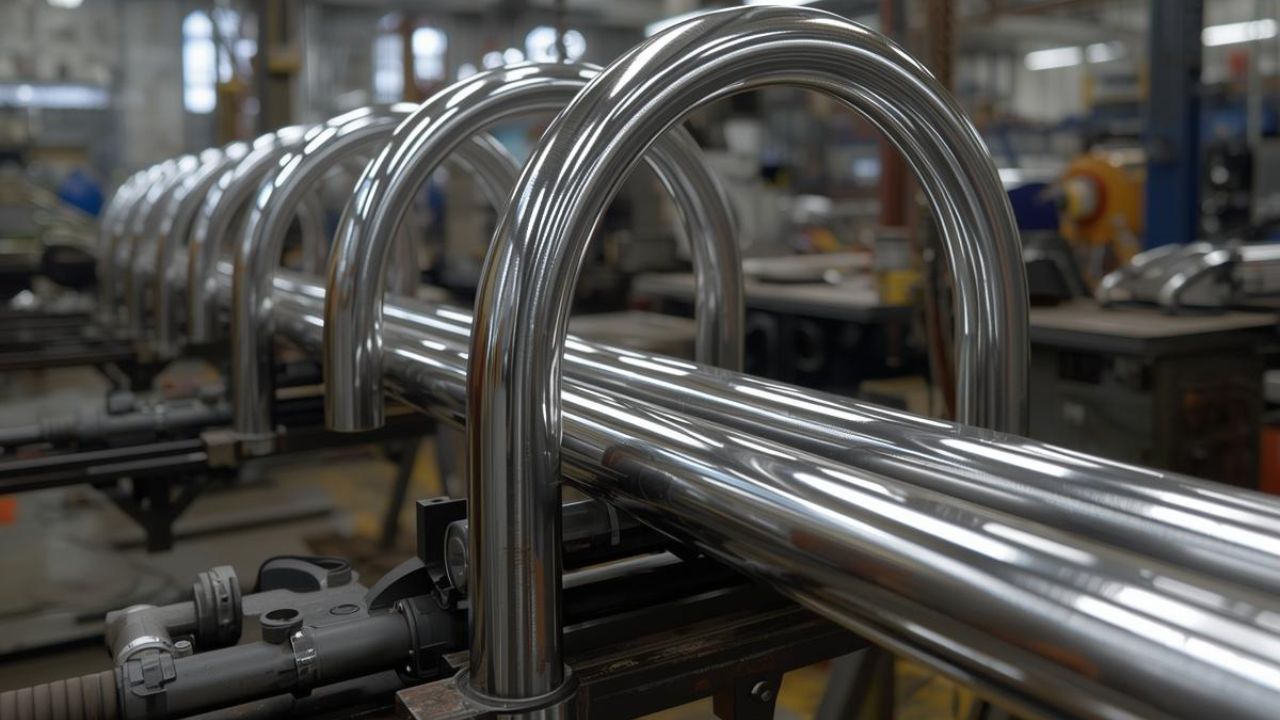
Aerospace tubing fabrication operates under the most demanding manufacturing standards in any industry. Components must withstand extreme temperatures, pressures, and corrosive environments while maintaining zero-defect reliability. This requires specialized materials like titanium and Inconel, precision processes including CNC tube bending services and laser tube cutting, and comprehensive quality systems governed by aerospace quality standards like AS9100.
From tight tolerance tube bending to non-destructive testing protocols, every aspect of aerospace manufacturing demands expertise that separates qualified providers from general fabricators. Understanding these requirements, processes, and certifications helps engineers and procurement teams select manufacturers capable of delivering the precision tube fabrication aerospace applications require.
What Special Requirements and Quality Standards Apply to Aerospace Tubing Fabrication Projects?
Aerospace tubing fabrication operates under the most stringent quality standards in manufacturing. The industry requires specific material specifications, certified quality management systems, and regulatory approvals that exceed typical industrial requirements.
The Aerospace Tubing Fabrication
Aerospace tubing fabrication demands components that deliver exceptional strength-to-weight ratios while resisting corrosion and withstanding extreme temperatures and pressures. These requirements stem from operating environments where failure isn’t an option—from high-altitude aircraft systems to spacecraft applications. The industry enforces rigorous quality control through specific standards that build upon general quality management frameworks, creating a hierarchy of requirements unique to aerospace manufacturing.
Key Requirements for Aerospace Tubing Materials
Titanium Tubing
Titanium remains the primary material for precision tube fabrication in aerospace applications. Common grades include commercially pure Titanium (Grade 1 and Grade 2) and titanium alloy Grade 5 (Ti-6Al-4V), selected for their 4.5 g/cm³ density and superior performance characteristics. Manufacturing processes span As Welded, Welded and Drawn, Drawn Over Mandrel (DOM), Seamless, Flash Controlled, Annealed/Heat Treated, and Extruded methods. AMS 4942, 4943, and 4944 define the chemical composition, mechanical properties, and quality assurance requirements, while ASTM B338 covers seamless and welded tubes for condensers and heat exchangers, and ASTM B861 addresses seamless tubes for structural applications.
Inconel Tubing
Inconel alloys, particularly Inconel 718, serve engine and exhaust systems requiring high-temperature strength and corrosion resistance. At approximately 8.5 g/cm³, Inconel is significantly denser than titanium but delivers critical performance in extreme heat environments where titanium cannot operate effectively.
Aerospace Quality Standards and Certifications (e.g., ISO 9001, AS9100)
AS9100 (AS9100D)
AS9100 represents the globally recognized Quality Management System standard for Aviation, Space, and Defense. This aerospace quality standard incorporates all ISO 9001:2015 requirements plus over 100 additional aerospace-specific requirements focused on safety, reliability, and supply chain quality. The IAQG has produced correlation matrices mapping AS9100:2016 (Rev D) clauses directly to FAA Part 21 and EASA Part 21 requirements, demonstrating that AS9100 certification satisfies regulatory mandates for aerospace manufacturing.
ISO 9001
ISO 9001 provides the foundational international standard for Quality Management Systems and serves as a prerequisite for AS9100 certification. This baseline standard ensures consistent production processes and quality control measures across all manufacturing operations.
FAA and EASA Requirements
The Federal Aviation Administration mandates compliance for all parts and components used in civil aircraft. Manufacturers must obtain a Production Certificate—FAA approval to manufacture duplicate products under approved design—and Parts Manufacturer Approval (PMA) for replacement or modification parts. EASA Part 21 establishes similar requirements for European aerospace manufacturing, creating parallel regulatory frameworks that certified facilities must navigate for global market access.
How Is Precision Achieved in Aerospace Tubing Fabrication?
Precision in aerospace tubing fabrication results from internationally standardized tolerances, advanced CNC tube bending services, and laser tube cutting technologies. These methods deliver the dimensional accuracy and geometric consistency required for critical aerospace applications.
The Role of Tight Tolerance Tube Bending in Aerospace Manufacturing
Tight tolerance tube bending operates under strict geometric constraints defined by international standards. ISO 12573 harmonizes dimensional tolerances for aerospace tubing globally, ensuring interchangeability across manufacturers and systems. PFI ES-24 specifies detailed tolerances for pipe bending, including maximum allowable ovality—the deformation from a perfect circle—and wall thinning limits. Wall thinning on the outside radius of bends must be controlled to maintain pressure-bearing capacity, as excessive reduction compromises structural integrity in high-pressure aerospace systems.
CNC Tube Bending Services for High-Precision Aerospace Applications
CNC tube bending services achieve precision through continuous dimensional monitoring during fabrication. Technicians measure outer diameter and wall thickness using precision calipers and micrometers throughout the bending process. Bend radius and angle must remain within tolerance ranges specified by design requirements and governing codes like ASME B31.3 and PFI ES-24. This real-time verification prevents out-of-specification components from progressing through production, reducing waste and ensuring aerospace quality standards compliance.
Laser Tube Cutting for Complex Aerospace Shapes
Laser tube cutting delivers the geometric complexity required for modern aerospace tubing fabrication. Laser welding has gained recognition for its efficiency and suitability for thin to medium-thickness materials common in aerospace applications. The inclusion of handheld laser welding in the ASME Boiler & Pressure Code represents industry acceptance of this technology for precision tube fabrication in critical applications.
CNC Machining in Aerospace Tubing Fabrication
CNC machining complements tube bending and cutting processes by providing precise end preparation, flange machining, and custom features required for aerospace assemblies. Computer-controlled operations eliminate human error in dimensional accuracy, delivering repeatable results across production runs while maintaining the tight tolerances aerospace manufacturing demands.
What Manufacturing Processes Ensure Aerospace Tubing Quality?
Aerospace tubing quality depends on controlled manufacturing processes that eliminate defects through precision welding, advanced cutting technologies, and automated systems. These processes work together to meet zero-defect standards required for aerospace applications.
Importance of Precision Tube Fabrication in Aerospace
Precision tube fabrication in aerospace targets zero-defect components—a non-negotiable standard where even minor flaws can compromise safety. ISO 9001 certification signals a manufacturer’s implementation of stringent quality control measures, complete material traceability, and comprehensive documentation procedures. This systematic approach ensures every component meets aerospace quality standards from raw material receipt through final delivery.
Key Processes: CNC Tube Bending and Laser Cutting
Welding Techniques
Gas Tungsten Arc Welding (GTAW or TIG) and Orbital GTAW dominate high-integrity aerospace tubing fabrication due to their precision and ability to produce clean, pure welds free from contamination. These processes excel with thin-wall tubing and reactive metals. Gas Metal Arc Welding (GMAW or MIG) handles thicker materials where higher deposition rates improve efficiency without sacrificing quality.
Filler Material Compatibility
AWS D17.1 emphasizes filler material compatibility, particularly for reactive metals like titanium and nickel alloys used in aerospace manufacturing. Incompatible filler metals cause hot cracking and contamination that compromise weld integrity. Proper filler selection prevents these defects while maintaining the base material’s mechanical properties and corrosion resistance.
Robotic Welding for Accuracy in Aerospace Tubing
Robotic welding eliminates human variability in aerospace tubing fabrication. Automated welding processes integrate focused ultrasonic search units for real-time quality monitoring during the weld cycle. Orbital GTAW provides an automated TIG welding variant that maintains consistent parameters around the entire tube circumference, delivering uniform penetration and bead geometry critical for tight tolerance tube bending applications and pressure-containing systems.
What Are the Challenges in Aerospace Tubing Fabrication?
Aerospace tubing fabrication faces unique challenges that separate it from standard industrial tube work. Tight tolerances, stringent quality standards, and complex material compatibility requirements demand specialized expertise and equipment.
Managing Tight Tolerances and Maintaining High Precision
Dimensional tolerances in aerospace tubing fabrication are extremely tight and governed by specific Aerospace Material Specifications (AMS) and international standards. ISO 12573 ensures interchangeability and proper fit in critical systems where even minor dimensional variations cause assembly issues or performance failures. AMS standards like AMS 2243L and AMS 2253F provide tolerance requirements tailored to different alloy types, recognizing that materials like titanium and Inconel behave differently during tight tolerance tube bending and CNC machining operations.
Meeting Stringent Aerospace Quality Standards
AS9100 compliance necessitates extensive documentation that tracks every aspect of aerospace manufacturing. Manufacturers must maintain complete traceability of all parts from raw material certification through final installation, creating a documented chain of custody for every component. This standard emphasizes risk management and First Article Inspection (FAI), requiring verification that new or modified processes produce parts meeting all specifications before full production begins—a time-intensive requirement that challenges production schedules.
Material Selection and Its Impact on the Fabrication Process
Material selection directly impacts fabrication complexity, particularly when joining dissimilar metals. Dissimilar Metal Welding (DMW) presents significant challenges in pressure vessels and aerospace systems where different materials must be joined. Procedures must be carefully developed using ASME BPVC Section IX to address differences in material strength, thermal expansion, and chemical properties. Specific filler metals must be avoided in certain applications due to long-term failure risks from galvanic corrosion or stress concentration at the weld interface. These material compatibility issues require specialized knowledge in precision tube fabrication and welding metallurgy.
How Do Aerospace Manufacturers Ensure Consistent Quality?
Aerospace manufacturers maintain consistent quality through comprehensive inspection protocols, rigorous testing procedures, and complete documentation systems. These quality assurance measures verify that every component meets aerospace quality standards before entering service.
Inspection Methods and Testing Procedures for Aerospace Tubing
Non-Destructive Testing (NDT) and Ultrasonic Testing (UT)
Ultrasonic Testing detects internal and surface discontinuity defects including cracks, voids, and inclusions that compromise structural integrity. Standards like GB/T 12969.1-2007 for titanium alloy tubes and various ASTM standards govern UT procedures in precision tube fabrication. Automated systems use focused ultrasonic search units to evaluate material thickness and integrity through sound wave propagation, identifying defects invisible to visual inspection.
Eddy Current Testing (ET)
Eddy Current Testing identifies surface and near-surface flaws in both welded and seamless tubing. ISO 25902-1:2009 specifically addresses eddy current examination of titanium pipes and tubes, providing standardized procedures for this critical quality control method in aerospace tubing fabrication.
Radiographic Testing (X-ray Inspection)
Radiographic Testing uses radiation to detect internal flaws, particularly in welds and complex structural parts produced through CNC tube bending services and laser tube cutting. X-ray imaging provides a permanent visual record of internal defects in both metallic and nonmetallic aerospace materials, enabling defect characterization and documentation for quality records.
Magnetic Particle and Liquid Penetrant Testing
Magnetic Particle Testing (MT) detects surface and near-surface flaws in ferromagnetic materials, while Liquid Penetrant Testing (PT) identifies surface defects in non-porous materials like titanium and Inconel. These complementary methods ensure complete surface inspection coverage across different material types used in aerospace manufacturing.
AWS D17.1 Inspection Classification
AWS D17.1 categorizes aerospace components into Inspection Classes A, B, and C based on criticality. Class A requires the highest scrutiny level with zero tolerance for major defects in load-bearing structures. ASME BPVC Section III establishes similarly stringent non-destructive examination requirements for nuclear components, reflecting the life-critical nature of these applications.
Pressure and Flow Testing in Aerospace Applications
Hydrostatic Testing
Hydrostatic testing verifies pressure-holding capacity and structural integrity of completed tubing assemblies. GB/T 241-2025, effective January 1, 2026, specifies hydraulic test methods for metallic tubes including titanium. Water pressure testing ensures components produced through tight tolerance tube bending can withstand specified operating pressures without leakage or deformation.
Pneumatic Testing
Pneumatic testing provides an alternative pressure verification method using air or gas. This approach suits applications where water contamination must be avoided or where testing conditions prevent hydrostatic methods.
Documentation and Traceability in Aerospace Tubing Fabrication
Material Handling and Inspection
Material verification begins with thorough checks of chemical composition using spectrometers and confirmation that mechanical properties meet specified ASTM standards. Proper material handling protocols prevent surface damage and contamination that could compromise finished components. Positive Material Identification (PMI) ensures correct alloy composition throughout production, especially critical in high-temperature or corrosive environments where material substitution would cause premature failure.
Traceability Requirements
AS9100 requires maintaining detailed documentation including raw material certificates and production records that track each component’s complete history from raw material to final product. This documentation system provides complete supply chain visibility, enabling rapid root cause analysis if quality issues emerge and supporting regulatory compliance in aerospace tubing fabrication. Every CNC machining operation, weld pass, and inspection result becomes part of the permanent quality record.
What Are the Emerging Trends in Aerospace Tubing Fabrication?
Aerospace tubing fabrication continues evolving through material innovations, automation technologies, and sustainability initiatives. These trends reshape manufacturing capabilities while maintaining the rigorous aerospace quality standards the industry demands.
Innovations in Materials for Aerospace Tubing
Advanced materials development focuses on improving strength-to-weight ratios and expanding temperature capabilities beyond current titanium and Inconel limits. Additive manufacturing enables complex geometries previously impossible with traditional precision tube fabrication methods, while composite-metal hybrid structures combine material properties for optimized performance. These material innovations drive corresponding advances in CNC tube bending services and laser tube cutting technologies to accommodate new fabrication requirements.
Advanced Fabrication Technologies: Automation and Robotics in Aerospace Manufacturing
Automation transforms aerospace manufacturing through enhanced precision and consistency. Automated ultrasonic testing systems with focused search units integrate real-time quality monitoring directly into production workflows, identifying defects immediately rather than in post-production inspection. Orbital GTAW automated welding systems deliver repeatable precision for critical applications, eliminating human variables in tight tolerance tube bending and tube-to-fitting connections. These robotic systems maintain consistent parameters throughout production runs, supporting the zero-defect requirements of aerospace quality standards while reducing labor costs and production times.
Sustainability in Aerospace Tubing Fabrication
Sustainability initiatives in aerospace tubing fabrication address material waste reduction, energy consumption, and recyclability. CNC machining and laser tube cutting optimize material utilization through precise programming that minimizes scrap. Manufacturers increasingly recover and recycle titanium and Inconel chips from machining operations, recapturing valuable materials that previously represented pure waste. Energy-efficient manufacturing equipment and process optimization reduce the carbon footprint of aerospace manufacturing while maintaining the precision and quality aerospace applications require.
Why Choosing an Experienced Manufacturer Matters in Aerospace Tubing Fabrication
Selecting the right aerospace tubing fabrication partner directly impacts project success, regulatory compliance, and component reliability. Manufacturer expertise, certifications, and capabilities determine whether components meet aerospace quality standards and perform as designed in critical applications.
The Value of Expertise in Tight Tolerance Tube Bending
Expertise in tight tolerance tube bending requires more than advanced equipment—it demands certified processes and qualified personnel. ASME Boiler and Pressure Vessel Code (BPVC) certification demonstrates a manufacturer’s compliance with rigorous standards for safety, quality, and reliability in pressure-critical applications. ASME Section IX sets specific standards for welding and brazing qualifications, ensuring both welders and procedures meet documented performance criteria. These certifications are essential for companies performing welded pipe bends in aerospace manufacturing, as they verify the manufacturer can consistently produce components meeting design specifications and regulatory requirements.
Partnering with a Specialized Aerospace Tubing Fabrication Provider
Qualified aerospace tubing fabrication providers maintain multiple certifications and capabilities that separate them from general tube manufacturers. ISO 9001 certification establishes foundational quality management systems, while AS9100 certification addresses aerospace-specific requirements including risk management and traceability. FAA Production Certificate and PMA capabilities enable legal manufacture of certified aircraft components. ASME BPVC compliance covers pressure-critical applications common in aerospace systems.
Technical capabilities distinguish experienced providers from basic fabricators. Positive Material Identification (PMI) testing verifies correct alloy composition before fabrication begins, preventing costly material substitution errors. Full NDT capabilities—including Ultrasonic Testing, Eddy Current Testing, Radiographic Testing, Magnetic Particle Testing, and Liquid Penetrant Testing—ensure comprehensive quality verification. Complete documentation and traceability systems satisfy AS9100 requirements while providing the component history records aerospace applications demand. Manufacturers offering integrated services from CNC tube bending and laser tube cutting through welding, CNC machining, and final inspection streamline production while maintaining quality control throughout precision tube fabrication processes.
Partner with CRD MFG, Inc. for Aerospace-Grade Tubing Fabrication
CRD MFG, Inc. delivers precision tube fabrication that meets the rigorous demands of aerospace applications. Our AS9100-certified facility combines advanced CNC tube bending services, laser tube cutting, and CNC machining with comprehensive NDT capabilities to ensure zero-defect components.
We maintain complete material traceability, FAA compliance, and ASME BPVC certifications required for critical aerospace systems. From titanium and Inconel tubing to tight tolerance tube bending and orbital welding, our experienced team understands the aerospace quality standards your projects demand.
Contact CRD MFG, Inc. today to discuss your aerospace tubing fabrication requirements and discover how our certified processes and professional tube welding solutions deliver the reliability your applications require.