
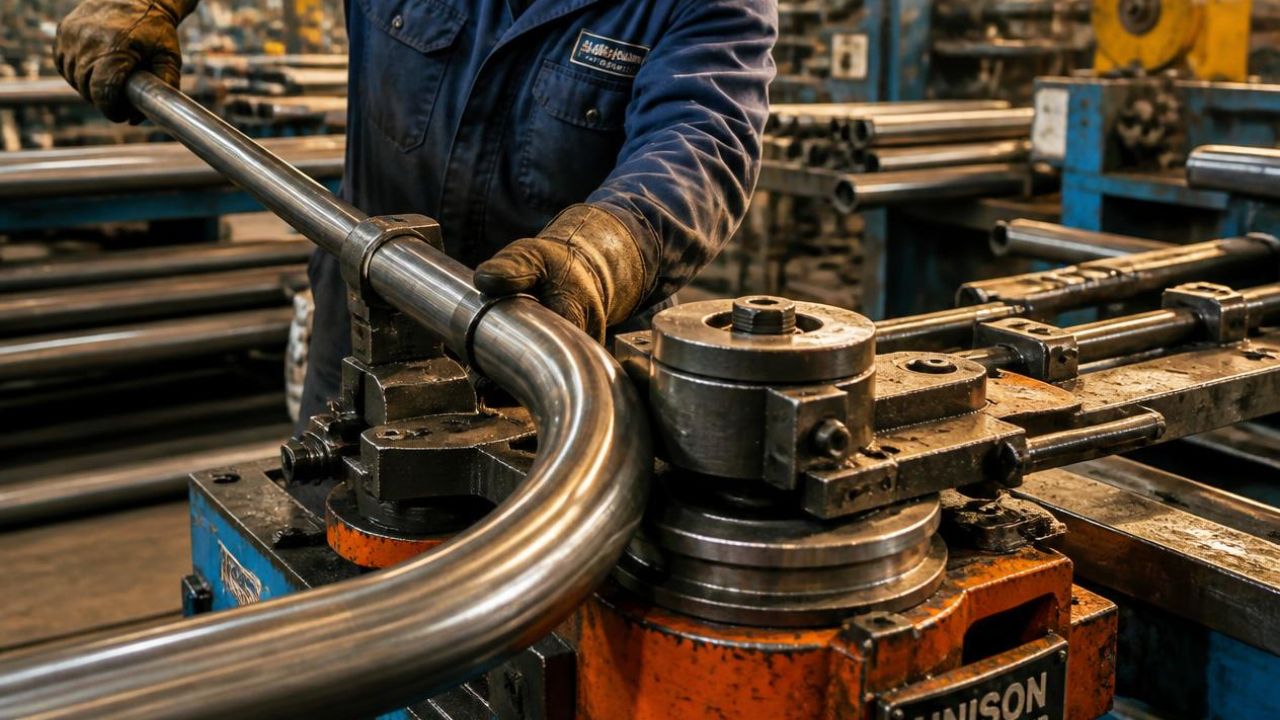
CNC tube benders and hydraulic tube benders represent fundamentally different approaches to metal forming. CNC systems use computer-controlled automation for consistent, repeatable bends with minimal operator intervention, while hydraulic benders rely on mechanical pressure and operator skill. The global metal fabrication equipment market, valued at USD 68.30 billion in 2024, is projected to reach USD 123.80 billion by 2035, reflecting a 4.15% compound annual growth rate.
Selecting between these tube bending technology options requires understanding capabilities, costs, and operational requirements. Production volume, precision demands, material characteristics, and workforce capabilities influence optimal equipment choice.
Key Takeaways
- CNC tube benders achieve ±0.05-degree accuracy with cycle times as fast as 2 seconds per bend, while hydraulic systems deliver ±2-5 degrees precision
- CNC systems cost USD 10,000 to over USD 100,000, compared to USD 5,000 to USD 50,000 for hydraulic benders
- Rotary draw bending provides high precision for automotive and aerospace components, while mandrel bending prevents tube collapse during tight-radius bends
- Generation Z represents 25% of the manufacturing workforce and prioritizes digital interfaces and automated safety features in equipment design
- Material type, production volume, and precision requirements determine whether CNC or hydraulic bending technology suits specific applications
What Are CNC and Hydraulic Tube Benders?
CNC and hydraulic tube benders are specialized machines that form metal tubes into precise angles and curves. CNC systems use computer programming to control multiple axes simultaneously, while hydraulic benders apply mechanical force through pressurized fluid systems.
The fundamental difference lies in control methodology and automation level. CNC tube benders execute programmed instructions with closed-loop feedback systems that automatically adjust for material springback and dimensional variations. Hydraulic benders depend on operator expertise to position materials and apply force.
How Does CNC Tube Bending Work?
CNC tube bending uses computer numerical control to automate the process through precise multi-axis movements. The system clamps the tube while a rotating die pulls material around a predetermined radius, with servo motors controlling bend angle, rotation speed, and feed rate. CNC tube benders handle diameters from 6.35mm to 150mm and achieve bend angles up to 180 degrees.
Automated systems measure actual bend angles in real-time against programmed specifications. If deviations occur due to material springback or wall thickness variations, the control system adjusts subsequent bends to maintain ±0.05 degrees accuracy.
How Does Hydraulic Tube Bending Work?
Hydraulic tube bending applies pressurized fluid to generate a force that pushes the tube against a stationary die. The operator positions the tube manually, activates the hydraulic ram, and monitors the bend angle using protractors or digital indicators. This method works effectively for large-radius curves and thick-walled materials requiring substantial forming force.
Bending accuracy depends on operator skill. Operators must account for material springback manually and adjust positioning for each bend. Hydraulic benders typically achieve ±2-5 degrees precision, suitable for applications with less critical angular tolerances.
What Are the Main Components of Each Bender Type?
CNC benders contain servo-controlled motors, programmable logic controllers, rotary draw tooling, mandrel systems, and touchscreen interfaces. The mandrel provides internal support during bending to prevent tube collapse, while pressure dies and wiper dies control material flow.
Hydraulic systems feature hydraulic pumps, cylinders, relief valves, manual positioning fixtures, and interchangeable dies. The operator selects the appropriate die radius, positions the tube, and controls hydraulic pressure manually. Simpler architecture reduces equipment cost but transfers complexity to operator training.
What Are the Key Differences Between CNC and Hydraulic Tube Benders?
Primary differences involve precision, automation level, and cost structures. CNC systems deliver superior accuracy through computer control and automated positioning, while hydraulic benders provide mechanical simplicity at lower capital investment. Production environments requiring high-volume consistency favor CNC technology; hydraulic systems suit low-volume custom work with relaxed tolerances.
CNC bending requires skilled programmers for toolpaths, but reduces operator involvement during production. Hydraulic bending demands experienced operators for each bend, but minimizes software expertise requirements.
How Do Precision and Accuracy Compare?
CNC tube benders achieve ±0.05 degrees of accuracy through closed-loop servo control and real-time measurement feedback. The automated system compensates for material variations, environmental factors, and tool wear without operator intervention. This precision bending enables manufacturers to produce components meeting aerospace and automotive standards where dimensional consistency affects assembly fit and structural performance.
Hydraulic benders deliver ±2-5 degrees precision, with actual accuracy depending on operator skill. Manual positioning and visual verification introduce variability between batches. Applications such as structural framework and utility piping often accept this tolerance range.
What Are the Differences in Speed and Automation?
CNC systems complete cycle times as fast as 2 seconds per bend once programming is finalized. Automated material handling, tool changing, and quality verification eliminate manual intervention between bends. High-volume runs benefit from this speed advantage, with some CNC benders processing hundreds of parts per shift.
Hydraulic bending operates more slowly because operators manually position each tube, activate the hydraulic system, and verify bend angles. Cycle times vary based on tube complexity and operator experience, but setup time for simple jobs remains minimal without programming requirements.
How Do Cost and Maintenance Requirements Differ?
CNC benders range from USD 10,000 for basic two-axis systems to over USD 100,000 for advanced multi-axis machines. Total ownership cost includes programming software, specialized tooling sets costing USD 5,000 to USD 15,000 per diameter, and preventive maintenance for servo motors and controls. Organizations must budget for CNC programmer training and software updates.
Hydraulic benders cost USD 5,000 to USD 50,000, with simpler mechanical systems reducing initial investment. Maintenance focuses on hydraulic fluid changes, seal replacements, and die inspection. Lower software complexity eliminates programming costs, but labor costs remain higher due to continuous operator involvement.
When Should You Choose CNC over Hydraulic Benders and Vice Versa?
Equipment choice depends on production volume, precision requirements, and workforce expertise. CNC benders suit high-volume manufacturing where part consistency, complex multi-plane bends, and minimal operator intervention justify higher capital investment. Hydraulic systems work well for custom fabrication shops handling diverse low-volume projects where flexibility and lower equipment cost outweigh automation benefits.
Material characteristics and bend geometry also influence equipment choice. Thin-walled tubes requiring tight radii benefit from a CNC pipe bender’s precision and mandrel control, while thick-walled materials needing large-radius bends perform well on hydraulic systems.
Which Applications Favor CNC Tube Bending?
Automotive exhaust systems, aerospace fuel lines, and medical equipment frames require CNC precision for consistent fit and performance. These applications demand repeatable accuracy across thousands of identical parts with minimal dimensional variation. CNC automation reduces labor costs per unit while maintaining quality standards.
Complex geometries involving multiple bends in different planes necessitate CNC capability. Aircraft hydraulic lines with compound curves and medical diagnostic equipment with intricate tube routing exceed the practical limits of manual hydraulic bending.
In What Situations Are Hydraulic Benders More Suitable?
Custom architectural metalwork, utility piping, and low-volume industrial frames work well with hydraulic bending technology. These projects involve unique specifications for each job, making CNC programming time-consuming relative to production time. Experienced operators can quickly set up hydraulic benders and produce acceptable results where ±2-5 degrees tolerance meets functional requirements.
Hydraulic benders handle extremely thick-walled materials more effectively than many CNC systems. Heavy equipment roll cages and structural building components often require bend angles limited to 120 degrees or less, aligning with hydraulic bender capabilities.
How Does Material Type Influence Bender Choice?
Materials processed include steel, stainless steel, aluminum, copper, and titanium, each with distinct bending characteristics. Aluminum’s lower yield strength bends easily on both systems, while titanium’s high strength and springback demand CNC precision for consistent results. Material selection affects tooling requirements, mandrel specifications, and machine capabilities.
Stainless steel and high-carbon steel exhibit significant springback that CNC systems automatically compensate through programmed overbending. Hydraulic operators must manually adjust for springback based on experience, leading to potential inconsistencies. Copper’s malleability allows successful bending on either system, making cost and volume the primary decision factors.
How Do Mandrel and Rotary Draw Bending Relate to CNC and Hydraulic Systems?
Mandrel and rotary draw bending represent specific forming methods implemented on both CNC and hydraulic platforms. Rotary draw bending rotates the tube around a stationary bend die while pulling material through the bending zone, producing smooth curves with minimal distortion. Mandrel bending inserts an internal support rod to maintain a circular cross-section, preventing collapse in thin-walled tubes.
CNC systems integrate these methods with automated mandrel insertion, precise die rotation control, and coordinated multi-axis movement. Hydraulic platforms can incorporate mandrel support and rotary dies but require manual coordination.
What Is Rotary Draw Bending and When Is It Used?
Rotary draw bending pulls the tube around a rotating die, offering high precision and a smooth surface finish. The process clamps the tube against a rotating bend die while a pressure die prevents material shifting, and a wiper die smooths the outer radius. Automotive and aerospace industries use rotary draw bending for exhaust components, fuel lines, and structural tubes where appearance and dimensional accuracy matter.
This method minimizes wall thinning on the outer radius and prevents inner radius wrinkling. Modern CNC systems execute rotary draw bending with programmed die rotation synchronized to material feed rates. Hydraulic systems can perform rotary draw manually, but require skilled operators to coordinate rotation with material advancement.
How Does Mandrel Bending Enhance Tube Integrity?
Mandrel bending utilizes internal support to prevent the tube from collapsing or wrinkling during bending. The mandrel consists of linked balls or a solid rod inserted before bending, providing structural support from inside while external dies shape the material. This maintains circular cross-section even during tight-radius bends.
Thin-walled tubes with diameter-to-wall-thickness ratios exceeding 25:1 require mandrel support for quality bends. CNC systems automate mandrel insertion, positioning, and extraction with precise timing coordinated to the bending sequence. Hydraulic operations perform mandrel insertion manually, requiring operators to properly size and position mandrels based on tube dimensions.
Which Bending Methods Are Common in Each Technology?
CNC tube benders predominantly use rotary draw bending with mandrel support for precision applications. Automated control coordinates die rotation, mandrel positioning, clamp pressure, and material feed simultaneously to produce complex geometries with tight tolerances. Precision tube bending tolerances achievable through CNC systems make rotary drawing the preferred method.
Hydraulic systems commonly employ compression or ram bending without mandrels for simpler applications. The operator positions the tube against a stationary die while the hydraulic ram pushes from the opposite side. Some hydraulic systems accommodate rotary draw tooling for improved accuracy, but manual coordination limits production speed.
How Is Workforce Demographic Impacting Tube Bender Technology Adoption?
Workforce demographics significantly influence manufacturing equipment purchasing decisions. Generation Z represents the first generation of digital natives entering manufacturing with expectations for intuitive digital interfaces and automated processes. Their preferences for touchscreen controls, cloud connectivity, and minimal manual labor drive manufacturers toward CNC systems with modern user interfaces.
Generational differences in technology comfort affect training time and equipment utilization rates. Organizations with younger workforces adopt advanced automation faster, while those with experienced manual operators may continue hydraulic operations longer.
What Are the Preferences of Different Generations in Manufacturing?
Generation Z represents 25% of the manufacturing workforce and prioritizes workplace flexibility, meaningful work, and physical safety. This cohort strongly prefers equipment with intuitive touchscreen interfaces, remote monitoring capabilities, and automated safety systems, minimizing manual handling risks. Their digital fluency allows rapid adaptation to CNC programming but creates disinterest in repetitive manual hydraulic operations.
Millennials form 35% of the manufacturing workforce, while Generation X represents 31% and Baby Boomers 15%. Millennials value continuous learning and career progression, making them receptive to CNC programming training. Generation X prioritizes equipment reliability and proven performance.
How Do SMEs and Large Enterprises Differ in Bender Usage?
Small and medium enterprises face barriers due to high initial costs ranging from USD 50,000 to over USD 100,000 for advanced CNC systems. Many SMEs continue using hydraulic tubing benders or adopt equipment leasing to access newer technology. Their lower production volumes make hydraulic systems economically viable since CNC programming overhead cannot be amortized across sufficient production quantities.
Large enterprises demonstrate high adoption rates of premium automated equipment, including multi-axis CNC benders with robotic material handling. These organizations possess the capital to invest in advanced systems and produce sufficient volume to justify automation costs. Their focus on reducing long-term labor costs and maintaining consistent quality drives CNC preference regardless of higher initial investment.
How Does Digital Natives’ Entry Affect Equipment Design?
Equipment manufacturers increasingly incorporate digital interfaces, cloud connectivity, and mobile device integration to attract younger operators. Touchscreen controls replace physical buttons, while augmented reality training modules supplement traditional manuals. These design changes reflect that 38% of Generation Z prioritize workplace flexibility and 41% prioritizes meaningful work.
Modern CNC tube bending machines feature smartphone-style interfaces with intuitive icon navigation and visual programming tools, reducing text-heavy code requirements. Cloud-based production monitoring allows operators to track machine performance remotely and receive maintenance alerts on mobile devices.
What Are the Integration Considerations for CNC Tube Benders?
CNC tube bender integration requires software infrastructure, programming expertise, and production workflow modification. Organizations must establish CAD/CAM systems for toolpath generation, implement quality control protocols for program verification, and train personnel on machine operation and programming. Successful integration connects CNC bending equipment to broader manufacturing operations and execution systems for material tracking, production scheduling, and quality documentation.
Total ownership cost extends beyond equipment purchase to include software licenses, tooling inventory, and maintenance contracts. Manufacturers must budget for specialized tooling sets costing USD 5,000 to USD 15,000 per diameter.
How Important Is Software and Programming Expertise?
CNC systems require programming expertise to translate engineering drawings into machine-executable toolpaths. Programmers must understand bend sequence optimization, springback compensation, and collision avoidance to create efficient production programs. Organizations hiring skilled CNC programmers or training existing staff face significant human capital investment that justifies itself through improved efficiency and reduced material waste.
Programming complexity varies from basic two-dimensional bends requiring minimal expertise to complex three-dimensional geometries demanding advanced CAD/CAM knowledge. Some modern CNC benders include visual programming interfaces, reducing technical barriers.
What Role Does Automation Play in Production Efficiency?
Automation eliminates repetitive manual tasks, including material loading, tool changing, and quality verification. CNC tube benders with automated material handling systems operate continuously with minimal supervision, significantly increasing parts per shift compared to manual hydraulic operations.
Integrated automation connects the tube bending production line to upstream cutting operations and downstream assembly processes. Material tracking systems automatically schedule bends based on inventory levels, while quality control systems verify dimensions against specifications without manual measurement.
How Do Tooling and Maintenance Affect Total Cost of Ownership?
Tooling sets, including bend dies, clamp dies, pressure dies, wiper dies, and mandrels, represent significant ongoing costs. Each tube diameter and bend radius requires specific tooling, with complete sets costing USD 5,000 to USD 15,000 per size. Manufacturers processing multiple diameters must maintain substantial tooling inventories.
Maintenance requirements differ substantially. CNC equipment needs regular servo motor calibration, encoder verification, and control system software updates, requiring specialized technician expertise. Hydraulic systems require fluid changes, seal replacements, and pressure valve maintenance that general maintenance staff can perform.
How Do CNC and Hydraulic Tube Benders Compare with Other Fabrication Technologies?
Tube benders complement broader fabrication technology ecosystems, including laser cutting, precision machining, and welding systems. Manufacturers increasingly integrate multiple processes to deliver complete fabricated assemblies. CNC tube bending often precedes laser cutting operations that add holes or slots to bent tubes, while hydraulic bending may follow manual cutting for custom applications.
Technology selection depends on production requirements across all fabrication steps. Organizations evaluating tube benders must consider how the equipment integrates with existing capabilities.
What Are the Advantages Over Traditional Manual Methods?
Manual tube bending using simple fixtures produces inconsistent results with high scrap rates and operator fatigue. CNC and hydraulic systems both deliver superior repeatability and reduced physical strain. Automation eliminates the skill ceiling limiting manual production.
Quality control improves dramatically when mechanical or automated systems replace manual forming. Measurement verification occurs during production rather than after completion, reducing rework costs and material waste.
How Do Benders Complement Tube Laser Cutting Systems?
Tube laser systems process outer diameters from 1.5 inches to 16 inches with a material thickness capacity of up to 3/4 inch. These systems cut holes, slots, and profile shapes with ±0.05-0.1mm precision and 2-30 seconds cycle times per cut. Tube laser cutting advantages include complex geometry capability and minimal material waste, making them ideal partners to tube bending operations.
Integrated workflows combine laser cutting before or after bending, depending on geometric requirements. Pre-bend cutting adds features while material remains straight and easily fixtured, whereas post-bend cutting accommodates features requiring precise orientation relative to bend angles.
What Is Their Role Alongside Orbital Welding Processes?
Orbital welding is a semi-automated process using a welding arc rotating mechanically 360 degrees around a static workpiece. Industries using orbital welding include semiconductor, pharmaceutical, and aerospace sectors requiring high-purity, contamination-free joints. Orbital welding precision reaches ±0.1mm, creating leak-proof connections critical for fluid handling systems assembled from bent tubes.
Bent tube components requiring orbital welding benefit from CNC bending precision, ensuring consistent fit-up for automated welding operations. Dimensional variations from hydraulic bending can complicate welding fixture design.
CNC and Hydraulic Tube Benders: Comprehensive Technology Comparison and Market Insights
CNC tube benders deliver automated precision through computer-controlled multi-axis systems, achieving ±0.05-degree accuracy with cycle times as fast as 2 seconds per bend. Hydraulic benders provide mechanical simplicity and robust performance with ±2-5 degrees precision at lower capital investment ranging from USD 5,000 to USD 50,000. This hydraulic bender comparison reveals distinct advantages for each bending technology depending on production volume, precision requirements, material characteristics, and workforce capabilities.
The global metal fabrication equipment market, valued at USD 68.30 billion in 2024, is projected to reach USD 123.80 billion by 2035, growing at 4.15% annually. Within this expanding market, manufacturers increasingly adopt CNC systems for high-volume precision applications while maintaining hydraulic equipment for custom fabrication and heavy-duty forming. Technology selection must balance immediate production needs against long-term scalability, workforce demographics, and total cost of ownership.
Manufacturing success requires selecting appropriate precision-bending equipment for specific application requirements. CNC technology suits organizations prioritizing automation, consistency, and high-volume output with available programming expertise and capital investment capacity. Hydraulic systems serve manufacturers needing flexible custom fabrication capabilities with lower initial costs.
CRD MFG, Inc. provides comprehensive tube fabrication services combining advanced CNC bending capabilities with extensive material expertise. Organizations requiring precision-bent components benefit from integrated fabrication workflows, eliminating vendor fragmentation and ensuring consistent quality from design through production.
Stop Guessing Which Bending Technology Fits Your Parts
Specifying the wrong bender or splitting work across multiple shops leads to missed tolerances, springback surprises, and parts that do not fit at assembly. CRD MFG, Inc. brings CNC tube bending, laser tube cutting, efficient robotic welding, precision machining, and full assembly together under one roof in Placentia, California, so your bent components hold spec from the first part to the last. A dedicated project manager owns your job from quote through delivery and answers your questions directly, not a call queue. Reach out to us to talk through your next tube-bending project.
