
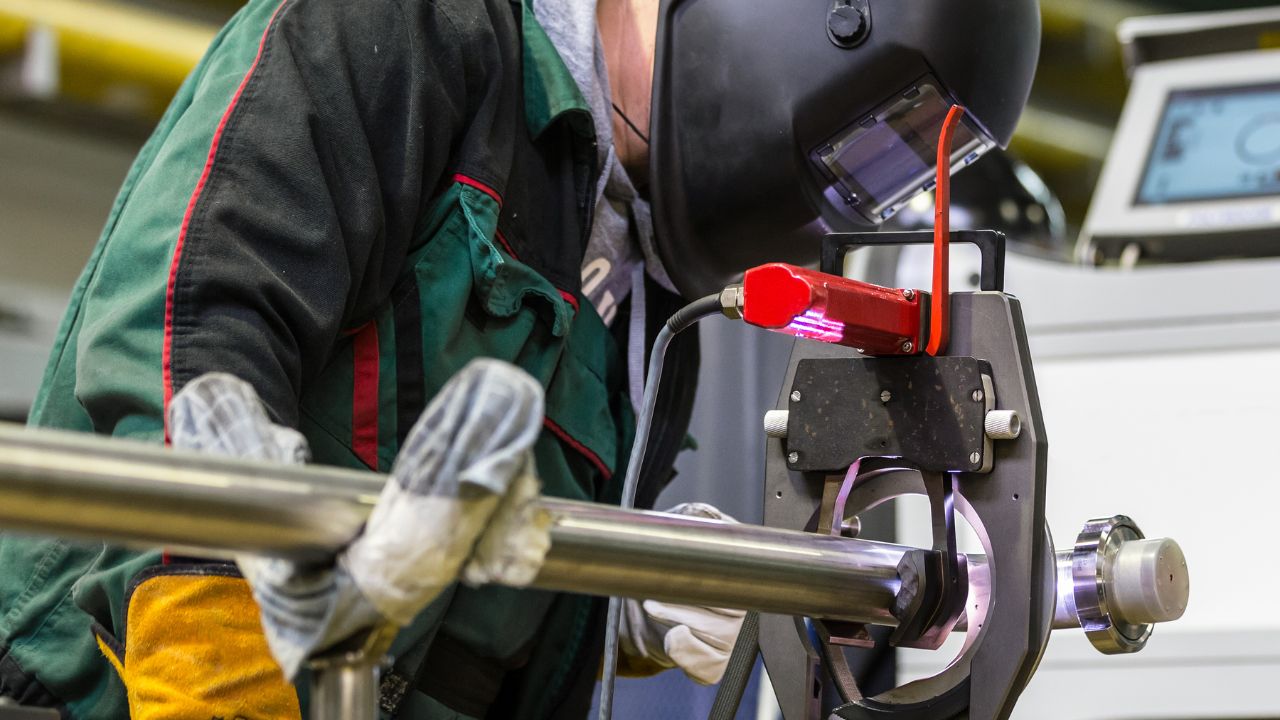
Orbital tube welding is a semi-automated process where a mechanically controlled arc rotates 360 degrees around a fixed workpiece. This technology produces consistent, contamination-free welds essential for pharmaceutical, semiconductor, and aerospace applications requiring absolute joint integrity. The process eliminates human variability through precise control over heat input, arc travel speed, and shielding gas coverage.
Industries requiring the best welding methods for tube fabrication increasingly rely on orbital systems to meet stringent purity standards. The controlled automation reduces oxidation, surface contamination, and structural defects. High-purity welds produced through orbital welding maintain internal smoothness and cleanliness necessary for sanitary and ultra-clean processing environments.
Key Takeaways
- Orbital tube welding uses a mechanically rotating arc to produce consistent, high-purity welds on static workpieces
- The technology delivers ±0.1mm precision with repeatable quality, critical for pharmaceutical and semiconductor applications
- Equipment costs range from USD 8,000 to over USD 30,000, with cycle times of 5-60 minutes per weld
- ASME BPE compliance and contamination control make orbital welding essential for bioprocessing and cleanroom environments
- Integration with tube laser cutting and CNC bending creates efficient workflows for complex tube fabrication projects
What Is Orbital Tube Welding and How Does It Work?
Orbital tube welding operates through a mechanically controlled welding head that rotates around a stationary tube or pipe joint. The system maintains consistent arc length, travel speed, and shielding gas coverage as it completes each 360-degree rotation, eliminating inconsistencies inherent in manual welding.
The process employs Tungsten Inert Gas welding technology with precise parameter control for each material type. Operators program welding current, voltage, travel speed, and gas flow rates into the control unit before initiating the automated cycle. The welding head then executes the programmed sequence with repeatable accuracy across multiple identical joints.
Key Components of Orbital Welding Systems
Modern orbital welding systems consist of a power supply, rotating welding head, and programmable control interface. The welding head contains the electrode holder and gas delivery nozzle that rotate on a precision track encircling the workpiece. Additional components include shielding gas regulators, cooling systems, and clamps securing tubes in perfect alignment.
Advanced systems incorporate closed-loop monitoring that tracks arc voltage and current in real time. These sensors detect variations and automatically adjust parameters to maintain consistent penetration depth and bead profile. The digital control interface stores multiple weld programs for different tube sizes and materials, enabling rapid changeover.
Typical Materials and Applications for Orbital Welding
Stainless steel, titanium, and copper alloys represent the primary materials processed through orbital tube welding systems. These materials demand the controlled heat input and contamination-free environment that orbital welding provides. Precision tube welding methods deliver purity levels required for pharmaceutical processing lines, semiconductor gas delivery systems, and aerospace hydraulic assemblies.
Orbital welding excels where internal surface cleanliness directly affects product quality and operational safety. High-purity gas distribution systems, bioprocessing equipment, and food-grade piping require smooth, oxide-free internal surfaces that resist contamination and bacterial growth. The process supports critical aerospace applications where weld defects could compromise structural integrity under extreme conditions.
How Orbital Welding Ensures Weld Consistency and Quality
Orbital welding eliminates human variables by maintaining identical parameters across every joint in a production run. The mechanical rotation delivers uniform heat distribution, preventing hot spots and cold laps that occur with manual variations. This consistency produces welds with ±0.1mm precision in penetration depth and bead width throughout the entire circumference.
Automated parameter control ensures complete joint penetration without excessive heat that distorts thin-walled tubes. The system maintains optimal arc length and travel speed regardless of operator fatigue. Documented weld parameters for each cycle provide traceability and quality verification required by aerospace and pharmaceutical manufacturing standards.
Why Is Orbital Welding Essential for High-Purity and Critical Welds?
High-purity welds require complete freedom from surface oxidation, particulate contamination, and internal irregularities that trap bacteria or release particles. Orbital tube welding achieves this through controlled shielding gas coverage and automated heat management that manual processes cannot consistently replicate. The enclosed welding environment prevents atmospheric contamination during the entire weld cycle.
Critical welding services for industries like semiconductor manufacturing and pharmaceutical production demand zero-defect performance where a single contaminated joint compromises entire production batches. Stainless steel tube welding techniques using orbital automation deliver repeatable quality necessary to meet these exacting requirements, eliminating risk variability associated with manual welding skill levels.
Importance of Contamination Control in Critical Industries
Contamination in welded joints creates irregularities that harbor bacteria in pharmaceutical systems or release particles in semiconductor gas lines. Manual welding often introduces surface oxides, slag inclusions, and microscopic crevices that compromise cleanliness. Orbital welding minimizes these risks through continuous inert gas shielding and controlled heat input, preventing oxidation throughout the weld zone.
The semiconductor industry requires gas delivery systems with internal surfaces free from particle-generating defects or chemical contaminants. Pharmaceutical bioprocessing demands sanitary welds, preventing bacterial colonization and allowing complete cleaning validation. Tube welding standards for these industries specify maximum surface roughness values and contamination limits that only automated orbital processes consistently achieve.
Advantages of Repeatability and Precision in Orbital Welding
Orbital welding cycle times range from 5 to 60 minutes per weld, depending on tube diameter, wall thickness, and material specifications. This automated consistency ensures the hundredth weld matches the quality of the first. Repeatability eliminates progressive quality degradation occurring as manual welders experience fatigue.
The welding precision enables manufacturers to reduce safety factors in design calculations because weld strength remains consistently within narrow tolerances. This predictability allows thinner-walled tubes and lighter assemblies in aerospace applications, where weight reduction directly improves fuel efficiency. Industrial welding operations benefit from reduced scrap rates and the elimination of rework costs.
Compliance With Industry Standards for High-Purity Fabrication
ASME BPE compliance is required for bioprocessing applications where equipment contacts sterile products or biological materials. This standard specifies surface finish requirements, weld penetration criteria, and documentation protocols that orbital welding systems readily satisfy through programmed parameter control. Automated documentation of each weld’s voltage, current, and travel speed provides traceability for regulatory audits and quality certifications.
Pharmaceutical manufacturers must validate that welded joints will not introduce contaminants or harbor microorganisms during production and cleaning cycles. Food-grade tube fabrication similarly demands sanitary weld quality, preventing bacterial growth in product contact surfaces. Orbital welding’s controlled automation provides consistent compliance documentation and physical weld characteristics that these regulated industries require.
How Does Orbital Welding Compare to Traditional Welding Methods?
Orbital welding delivers superior consistency and purity compared to manual Tungsten Inert Gas welding, but requires higher initial equipment investment. Traditional manual welding offers greater flexibility for complex joint geometries and field repairs where orbital equipment cannot be positioned. The choice depends on production volume, required purity levels, and weld defect prevention criticality.
Manual welding remains faster and more cost-effective for simple joints in non-critical applications where minor variations in bead profile do not affect performance. However, applications requiring documented quality control, high-purity surfaces, or repeatable mechanical properties across hundreds of joints justify orbital welding’s automation benefits.
Manual Welding Versus Orbital Welding Accuracy and Reliability
Manual Tungsten Inert Gas welding accuracy depends entirely on operator skill, physical steadiness, and consistent technique. Even highly skilled welders produce visible variations in bead width and penetration depth around a tube circumference. Orbital welding eliminates this variability by mechanically controlling electrode position and travel speed with digital precision.
Reliability in manual welding fluctuates based on operator fatigue, environmental conditions, and joint accessibility. Orbital systems maintain programmed parameters regardless of production duration or configuration complexity. The automated process produces defect rates below 1% compared to manual welding’s typical 5-10% rejection rates in high-purity applications.
Automation Levels and Operator Skill Requirements
Orbital welding requires skilled operators for equipment setup, parameter programming, and quality verification, but eliminates the manual dexterity needed for torch manipulation. Operators must understand material properties, welding metallurgy, and how parameter adjustments affect weld penetration and bead profile. Training focuses on technical knowledge rather than hand-eye coordination.
Manual welding demands years of practice to develop muscle memory and torch control necessary for consistent, high-quality welds. This creates workforce challenges as experienced welders retire and fewer workers pursue welding careers. Orbital automation enables technicians with strong technical aptitude but limited manual experience to produce critical welds.
Cost and Time Considerations in Orbital Welding
Orbital welding equipment costs range from USD 8,000 to over USD 30,000, depending on power output, automation features, and weld documentation capabilities. This represents a higher initial cost compared to manual Tungsten Inert Gas setups, ranging from USD 2,000 to USD 8,000. However, the automated process reduces labor costs per weld and eliminates expensive rework from defective manual welds.
Slower cycle times affect project economics in low-volume applications. A skilled manual welder can complete simple tube joints in 2-5 minutes, while orbital systems require 5-60 minutes for setup and automated welding. The time disadvantage disappears in high-volume production, where orbital welding’s consistency eliminates inspection time and scrap costs.
What Are the Main Applications and Industries Benefiting from Orbital Welding?
Pharmaceutical and bioprocessing facilities utilize orbital welding to fabricate ultra-clean piping systems, maintaining product sterility and preventing contamination. Semiconductor manufacturers depend on orbital-welded gas delivery systems to eliminate particle generation that would contaminate cleanroom environments. High-speed aerospace tubing fabrication requires the structural integrity and documented quality that orbital welding provides for hydraulic lines operating under extreme conditions.
The technology serves applications where weld defects create safety hazards, contamination risks, or operational failures with severe consequences. Nuclear power plants use orbital welding for reactor coolant piping, where joint failures could release radioactive materials. Chemical processing facilities require orbital-welded systems to contain hazardous materials under high pressure without leakage.
Pharmaceutical and Bioprocessing Industry Requirements
Bioprocessing equipment must maintain sterile conditions during production and withstand aggressive cleaning chemicals between batches. Orbital welding produces smooth internal surfaces and complete joint penetration necessary to prevent bacterial colonization in product contact piping. The automated process ensures weld quality consistency across complex piping networks containing hundreds of identical joints.
ASME BPE standards specify a maximum internal surface roughness of 0.5 micrometers for bioprocessing applications to enable effective cleaning validation. Manual welding struggles to consistently achieve this smoothness, while orbital welding maintains it through controlled heat input and automated torch travel. Pharmaceutical manufacturers also require complete weld documentation showing parameter compliance for regulatory inspections.
Semiconductor and Electronics Manufacturing Needs
Semiconductor fabrication facilities require ultra-high-purity gas delivery systems where any internal surface defect generates particles contaminating cleanroom environments. Orbital welding creates joints with zero crevices, oxidation, or irregularities that could release contaminants into process gases. The technology supports the semiconductor industry’s continuous push toward smaller feature sizes requiring stricter contamination control.
High-purity gas systems for electronics manufacturing transport corrosive and toxic chemicals, demanding leak-free joints capable of withstanding aggressive chemical exposure. Orbital-welded stainless steel and specialized alloy piping maintain chemical resistance while preventing galvanic corrosion occurring in mechanically joined systems.
Aerospace and High-Integrity Piping Systems
Aerospace hydraulic systems operate at pressures exceeding 3,000 psi with safety-critical functions where joint failures could cause catastrophic accidents. Orbital welding delivers complete penetration and consistent mechanical properties necessary to meet aerospace qualification testing requirements. Documented weld parameters provide traceability demanded by aviation safety regulations.
Aircraft fuel systems require leak-free joints maintaining integrity through extreme temperature cycles from ground conditions to high-altitude environments. Orbital welding prevents incomplete fusion and porosity defects, creating leak paths in manual welds subjected to thermal stress. Industries that rely on custom pipe bending integrate orbital welding to complete complex tubular assemblies where each joint must meet identical quality specifications.
How to Select the Right Orbital Welding Equipment for Your Project?
Equipment selection begins with defining required purity levels based on industry standards and application-specific contamination limits. Semiconductor applications demand the highest purity specifications, requiring advanced orbital systems with extensive purge gas control and weld monitoring. Food-grade and pharmaceutical applications require intermediate purity with ASME BPE compliance, while aerospace applications prioritize structural integrity documentation.
Material compatibility determines power supply requirements, torch design, and available parameter ranges. Stainless steel welding requires different voltage and current capabilities than titanium or specialized nickel alloys. Understanding the full range of materials and tube sizes for current and future production prevents premature equipment obsolescence.
Assessing Purity and Material Compatibility Requirements
Defining required purity levels establishes baseline equipment specifications for gas delivery systems, torch design, and contamination control features. Ultra-high-purity semiconductor applications require sealed weld chambers with multiple purge cycles, while pharmaceutical applications focus on a smooth internal surface finish. Purity specification directly affects equipment cost as advanced contamination control features increase system complexity.
Material compatibility extends beyond basic welding capability to include proper parameter ranges for achieving required mechanical properties and corrosion resistance. Some stainless steel alloys require specific heat input limits to prevent sensitization, reducing corrosion resistance. Titanium welding demands exceptional shielding gas coverage to prevent atmospheric contamination that embrittles the weld zone.
Choosing Between Semi-Automated and Fully Automated Systems
Semi-automated orbital welding systems require manual tube alignment and tack welding before automated arc rotation begins. These systems offer lower initial cost and greater flexibility for varying tube sizes and joint configurations, suiting job shop environments and prototype development where production volumes do not justify fixed automation investments.
Fully automated systems integrate tube loading, alignment verification, tack welding, and final welding into a continuous production cell. These systems maximize throughput and consistency for high-volume production of identical assemblies, eliminating operator-induced alignment variations affecting weld quality.
Evaluating Precision, Documentation, and Quality Control Features
Precision and repeatability evaluation for quality control requirements determines necessary monitoring and documentation capabilities. Basic systems provide manual parameter setting with visual arc monitoring, while advanced systems incorporate closed-loop control and automated weld data recording. Applications requiring full traceability need systems documenting voltage, current, and travel speed throughout each weld cycle.
Quality control features like arc voltage monitoring detect problems during welding and can automatically abort defective welds before completion. This prevents wasted labor on assemblies requiring complete disassembly when defects appear during final inspection, reducing scrap costs and improving production efficiency.
How Does Orbital Welding Integrate With Other Tube Fabrication Technologies?
Orbital welding completes tube assemblies following upstream cutting and bending operations that prepare individual components. Tube laser cutting systems process round, square, rectangular, oval, and special-shaped profiles to create precise joint geometries for welding. Laser-cut edges provide superior fit-up compared to saw-cut tubes, reducing alignment time during orbital weld setup.
CNC tube bending utilizes automated, multi-axis control to achieve welding precision and consistency in bending operations before joints reach the welding station. Programmed consistency in bend locations and angles ensures repeatable tube positioning for orbital weld fixturing. Integration of these technologies creates efficient production workflows where each process contributes to overall assembly quality.
Coordination With Tube Laser Cutting and CNC Tube Bending
Efficiet tube laser cutting uses laser sources to cut various tube profiles, including round, square, rectangular, oval, and special-shaped profiles with ±0.05-0.1mm accuracy. This precision enables tight-tolerance joints, minimizing gap variations affecting orbital weld penetration and bead profile. Tube laser systems process outer diameters from 1.5 inches to 16 inches with cycle times of 2-30 seconds per cut.
CNC tube benders handle diameters from 6.35mm to 150mm with bend angle accuracy within ±0.05 degrees for repeatable assembly geometry. Automated bending eliminates springback variations and angle inconsistencies, creating alignment challenges during welding setup. Coordinated programming between cutting, bending, and welding operations optimizes the complete fabrication workflow.
Impact on Downstream Assembly and Inspection Processes
Consistent orbital weld quality reduces inspection time and nonconformance rates in final assembly verification compared to manual welding variability. Automated weld documentation provides inspection data without requiring destructive testing or extensive visual examination of every joint, streamlining quality assurance workflows and reducing inspection labor costs.
Smooth internal surfaces produced by orbital welding simplify pressure testing and leak detection procedures in final assembly validation. Irregular manual weld beads can create false leak indications during helium testing or cause flow restrictions in hydraulic system commissioning. Orbital weld consistency eliminates these assembly complications.
Enhancing Overall Fabrication Workflow Efficiency
Integrated fabrication workflows coordinate tube laser cutting cycle times of 2-30 seconds per cut with CNC bending and orbital welding operations for balanced production flow. The speed advantage of laser cutting enables cut-to-length operations to stay ahead of slower welding processes without creating inventory bottlenecks. Proper workflow balancing minimizes work-in-process inventory and reduces production lead times.
Digital integration between cutting, bending, and welding equipment enables single-source CAD programming that eliminates manual data transfer errors and reduces setup time. A unified digital workflow allows rapid changeover between product variants without reprogramming multiple machines, supporting smaller batch sizes and customized products requiring frequent production changes.
What Workforce and Technological Trends Influence Orbital Welding Adoption?
Generation Z workers aged 13-28 years are the first digital natives entering manufacturing environments. This demographic represents 25% of the current workforce and demonstrates strong preferences for automated equipment with intuitive digital interfaces. Their comfort with technology-driven processes accelerates orbital welding adoption over traditional manual welding, requiring years of hands-on skill development.
Younger workers prioritize workplace flexibility at 38% and meaningful work at 41% over traditional compensation-focused career decisions. Orbital welding aligns with these preferences by offering technology-focused careers requiring problem-solving skills rather than physically demanding manual labor. The occupation appeals to digitally native workers seeking advanced manufacturing careers with clear progression into programming and process engineering roles.
Digital Natives and Automation Preferences in Modern Manufacturing
Generation Z’s digital fluency translates into faster orbital welding system adoption and more effective utilization of advanced equipment features. These workers quickly master touchscreen interfaces, automated parameter programming, and digital weld documentation. Their preference for data-driven decision-making aligns with orbital welding’s extensive process monitoring and quality documentation capabilities.
Manufacturing facilities investing in orbital welding technology attract younger workers seeking modern, technology-intensive work environments over traditional manual fabrication shops. This recruitment advantage helps address the skilled labor shortage affecting manual welding as experienced workers retire. Automated welding careers offer technological sophistication and continuous learning opportunities, appealing to educated young workers entering manufacturing.
Training and Skill Development for Orbital Welding Operators
Orbital welding operator training emphasizes technical understanding of welding metallurgy, material properties, and parameter relationships rather than manual torch manipulation skills. This knowledge-based training approach suits workers with strong analytical abilities who may lack interest in developing manual dexterity-dependent skills. The shorter training timeline compared to manual welding certification enables faster workforce development.
Effective training programs combine classroom instruction on welding theory with hands-on equipment operation and troubleshooting exercises. Operators must understand how voltage, current, travel speed, and shielding gas flow interact to produce acceptable weld penetration and surface quality. Advanced training covers programming techniques for new materials and developing custom weld schedules.
Market Growth Drivers and Regional Adoption Patterns
Orbital welding systems demonstrate 8% compound annual growth rate driven by expanding pharmaceutical and semiconductor manufacturing capacity. Asia-Pacific holds 38% market share, reflecting rapid industrialization and growing high-tech manufacturing in China, South Korea, and Southeast Asia. North America holds 35% market share, supported by the aerospace and pharmaceutical industries requiring high-purity welding capabilities.
Europe holds 20% market share concentrated in automotive, aerospace, and precision manufacturing sectors with established quality standards requiring automated welding. Other regions hold 7% market share with growth potential in emerging pharmaceutical and electronics manufacturing. Regional adoption patterns reflect industrial maturity levels and the presence of industries demanding contamination-free, high-integrity welded assemblies.
Orbital Tube Welding Services as a Strategic Solution for High-Purity and Critical Weld Fabrication
Orbital tube welding provides essential contamination control and repeatability for industries where weld defects create safety hazards or compromise product quality. The technology’s automated precision eliminates manual welding variability while delivering documented quality control necessary for regulated industries. Integration with advanced tube cutting and bending technologies creates comprehensive fabrication capabilities for complex assemblies requiring high-purity standards.
Manufacturing operations adopting orbital welding gain competitive advantages through reduced defect rates, faster production cycles, and enhanced workforce recruitment capabilities. The technology addresses critical labor challenges by enabling technically skilled workers to produce welds previously requiring years of manual welding experience. CRD MFG delivers integrated tube fabrication solutions combining precision cutting, bending, and orbital welding expertise for demanding aerospace, pharmaceutical, and industrial applications.
Ready to Eliminate Weld Defects in Your High-Purity Tube Assemblies?
Contamination, inconsistent penetration, and failed inspections cost you scrapped parts and missed deadlines on pharmaceutical, semiconductor, and aerospace projects. CRD MFG, Inc. produces contamination-free, repeatable welds through programmable robotic welding, paired with CNC tube bending and laser tube cutting under one roof in Placentia, California. A dedicated project manager handles your project from material sourcing through precision inspection, so your critical tube assemblies meet purity and traceability requirements the first time. Contact our team to discuss how orbital welding integration enhances your tube fabrication capabilities and ensures compliance with industry purity standards.
