
Key Takeaways
- Pipes transport fluids; tubes provide structure. Pipes are measured by inside diameter for flow capacity, while tubes are specified by exact outside diameter and wall thickness for precision applications requiring tight tolerances.
- Material selection drives cost and performance. Aluminum suits weight-critical aerospace and automotive applications, stainless steel handles corrosive environments, copper excels in thermal applications, and specialty alloys deliver maximum strength-to-weight ratios at premium costs.
- CNC automation eliminates variability. Computer-controlled bending produces identical parts across production runs through programmed instructions and real-time sensor feedback, unlike manual methods that depend on operator skill.
- Production volume determines technology choice. Manual bending suits low-volume custom work, while automated CNC and laser systems justify investment at higher volumes through reduced labor, waste, and rework costs.
- Integrated fabrication improves efficiency. Combining laser cutting with CNC bending enables complex geometries in single operations, reducing handling, minimizing waste, and shortening lead times compared to separate process steps.
Pipe bending and tube bending serve distinct manufacturing needs, yet confusion between the two costs projects time and money. Pipe bending services are used for pipes that transport fluids under pressure, measured by inside diameter and schedule ratings.
Custom pipe bending is essential for creating pipes with precise curves and configurations, ensuring structural integrity for fluid flow systems. In contrast, professional tube bending services are used to create tubes that provide structural support and precision components, specified by exact outside diameter and wall thickness.
This distinction drives everything from material selection to bending methods and quality requirements. Understanding which service your project demands—and why—determines cost-effectiveness, performance, and manufacturability. This guide clarifies the differences between pipe bending services, tube bending services, and custom bending, examines materials and methods for each, and provides decision frameworks for selecting the right fabrication approach for automotive, aerospace, industrial, and custom applications.
What is Pipe Bending?
Pipe bending reshapes pipes into curves or angles for fluid transport systems. This process maintains the pipe’s structural integrity while adapting it to fit specific routing requirements in plumbing, gas lines, and industrial piping networks.
What Materials Are Commonly Used for Pipe Bending?
Steel dominates pipe bending for its high strength and durability in heavy-duty applications. Standard steel requires protective coatings or stainless steel grades to prevent corrosion. Carbon steel, galvanized steel, and stainless steel variants each serve different pressure and environmental demands. Copper and PVC appear in lower-pressure residential systems.
Common Applications of Pipe Bending Services
Pipe bending serves fluid and gas distribution systems across industries. Plumbing networks, HVAC installations, oil and gas pipelines, and industrial process systems all require bent pipes to navigate structural obstacles. Construction projects use bent pipes for water supply, drainage, and heating systems. Manufacturing facilities depend on bent pipes for coolant lines, compressed air distribution, and hydraulic systems.
Methods of Pipe Bending in Manufacturing
Manual Pipe Bending
Manual bending uses basic tools like pipe benders and hydraulic presses for simple angles and small-diameter pipes. Operators physically apply force through lever mechanisms to achieve desired bends. This method suits low-volume work and field installations where portability matters more than precision.
Machine-Assisted Pipe Bending
Hydraulic and mechanical benders automate the bending force for larger pipes and consistent angles. These machines increase throughput while maintaining repeatability across production runs. They handle schedule 40 and schedule 80 pipes common in commercial applications.
Custom Pipe Bending for Specialized Needs
Custom bending addresses unique specifications for complex routing or extreme conditions. Specialty equipment handles large-diameter pipes, tight radius bends, or exotic materials. Projects requiring specific certifications or non-standard geometries demand custom solutions with documented quality controls.
What is Tube Bending?
Tube bending forms hollow structural components into precise angles and curves for applications demanding exact tolerances. Unlike pipes designed for fluid transport, tubes serve structural, mechanical, and aesthetic functions where dimensional accuracy and wall thickness consistency are critical.
Common Materials Used in Tube Bending
Aluminum dominates aerospace and automotive tube bending for its lightweight properties and corrosion resistance. Its high ductility allows tight-radius bends without cracking. Stainless steel provides strength plus corrosion resistance for marine environments, medical devices, and food-grade equipment. Copper excels in thermal applications like HVAC systems and refrigeration lines due to superior heat conductivity. Specialty alloys including titanium and chromoly deliver exceptional strength-to-weight ratios for racing and aerospace applications, though their cost and bending difficulty limit use to high-performance requirements.
Popular Applications for Tube Bending Services
Automotive manufacturers use bent tubes for exhaust systems, roll cages, and chassis components where weight reduction matters. Precision aerospace tube fabrication services produce bent tubes for hydraulic lines, fuel systems, and structural airframe components. Medical device manufacturing relies on stainless steel tubes for surgical instruments and diagnostic equipment. Construction projects incorporate bent tubes in handrails, furniture, and architectural features. HVAC systems use copper tubes for refrigerant lines and heat exchangers.
Methods of Tube Bending in Manufacturing
CNC Tube Bending Services
CNC tube bending uses computer-controlled machinery to execute programmed instructions for positioning, rotation, and bend angles. The process starts with digital designs fed into the machine’s control system, which then automatically feeds, clamps, and bends tubes to exact specifications using precision dies. Advanced sensors monitor real-time performance and adjust immediately when deviations occur. This automation eliminates operator variability, produces identical bends across production runs, and creates intricate multi-bend geometries in single pieces. Automated quality control reduces post-bend inspections and rework, lowering production costs while maintaining consistent accuracy.
Rotary Draw Tube Bending
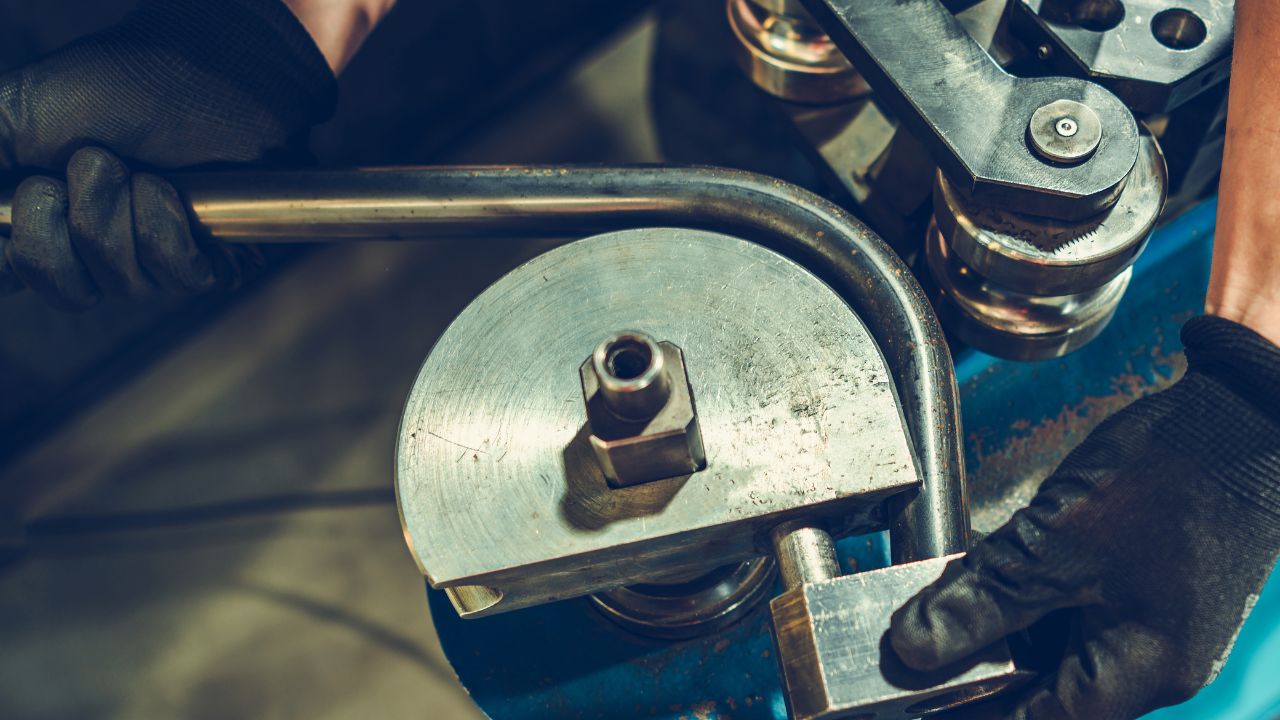
Rotary draw bending clamps the tube and pulls it around a fixed-radius die while a mandrel supports the inner wall. This method prevents collapse and wrinkling in thin-walled tubes during tight-radius bends. The technique achieves the tightest bend radii available—often less than two times the tube diameter—making it ideal for complex shapes in limited spaces. Tooling includes a bend die, clamp die, pressure die, and mandrel working in coordination for controlled bends.
Laser Tube Cutting Services for Precision
Laser cutting uses focused beams to cut, engrave, and shape tubes with exceptional accuracy. The non-contact process creates intricate features impossible with traditional methods, including through-holes as small as the wall thickness and channels that facilitate subsequent bending and welding. Fiber lasers handle most metals versatilely, while CO2 lasers suit niche materials like titanium. Laser power measured in watts determines cut depth and speed—higher wattage enables faster, deeper cuts. The semi-to-fully automated process accommodates tube diameters from 0.5 to 6.0 inches with wall thicknesses up to 0.5 inches. Thin kerf width minimizes material waste. Limitations include restriction to thin-walled materials and occasional discoloration halos from backsplash near cut edges.
What’s the Difference Between Pipe Bending and Tube Bending Services?
Pipes and tubes differ fundamentally in their intended purpose and manufacturing specifications. Understanding these distinctions determines which bending service matches your project requirements and budget constraints.
Key Structural and Material Differences Between Pipes and Tubes
Pipes are measured by nominal inside diameter and designed for fluid or gas transport under pressure. Wall thickness varies within schedule ratings (Schedule 40, 80, etc.). Tubes are specified by exact outside diameter and wall thickness, engineered for structural loads and precise dimensional tolerances. Tubes maintain tighter tolerances on roundness, concentricity, and wall uniformity. This precision makes tubes suitable for applications where exact fit and structural integrity matter more than flow capacity.
Impact of Geometry and Design on Bending Techniques
Tubes accommodate complex geometries and intricate features that pipes cannot achieve. Laser cutting creates design elements impossible with traditional methods, enabling multi-plane bends, integrated mounting tabs, and precise notching. Tube bending supports tighter radius requirements and multiple bends in single pieces without compromising structural performance. Pipe bending prioritizes maintaining flow characteristics and pressure ratings over geometric complexity.
Cost, Precision, and Time Efficiency of Pipe Bending vs. Tube Bending
When to Choose Pipe Bending Service vs. Tube Bending Service
Choose pipe bending for fluid transport systems where flow capacity and pressure ratings drive specifications. CNC tube bending delivers unparalleled precision, consistency, and efficiency for structural and mechanical applications. Automated quality control reduces production costs through minimized rework and inspection requirements. Projects requiring tight tolerances, complex geometries, or aesthetic finish quality demand tube bending services.
Choosing the Right Service Based on Material Properties and Requirements
Material selection directly impacts manufacturing process, final product performance, and overall cost. Steel suits heavy-duty applications requiring maximum strength despite added weight. Aluminum serves weight-critical projects needing corrosion resistance. Stainless steel combines strength with corrosion protection for harsh environments. Copper provides thermal conductivity for heat transfer applications. Specialty alloys like titanium deliver optimal strength-to-weight ratios for high-performance requirements. Match material properties—strength, weight, corrosion resistance, bendability—to application demands for cost-effective solutions.
How Do CNC Tube Bending Services Enhance Manufacturing?
CNC tube bending transforms raw material into precision components through automated control systems. This technology eliminates human variability while increasing throughput, accuracy, and repeatability across production runs.
The Role of CNC Technology in Tube Bending
CNC technology has revolutionized tube fabrication by delivering unparalleled precision, consistency, and efficiency. Programmed instructions control every aspect of positioning, rotation, and bend angles. Digital designs feed directly into the machine’s control system, eliminating manual setup errors and operator-dependent results. This automation removes skill variability from the equation, producing identical parts regardless of shift or operator.
Benefits of Using CNC Tube Bending Services for Complex Geometries
CNC bending excels at intricate shapes and multiple bends in single pieces without compromising structural integrity. Every bend replicates exactly, ensuring part-to-part consistency across entire production runs. Advanced sensors and feedback systems monitor operations in real-time, detecting deviations instantly and making immediate corrections. This closed-loop control minimizes post-bend inspections and rework, reducing quality control costs while maintaining tight tolerances on complex geometries.
Integrating Laser Tube Cutting Services with CNC Tube Bending for Enhanced Precision
Laser cutting complements CNC bending by preparing tubes with features that improve bend quality and enable complex designs. Pre-cut channels facilitate easier bending in tight-radius applications while reducing springback. Laser-cut through-holes as small as the wall thickness eliminate secondary drilling operations. The non-contact process creates intricate features and complex geometries without tool wear or material deformation. Thin kerf width minimizes material waste. Semi-to-fully automated laser systems match CNC bending’s high throughput and repeatability, creating integrated manufacturing cells that reduce handling and lead times.
Custom Pipe Bending Services: When and Why You Need It
Standard pipe bending equipment handles common angles and radii, but custom projects demand specialized capabilities. Custom pipe bending services address unique specifications that off-the-shelf solutions cannot accommodate.
Tailoring Pipe Bending Services to Meet Specific Project Needs
Custom pipe bending addresses non-standard dimensions, materials, or geometries beyond typical production equipment capabilities. Projects requiring large-diameter pipes, compound bends, or exotic alloys need tailored tooling and processes. Site-specific installations often demand custom bend angles to navigate existing infrastructure or architectural constraints. Prototype development and low-volume specialty applications justify custom services when standard parts increase assembly complexity or system costs.
The Importance of Working with Top Pipe Bending Companies for Custom Solutions
Experienced pipe bending companies possess the engineering expertise and equipment range to solve complex bending challenges. Top providers offer material testing, bend simulation, and prototype validation before full production. They maintain quality certifications required for regulated industries like petrochemical, pharmaceutical, and food processing. Established companies invest in specialized tooling and can recommend design modifications that improve manufacturability while meeting performance requirements.
Benefits of Partnering with Custom Pipe Bending Specialists for Unique Designs
Custom specialists reduce project risk through proven problem-solving experience with difficult materials and geometries. They provide design consultation early in the engineering phase, preventing costly redesigns after tooling investment. Specialists maintain relationships with material suppliers, accessing specialty alloys and expedited delivery when timelines are tight. Their quality documentation and traceability support compliance requirements. Long-term partnerships enable predictable lead times, consistent quality, and responsive support for evolving project needs.
Pipe Bending Vs. Tube Bending: Which Do You Need for Your Project?
Selecting between pipe and tube bending services depends on application requirements, material properties, and production volume. Matching the right process to your project parameters optimizes cost and performance.
Factors to Consider When Selecting Pipe Bending Services or Tube Bending Services
Application Needs (Automotive, Aerospace, Industrial, etc.)
Aerospace applications demand aluminum for weight reduction and specialty alloys like titanium for high-performance structural components. Automotive projects use aluminum tubes for weight-critical chassis and exhaust systems. Medical device manufacturing requires stainless steel for corrosion resistance and biocompatibility. Marine environments need stainless steel’s corrosion protection against saltwater exposure. Food-grade processing equipment specifies stainless steel to meet sanitation standards. Plumbing and HVAC systems rely on copper pipes for thermal conductivity in heat transfer applications. Racing applications justify specialty alloys for maximum strength-to-weight ratios in safety-critical roll cages and suspension components.
Material Strength and Flexibility Requirements
Aluminum’s high ductility enables tight-radius bends without cracking, ideal for complex geometries. Steel delivers maximum strength and durability for heavy-duty structural loads despite added weight. Specialty alloys like titanium and chromoly provide exceptional strength-to-weight ratios but resist bending, requiring specialized equipment and expertise. Material selection balances strength, weight, corrosion resistance, and bendability against project constraints. Higher strength materials typically reduce bendability and increase tooling costs.
How to Decide Based on Manufacturing Volume
One-Off Jobs vs. Mass Production
Manual and semi-automatic methods suit low-volume custom work and prototypes where setup costs outweigh production efficiency. CNC bending and laser cutting deliver high throughput through semi-to-fully automated processes, justifying investment for medium to high production volumes. Automated systems ensure consistency across production runs, eliminating part-to-part variation that manual methods introduce. Volume thresholds typically favor automation above 50-100 parts, though complex geometries may justify CNC for smaller batches.
Long-Term Cost-Effectiveness in Production Runs
Automated quality control minimizes post-bend inspections and rework, reducing per-part labor costs in high-volume production. Laser cutting’s minimal material waste improves material utilization rates compared to traditional cutting methods. CNC bending’s consistent accuracy eliminates variability-driven waste and reduces scrap rates. Initial automation investment amortizes across production volume—higher volumes achieve faster return on equipment costs. Long production runs benefit from reduced setup time per part and predictable cycle times that improve scheduling accuracy.
The Benefits of Laser Tube Cutting and CNC Tube Bending Services
Laser tube cutting and CNC bending represent the current standard in precision tube fabrication. These technologies deliver measurable improvements in accuracy, waste reduction, and production consistency over conventional methods.
How Laser Tube Cutting Services Improve Cutting Precision and Reduce Waste
Laser cutting delivers highly complex, clean, and precise cuts with exceptional accuracy, speed, and efficiency. The thin kerf width minimizes material waste compared to mechanical cutting methods that remove wider material paths. Lasers create through-holes as small as the tube’s wall thickness, eliminating secondary drilling operations. The process accommodates stainless steel, aluminum, and various steel alloys without tooling changes. Non-contact cutting prevents material deformation and burr formation, reducing finishing requirements.
Enhancing Quality and Consistency with CNC Tube Bending Services
CNC bending delivers consistent accuracy across multiple bends, ensuring every part matches specifications. Advanced sensors and feedback systems detect deviations in real-time and make immediate adjustments to maintain accuracy. Automated quality control minimizes post-bend inspections by preventing defects during production rather than catching them afterward. Every bend replicates identically from first part to last, eliminating the variation inherent in manual methods. This consistency produces higher quality output while reducing rework costs and material waste.
How Integrating CNC Tube Bending with Robotic Welding Elevates Product Quality
Laser-cut channels and precision notches facilitate easier welding by providing exact fit-up and improved access for welding equipment. CNC-bent tubes arrive at welding stations with consistent geometry, enabling robotic welders to execute programmed weld paths without manual adjustment. This integration creates fully automated fabrication cells where tubes move from cutting to bending to welding with minimal handling. Reduced human touchpoints lower contamination risk and improve weld consistency. Automated systems maintain detailed production data for quality traceability and process optimization.
Key Challenges in Pipe and Tube Bending and How to Overcome Them
Pipe and tube bending face persistent technical challenges that affect dimensional accuracy and production efficiency. Material behavior, process limitations, and operator variability create quality control obstacles that modern technologies increasingly address.
Managing Springback and Material Deformation in Both Bending Methods
Springback occurs when bent material partially returns to its original shape after bending force is removed, causing dimensional inaccuracy. The effect varies by material type, wall thickness, bend radius, and bending method. Thinner walls and tighter radii increase springback severity. Overbending compensates by exceeding the target angle to achieve correct final dimensions after springback. Material deformation includes wall thinning on the outer radius, wall thickening on the inner radius, and cross-section ovalization. Mandrels support tube interiors during bending to prevent collapse and maintain roundness in thin-walled applications.
How Advanced Technologies Like CNC Bending and Laser Cutting Mitigate Common Issues
Advanced sensors and feedback systems in CNC bending detect deviations from programmed parameters and make immediate adjustments during the bend cycle. Real-time monitoring ensures accuracy by compensating for springback and material variations automatically. Automated quality control minimizes defects and rework by preventing errors rather than catching them post-production. Laser cutting’s non-contact process eliminates tool pressure and mechanical stress that cause material deformation. This prevents work hardening and dimensional changes that traditional cutting introduces.
Overcoming Limitations in Traditional Pipe and Tube Bending Methods
Traditional methods rely on operator skill, introducing part-to-part variability based on experience level and technique consistency. Manual bending lacks the repeatability automated CNC processes provide across production runs. CNC benders eliminate human variability by following programmed instructions identically for every part. Laser cutting creates features difficult or impossible with traditional sawing, drilling, or plasma cutting methods. Complex notches, compound angles, and intricate patterns that require multiple setups and tools in conventional fabrication execute in single automated operations with laser systems.
CRD MFG, Inc. Expertise in Pipe and Tube Bending Services
CRD MFG, Inc. combines advanced fabrication technologies with precision engineering expertise. Their integrated approach to pipe and tube bending addresses complex manufacturing challenges across diverse industries.
How CRD MFG, Inc. Provides Reliable and Precise Pipe and Tube Bending Services
Laser Tube Cutting Services and CNC Tube Bending Integration
CRD MFG, Inc. integrates laser cutting with CNC bending to enable complex geometries that single-process operations cannot achieve. Laser-cut channels facilitate easier bending by reducing material stress in tight-radius applications. This combined approach offers minimal material waste and high precision through coordinated toolpaths and fixtures. Both processes operate semi-to-fully automated for consistency, eliminating handling errors between operations and reducing lead times through streamlined workflow.
Custom Pipe Bending Services Offered by CRD MFG, Inc. for Complex Designs
CRD MFG, Inc. produces intricate shapes with multiple bends in single pieces, eliminating welded joints that add weight and potential failure points. Their CNC technology enables complex geometries without sacrificing structural integrity or dimensional accuracy. Equipment accommodates tubes from 0.5 to 6.0 inches outer diameter with wall thicknesses up to 0.5 inches, covering common specifications across automotive, industrial, and architectural applications. This capability range handles both standard production parts and custom prototype development.
Why CRD MFG, Inc. Stands Out Among Pipe Bending Companies for Customer Satisfaction and Quality
Automated quality control at CRD MFG, Inc. minimizes post-bend inspections and rework, reducing project timelines and costs. Advanced sensors provide real-time monitoring for accuracy, catching and correcting deviations during production rather than after completion. High throughput and repeatability from automated processes support both small custom orders and large production runs with consistent quality. Lower production costs through reduced waste and rework translate to competitive pricing without compromising precision or delivery schedules.
Choosing the Right Bending Service for Your Needs
Selecting between pipe and tube bending services requires evaluating application demands against available technologies and capabilities. The right choice balances performance requirements with production economics.
Summary of Pipe Bending vs. Tube Bending
Key differences between pipe and tube bending relate to structural requirements, material properties, and precision needs. Pipes serve fluid transport applications where flow capacity and pressure ratings dominate specifications. Tube bending particularly suits applications requiring complex geometries and tight tolerances for structural or mechanical functions. Material selection—steel, aluminum, stainless steel, copper, specialty alloys—impacts both process choice and final product performance. Each material’s bendability, strength-to-weight ratio, and corrosion resistance determines its suitability for specific applications and bending methods.
Final Decision Factors in Selecting the Appropriate Service
Consider required strength, weight, corrosion resistance, and bendability when matching materials to application demands. Production volume affects technology choice, with automated CNC and laser systems justified at higher volumes while manual methods suit prototypes and low-volume custom work. Application requirements across automotive, aerospace, medical, marine, and industrial sectors influence both material and process selection. Cost-effectiveness depends on precision requirements, production volume, and material waste reduction potential. Projects demanding tight tolerances and complex geometries favor automated processes despite higher setup costs.
How CRD MFG, Inc. Can Help You with Pipe Bending Services or Tube Bending Services
CRD MFG, Inc. employs advanced CNC and laser cutting technologies that deliver precision, consistency, and efficiency across diverse fabrication projects. Automated processes ensure high quality with lower production costs through reduced waste and rework. Their capability range handles diverse materials and complex geometries from 0.5 to 6.0 inches outer diameter with wall thicknesses up to 0.5 inches. Real-time monitoring and quality control systems minimize defects during production rather than catching them after completion. This integrated approach supports both custom prototypes and high-volume production runs with consistent results and competitive lead times.
Partner with CRD MFG, Inc. for Precision Pipe and Tube Bending
CRD MFG, Inc. delivers precision pipe and tube bending solutions backed by advanced CNC and laser cutting technology. Whether you need custom prototypes or high-volume production runs, their integrated fabrication approach ensures consistent quality, tight tolerances, and competitive lead times.
Their equipment handles materials from aluminum to specialty alloys in diameters from 0.5 to 6.0 inches. Real-time quality monitoring and automated processes minimize waste while maximizing accuracy. Don’t risk project delays or quality issues with inadequate fabrication capabilities. Contact CRD MFG, Inc. today to discuss your pipe and tube bending requirements—along with certified tube welding services—and discover how their expertise transforms complex specifications into reliable, precision-bent components.