
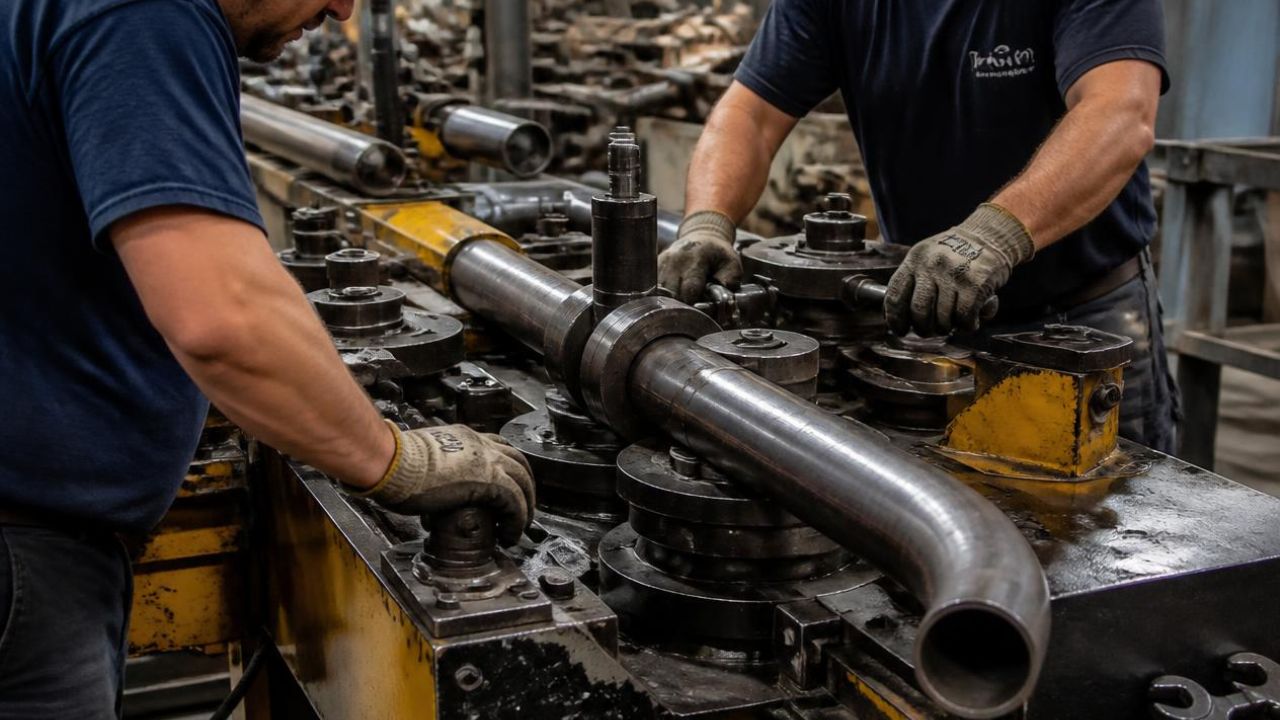
Effective tube assembly project management determines the difference between profitable fabrication and costly production delays. Coordinating material procurement, tooling setup, manufacturing workflow, and quality inspection requires structured planning and disciplined execution. Tube fabrication serves high-stakes applications in aerospace, automotive, and industrial equipment where component failure carries severe consequences. Project managers must balance competing demands for speed, precision, and cost control while maintaining regulatory compliance.
Key Takeaways
- Tube assembly project management follows five critical stages from initiation through closure to ensure quality and timeline adherence
- Material costs represent 45-55% of total project budgets, while labor accounts for 20-40% of expenses
- Robotic welding achieves defect rates under 2% in automated tube fabrication processes
- North America leads global tube assembly demand at 35%, followed by Europe at 28%
- The Precision Steel Tube Market will reach USD 8.96 billion by 2034 at 4.48% CAGR
What Are Tube Assembly Services and Their Market Landscape?
Tube assembly services integrate cutting, bending, welding, and finishing operations to produce precision components for pressure systems. These services transform raw tubing into functional assemblies meeting specific dimensional and performance requirements. The global precision steel tube market was valued at USD 6.04 billion in 2025. This market will expand to USD 8.96 billion by 2034 at 4.48% CAGR.
What Segments and Applications Define Tube Fabrication?
Tube fabrication serves diverse industrial applications requiring pressure-rated fluid transfer and structural support components. Fuel injection systems demand tight tolerances and corrosion-resistant materials for automotive and aerospace engines. Oil and gas industry applications utilize high-strength assemblies for drilling, extraction, and refining operations. Power generation facilities require heat-resistant tubing for boiler systems and steam distribution networks. Heat exchanger applications depend on precision-bent tubes to maximize thermal transfer efficiency in HVAC systems.
Which Industry Leaders Shape the Competitive Environment?
Five major manufacturers dominate the aerospace tube assembly sector through advanced capabilities and certification portfolios. PFW Aerospace in Germany specializes in complex hydraulic and fuel system components for commercial aircraft. Leggett & Platt operates extensive U.S. manufacturing facilities serving automotive and aerospace markets with high-volume production. Parker Hannifin delivers precision fluid conveyance systems across aerospace, industrial, and mobile equipment segments. Eaton Corporation manufactures hydraulic and fuel delivery assemblies from its Ireland headquarters for global distribution. Arrowhead Products provides specialized tube assemblies for defense and commercial aerospace applications requiring stringent quality control.
What Buyer Preferences Influence Tube Assembly Procurement?
Quality and reliability score highest at 95/100 among buyer decision criteria for tube assembly procurement. Component failure in high-pressure aerospace applications creates catastrophic safety risks and regulatory consequences. Price competitiveness ranks second at 88/100 importance as manufacturers seek cost reduction without sacrificing performance. Lead time receives 82/100 priority from buyers operating in just-in-time manufacturing environments with minimal inventory buffers. Technical support during design phases earns 76/100 importance for complex geometries and material selection guidance. Certifications achieve 71/100 relevance as baseline requirements for regulated industries like aerospace and medical devices.
Why Is Project Management Critical in Tube Assembly Fabrication?
Tube assembly fabrication demands coordinated oversight across design, tooling, production, and inspection to prevent costly rework. Poorly managed projects experience scope creep, budget overruns, and schedule delays that erode profit margins. Structured tube assembly project management establishes clear objectives, resource allocation, and accountability throughout the production cycle. Typical manufacturing cycles span 3-5 weeks from initial planning through final delivery and quality verification.
What Are the Key Stages of Manufacturing Project Management?
Manufacturing project management progresses through five sequential stages, ensuring systematic execution and quality control. Initiation defines project scope, identifies stakeholders, conducts feasibility analysis, and establishes success criteria for deliverables. Planning develops detailed roadmaps, creates Work Breakdown Structures, allocates resources, implements capacity planning, and develops risk mitigation strategies. Execution transforms plans into production, manages resources, implements daily standups, and tracks real-time progress against targets. Monitoring compares actual progress to plan, tracks KPIs, measures quality metrics, and enables early course correction. Closure formalizes project completion, secures stakeholder acceptance, documents lessons learned, and archives project documentation for future reference.
Which Critical Success Factors Drive Project Outcomes?
Critical Success Factors represent essential elements determining manufacturing project management effectiveness and final outcomes. Project manager leadership drives team alignment, stakeholder communication, and proactive problem resolution throughout production phases. Top management support ensures adequate resource allocation and removes organizational roadblocks impeding progress toward project goals. Detailed upfront planning prevents downstream delays and cost overruns by identifying potential obstacles before production begins. Clear and realistic goals prevent scope creep from unclear objectives that expand deliverables beyond original specifications. Adequate financial support maintains continuous execution without process interruptions that disrupt assembly scheduling and delivery commitments.
How Does Integrated Coordination Improve Manufacturing Efficiency?
Integrated tube manufacturing consolidates cutting, forming, welding, and inspection operations under single-source accountability for streamlined production. This approach reduces handoffs between vendors, shortens timelines, and tightens process control compared to fragmented supply chains. Robotic welding achieves defect rates under 2% in automated tube fabrication environments where consistency determines component reliability. Automated processes eliminate human variability in critical joining operations while maintaining documentation for quality traceability and certification requirements.
How Do Tube Fabrication Categories Differ by Manufacturing Method and Use?
Tube assembly categories are distinguished by production techniques that determine structural properties, pressure ratings, and application suitability. Manufacturing methods impact material integrity, cost structures, and dimensional capabilities for different industrial requirements. Seamless tubes offer superior strength for high-pressure applications, while welded tubes provide cost advantages in larger diameters. Material selection influences bending characteristics, corrosion resistance, and thermal performance across diverse operating environments and regulatory standards.
What Distinguishes Seamless from Welded Tube Assemblies?
Seamless tubes are formed by extruding or piercing a solid billet of steel, then elongating and sizing it without a weld seam. This manufacturing method creates uniform strength throughout the tube wall with superior pressure capacity and fewer defects. Welded tubes are produced by rolling a flat steel plate or strip into a cylindrical shape and welding the seam longitudinally or helically. Welded construction offers lower costs and wider size availability up to 100+ inches compared to seamless tubes, typically limited to 24-inch diameters. Seamless tubes provide better performance in critical applications but command premium pricing due to complex manufacturing and material waste.
When Are ERW and Mandrel-Bent Assemblies Applied?
ERW tubes utilize Electric Resistance Welding with high-frequency current to heat and fuse edges without filler material. This process delivers cost-effective solutions for low-to-medium pressure applications requiring consistent quality in fuel injection and hydraulic systems. Mandrel-bent assemblies incorporate an internal steel rod inserted during bending to prevent tube collapse or deformation in tight-radius applications. Without specialized mandrels, tight-radius bends develop wrinkling that compromises flow characteristics and structural integrity in performance-critical components. Tight radii require slower bending speeds, while 3D bends need precise rotational control to maintain dimensional accuracy across multiple planes.
How Do Pricing Tiers Reflect Tube Fabrication Types?
Equipment investment requirements establish distinct pricing tiers based on automation capabilities and precision levels for tube fabrication operations. Entry-level equipment ranges from $10,000 to $18,000 for basic automation and limited feature sets in low-volume production. Mid-range equipment costs $20,000 to $32,000, offering higher capacity and advanced features for increased throughput and complexity. High-capacity equipment spans $35,000 to $49,000, supporting complex bends, multiple axes, and mandrel support for precision applications. Custom industrial systems exceed $100,000 with full automation, advanced control, and orbital welding capabilities for aerospace-grade production. Aerospace assemblies run 5:1 to 10:1 higher than commercial equivalents due to specialized alloys and extensive documentation requirements.
What Key Cost Drivers Affect Pricing in Tube Assembly Projects?
Cost drivers in tube assembly projects stem from material specifications, geometric complexity, tolerance requirements, and production volume factors. Understanding these variables enables accurate budgeting and realistic project success expectations for fabrication timelines. Material costs represent 45-55% of total project budgets, while labor accounts for 20-40% of expenses in typical fabrication operations. Tooling and equipment consume 5-10% of budgets, with overhead and facilities adding another 5-10% to final pricing.
How Do Material and Tooling Impact Costs?
Material selection determines both raw stock expenses and required bending force for forming operations across different alloy specifications. Thicker walls add material cost and require larger equipment setups capable of generating sufficient force for plastic deformation. Custom alloys require minimum order quantities that increase per-piece costs in low-volume production runs compared to standard grades. Non-standard radii demand custom-machined tooling, representing significant portions of quotes for prototype and limited-production jobs requiring specialized dies.
What Role Do Part Complexity and Tolerances Play?
Part complexity drives pricing through geometric requirements ranging from simple single-plane bends to multi-axis compound assemblies. A single 90-degree bend costs significantly less than multi-plane assemblies requiring rotational repositioning and sequential forming operations. Tight tolerances of ±0.005 inches versus standard tolerances of ±0.030 inches require higher-end machinery and custom checking fixtures. Precision requirements necessitate extensive documentation, including PPAP reports, FAIR certifications, and CMM inspection data for regulatory compliance and quality verification.
How Do Quantity, Secondary Operations, and Lead Time Influence Pricing?
Production quantity determines per-piece costs through setup time distribution across total output volumes in tube fabrication operations. Prototype runs and low volumes carry higher per-piece costs because programming and tooling setup spread across fewer finished components. High-volume production enables efficiency gains and tooling amortization that reduce unit costs through economies of scale. Expedited delivery requires overtime labor or rush surcharges, particularly when custom tooling must be fabricated on accelerated schedules. Secondary operations like welding, brazing, threading, flaring, coating, and pressure testing add labor and equipment time to final costs.
How Is Project Planning Implemented to Balance Quality, Cost, and Schedule?
Project planning establishes detailed roadmaps balancing quality standards, budget constraints, and delivery timelines through structured coordination strategies. Resource allocation and capacity planning prevent bottlenecks while risk mitigation strategies address potential disruptions before production begins. Designing custom tube assemblies requires engineering collaboration between fabricators and clients to optimize manufacturability while meeting performance specifications. Effective planning reduces costly downstream changes and maintains project momentum through systematic execution protocols.
What Resource and Capacity Planning Practices Are Used?
Work Breakdown Structures decompose complex tube assembly projects into manageable tasks with clear deliverables and timeline assignments. This detailed planning component identifies resource requirements, potential conflicts, and critical path dependencies affecting overall project duration. Capacity planning allocates equipment time, labor hours, and material procurement across concurrent projects to prevent resource contention and scheduling conflicts. Typical manufacturing cycles run 3-5 weeks from initial material receipt through final inspection and delivery to customer facilities. Overhead and facilities costs represent 5-10% of project budgets absorbed into labor and equipment rates for comprehensive pricing.
How Are Risks Mitigated Through Scheduling and Contingencies?
Risk mitigation strategies identify potential disruptions, including material delays, equipment failures, and quality issues, before they impact delivery schedules. Process interruptions from inadequate financial support create cascading delays affecting downstream operations and client commitments in time-sensitive production environments. Contingency planning builds buffer time into critical operations and maintains backup supplier relationships for essential materials and services. Catastrophic failure in high-pressure and aerospace applications demands rigorous quality protocols that prevent defective components from reaching final assembly. Schedule buffers account for inspection holds, rework requirements, and unforeseen technical challenges discovered during production phases.
What Performance Indicators Monitor Progress and Quality?
Schedule Performance Index tracking compares actual progress against planned timelines to identify delays requiring corrective action or resource reallocation. This metric enables project managers to quantify schedule variance and communicate status to stakeholders with objective data. Cost Performance Index tracking measures budget utilization efficiency by comparing earned value to actual costs incurred during production phases. Quality control protocols monitor dimensional accuracy, surface finish, and weld integrity through systematic inspection at critical manufacturing milestones, ensuring specification compliance.
What Best Practices Enhance Coordination and Quality Control in Tube Fabrication?
Best practices in tube fabrication integrate single-source accountability, automated processes, rigorous inspection, and continuous stakeholder communication for consistent results. These coordination strategies reduce handoffs, minimize errors, and maintain transparency throughout production cycles from initial design through final delivery. Reducing tube fabrication lead times requires streamlined workflows that eliminate unnecessary process steps while preserving quality checkpoints and documentation requirements. Systematic approaches prevent miscommunication and ensure all parties maintain aligned expectations regarding specifications, timelines, and deliverables.
How Do Single-Source Accountability and Automation Reduce Defects?
Single-source accountability consolidates design, fabrication, and inspection under unified project management, eliminating coordination gaps between multiple vendors. This approach establishes clear responsibility for outcomes while reducing communication overhead and potential specification misinterpretation across organizational boundaries. Robotic welding achieves defect rates under 2% through consistent heat input, precise positioning, and repeatable process parameters, eliminating human variability. Automated systems maintain detailed production logs documenting process parameters for every weld, enabling traceability and continuous improvement through statistical analysis.
What Inspection and Documentation Standards Ensure Compliance?
AS9100 certification for aerospace applications mandates rigorous quality management systems covering design, production, and inspection throughout the manufacturing lifecycle. This standard requires documented procedures, calibrated measurement equipment, and comprehensive traceability for materials and processes used in critical components. Aerospace requires specialized alloys and extensive documentation, including material certifications, process validation records, and dimensional inspection reports for regulatory compliance. Local tube bending services provide direct access to engineering support and faster response times for design modifications compared to offshore manufacturing alternatives.
How Does Continuous Communication Support Stakeholder Alignment?
Daily standups provide real-time progress updates, identify emerging obstacles, and facilitate rapid problem resolution among cross-functional team members. These brief coordination meetings maintain project momentum by addressing issues before they escalate into schedule-impacting delays or quality concerns. Stakeholder communication protocols establish regular reporting intervals with standardized formats covering schedule status, budget performance, and quality metrics for decision-making. Proactive communication prevents surprises, builds trust, and enables collaborative problem-solving when technical challenges or scope changes arise during production.
How Do Consumer Demographics and Market Trends Shape Fabrication Strategies?
Consumer demographics reveal distinct geographic concentrations, organizational sizes, and procurement priorities influencing tube fabrication service offerings and capabilities. Market trends indicate sustained growth in precision tube demand driven by aerospace expansion, automotive electrification, and infrastructure modernization initiatives. North America leads with 35% of the global customer base, followed by Europe at 28% and Asia-Pacific at 22%. Medium enterprises represent 35% of customers, while large corporations account for 32% of the total demand for tube assembly services.
What Geographic and Organizational Profiles Dominate Demand?
Geographic distribution shows 42% of customers located in urban metro areas, with another 28% in suburban regions near manufacturing hubs. Industrial clusters account for 18% of customer locations, while rural areas represent only 12% of the total demand for tube fabrication. Medium enterprises with 51-500 employees comprise the largest customer segment requiring flexible production capabilities from prototype through medium-volume production. Large corporations with 500-5,000 employees demand consistent quality, extensive documentation, and proven capacity for high-volume production runs meeting aerospace and automotive standards.
How Do Lead Times and Customization Needs Vary by Sector?
Aerospace applications prioritize quality and certification over speed, with lead times extending 6-12 weeks for complex assemblies requiring extensive documentation. These projects demand specialized alloys, tight tolerances, and rigorous inspection protocols that justify premium pricing and extended timelines. Automotive production favors rapid turnaround with typical lead times of 2-4 weeks, supporting just-in-time manufacturing and frequent design iterations. Industrial equipment applications balance cost, quality, and delivery speed based on project criticality and production volume requirements across diverse specifications.
What Emerging Markets Present Growth Opportunities?
The Precision Steel Tube Market will reach USD 8.96 billion by 2034 at 4.48% CAGR, driven by infrastructure investment and automotive demand. Asia-Pacific growth at 6.5% CAGR outpaces global averages, reflecting rapid industrialization and manufacturing capacity expansion in emerging economies. North America’s growth at 6.3% CAGR demonstrates sustained demand from aerospace, energy, and advanced manufacturing sectors requiring precision components. The Aerospace Tube Assemblies Market, valued at USD 2.0 billion in 2024, indicates strong specialized segment growth supporting commercial aircraft production and defense applications.
Project Management and Coordination Strategies for Success in Tube Assembly Services
Successful tube assembly fabrication integrates structured project management with proven coordination strategies that align stakeholder expectations and manufacturing capabilities. The five-stage project management framework—initiation, planning, execution, monitoring, and closure—provides systematic oversight, preventing scope creep and budget overruns. Critical success factors, including project manager leadership, top management support, and detailed planning, establish foundations for positive outcomes. Understanding cost drivers enables accurate budgeting, while performance tracking identifies variances requiring corrective action before they impact delivery commitments.
Single-source accountability through integrated manufacturing consolidates operations under unified project management, eliminating coordination gaps and vendor handoffs. Automation technologies like robotic welding achieve defect rates under 2% while maintaining comprehensive documentation for quality traceability and certification requirements. As the precision tube market expands toward USD 8.96 billion by 2034, manufacturers embracing structured project management and advanced automation will capture growing demand across aerospace, automotive, and industrial sectors. CRD MFG delivers integrated tube assembly services combining laser cutting, CNC bending, robotic welding, and inspection under dedicated project management for streamlined production.
Stop Losing Time to Vendor Handoffs and Production Surprises
Fragmented workflows across multiple suppliers create the coordination gaps, missed deadlines, and quality variances that derail tube assembly projects. CRD MFG, Inc. consolidates laser tube cutting, professional CNC tube bending, robotic welding, and precision inspection under one roof, with a dedicated project manager who owns your project from initiation through final delivery. That single point of contact keeps your schedule, budget, and quality requirements aligned at every stage. Reach out to us to talk through your next fabrication requirement and how integrated project management can shorten lead times and keep your production on track.
