
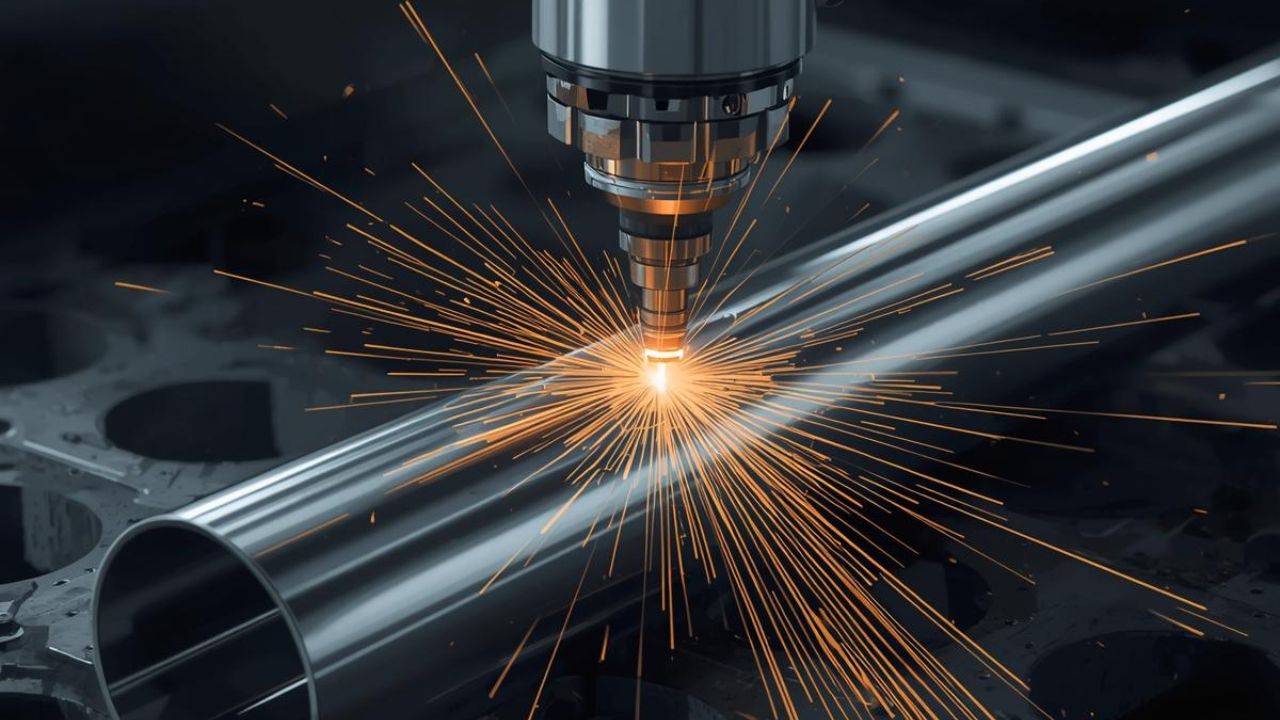
Tube laser cutting has fundamentally changed how manufacturers process metal tubing. One machine now replaces what used to require sawing, drilling, milling, and deburring across multiple setups. The result is faster production, tighter tolerances, and lower per-part costs across aerospace, automotive, medical, and industrial applications. With the global tube assembly market projected to reach $20.23 billion by 2033, laser tube cutting is no longer an upgrade, it’s the baseline for competitive manufacturing. This guide breaks down the key applications, precision capabilities, industry use cases, and emerging trends driving adoption.
Key Takeaways
- Tube laser cutting reduces total processing time by up to 83% compared to traditional saw-and-drill methods, completing in 25 minutes what conventional approaches take 150 minutes to finish.
- CNC laser systems hold positioning tolerances within ±0.005 inches and cut minimum hole diameters as small as 0.002″ — delivering five times the precision of traditional methods.
- Cost savings on complex parts range from 25–50%, driven by labor reductions (40%), material savings (25%), reduced rework (20%), and faster throughput (15%).
- Aerospace, automotive, and medical sectors are the primary beneficiaries, with combined market value exceeding $30 billion and strict certification requirements (AS9100, IATF 16949, ISO 13485) that laser cutting’s precision and repeatability directly support.
- Equipment payback periods range from 10 to 18 months, and the shift to fiber lasers cuts operating costs to one-third to one-fifth of CO₂ equivalents while delivering 2–5× faster cutting speeds on thin metals.
What Are the Leading Applications of Tube Laser Cutting in Today’s Manufacturing Landscape?
Tube laser cutting applications now span nearly every manufacturing sector. The technology replaces multiple traditional processes with a single setup, driving the global tube assembly market from $12.5 billion in 2024 toward a projected $20.23 billion by 2033. From automotive exhaust systems to aerospace hydraulic lines, these machines handle complex geometries on diverse materials in a single pass. The sections below examine how each sector applies the technology and what drives adoption.
Tube Laser Cutting Is Revolutionizing Modern Manufacturing Through Single-Setup Processing
A high-powered, CNC-controlled laser beam vaporizes metal while assist gases clear the cut path. The result is clean, finished edges with little to no secondary processing. This eliminates sawing, drilling, milling, and deburring in one operation — reducing processing times by up to 80% compared to traditional methods.
Modern manufacturing uses for laser tube fabrication extend across a wide material range. These systems cut stainless steel, aluminum, copper, brass, titanium, and even non-metals like wood and plastic. Profile versatility is equally broad: round tube, square tube, angle, rectangular, beam, formed, and custom extruded shapes all run on the same machine.
Key Industry Use Cases Include Automotive, Aerospace, Construction, Energy, and Medical
The precision cutting benefits of laser tube cutting serve demanding sectors across the board. In automotive, manufacturers produce chassis parts, roll cages, exhaust systems, and fuel lines — a market segment expected to reach $6.16 billion by 2025. Aerospace applications include structural tubes, wing supports, and fuel systems, with direct diode lasers handling superalloys like Inconel and Hastelloy.
Construction and architecture rely on laser-cut structural frames, railings, staircases, and decorative facades. Energy and oil & gas use cases cover pipeline fabrication, heat exchangers, and custom fittings. Furniture manufacturers cut table frames, chair legs, and decorative panels. Agricultural equipment uses laser-cut slots and holes in structural tubing. Medical devices demand high-tolerance components with exceptional cleanliness. Military applications include armored plates and components from hardened steel, titanium, and Kevlar.
How Does Laser Tube Cutting Enhance Precision in Manufacturing?
Laser tube cutting delivers repeatable accuracy that traditional methods cannot match. CNC-controlled systems hold positioning tolerances within ±0.005 inches and produce features five times more precise than conventional approaches. That precision advantage applies across material types and tube profiles, from thin-wall stainless steel to heavy-wall titanium. The capability to cut complex features without repositioning the workpiece eliminates the cumulative error that plagues multi-step processes.
Laser Tube Fabrication Achieves Tolerances as Tight as ±0.005 Inches Across Complex Geometries
CNC laser precision reaches ±0.1 mm compared to ±0.5 mm or worse with traditional cutting. Thermal cut features hold ±0.010″–0.015″, and minimum hole diameters go as small as 0.002″ (~50 microns). Systems handle round tubes up to 10 inches in diameter and lengths up to 26 feet, with bevel cutting capability up to 45°.
What sets laser tube fabrication apart is single-setup versatility. One machine performs complex profile cutting for slots, holes, notches, and contours. It handles miter cuts for tube-to-tube joining, end profiling for weld preparation, feature cutting for bolt holes and mounting tabs, and marking or engraving for part identification — all without repositioning the workpiece.
Laser Tube Cutting Outperforms Traditional Methods by 83% in Total Processing Time
Head-to-head benchmarks tell a clear story. Processing 100 pipes, laser cutting completes the job in 25 minutes versus 150 minutes for traditional saw-and-drill methods — an 83% total time reduction. Setup drops from 20 minutes to 5. Cutting falls from 60 minutes to 15. Drilling time disappears entirely because the laser handles it during the cut cycle. Handling time drops from 30 minutes to 5.
Real-world results confirm the data. A UK manufacturer cut per-pipe processing from 30 minutes to under 10 — a 67% reduction. A Southeast Asia operation achieved 15% material cost savings through tighter nesting and zero-tail cutting. Beyond speed, laser cutting eliminates secondary operations like drilling, milling, and deburring, removing entire process steps and their associated labor and tooling costs.
Choose laser tube cutting when your parts require complex profiles, tight tolerances, or multi-feature processing in a single setup. Choose traditional saw-and-drill methods only when budgets are extremely constrained and part geometry is simple — straight cuts with no holes, slots, or contours.
How Does CNC Machining Integrate with Laser Tube Cutting?
Laser tube cutting and CNC machining serve different but complementary roles. Together, they form a complete production workflow that handles everything from raw profile cutting to precision-finished components. Laser cutting excels at profile geometry and high-speed material removal, while CNC machining handles finishing, threading, and tight-tolerance detail work. Pairing the two eliminates gaps between rough cutting and final part specifications.
Laser Tube Cutting Handles Profile Geometry While CNC Machining Delivers Finishing Precision
The division of labor is straightforward. Laser tube cutting manages complex profile geometry — slots, holes, contours, and miters — while CNC machining delivers tight-tolerance finishing, threading, and detail work on metal and plastic materials. Manufacturers with on-site tooling shops bridge the two workflows through rapid custom tool development.
Modern laser systems automate what used to require manual setup. Smart Profile Detection loads complicated geometries without operator intervention. SeamLine Tube technology reads weld seams and markings to align tubes correctly before the first cut. Intelligent cutting heads use slim nozzles for inner edges and magnetic coupling for collision protection. FocusLine maintains consistent focus position across material types and thicknesses, while PierceLine controls piercing for small, precise holes — protecting both machine and material.
CNC Laser Cutting Improves Production Speed by 30–70% Through Automation and Zero Tool Changes
The production speed benefits of CNC laser cutting start at setup. Automated loading systems like TRUMPF’s LoadMaster Tube accommodate up to 4 tons of raw material and minimize changeover time. One laser cuts different material types, wall thicknesses, and profile geometries with no tool changes required.
Fiber lasers push throughput further. A 4kW fiber laser cuts 1mm stainless steel at over 30 meters per minute — roughly triple the speed of an equivalent CO₂ system. Overall cutting speeds improve 30–70% over conventional methods. In one benchmark, a Senfeng SF6012PLUS processed 533 raw tubes into 3,198 finished parts across a single 16-hour shift — approximately 9 tons of material. Software platforms like TRUMPF TruTops streamline programming with built-in design aids, keeping downtime between jobs minimal.
What Are the Advantages of Laser Tube Cutting in Manufacturing Efficiency?
The advantages of laser tube cutting center on doing more with less, fewer operators, fewer process steps, less waste, and lower per-part costs. The efficiency gains compound across every stage of production. From reduced labor headcount and minimized scrap to faster cycle times and eliminated secondary operations, the efficiency case for laser tube cutting is built on measurable, compounding returns at every production stage.
Laser Tube Cutting Increases Output While Reducing Labor by Up to Two-Thirds
Automation is the primary driver. A workshop that previously required three operators may need only one with a laser cutter — yielding annual wage savings of CNY 190,000–240,000. Precision of ±0.1mm minimizes rework and material waste, saving thousands of dollars per year.
Advanced nesting optimization utilizes most of the workpiece, reducing scrap significantly. Parts come off the machine ready for use or assembly, limiting or eliminating secondary processing. Some systems, like the TRUMPF TruLaser Tube, form threads directly during cutting, removing downstream handling and storage steps entirely.
Cost Savings on Complex Parts Range from 25–50% Compared to Conventional Methods
The cost advantages of laser tube cutting break down across four categories: labor savings account for roughly 40% of total reductions, material savings contribute 25%, reduced rework adds 20%, and faster throughput delivers the remaining 15%.
These savings come from consolidation. One machine integrates cutting, drilling, milling, notching, and marking — eliminating the need for multiple vendors and secondary operations. That single-source capability compresses both timelines and overhead.
Downstream efficiency matters too. Ergonomic unloading systems use conveyor tables at working height with material buffers and gentle part ejection, reducing damage and handling costs. Intelligent sensors detect correct part ejection automatically, ensuring process reliability and cutting quality rejects. When every step from raw tube to finished part runs through fewer machines, fewer hands, and fewer transfers, the cumulative cost reduction reshapes what’s economically viable — especially for complex geometries that would otherwise require extensive manual fabrication.
Which Industries Benefit the Most from Laser Tube Cutting?
Aerospace, automotive, and medical manufacturing drive the highest demand for laser tube cutting. Each sector requires tight tolerances, certified quality systems, and specialized materials that laser technology is uniquely positioned to deliver. The common thread across these sectors is that precision failures carry outsized consequences — from grounded aircraft to recalled medical devices. Laser cutting’s repeatability and traceability make it a natural fit for regulated manufacturing environments.
Aerospace and Medical Devices Demand the Tightest Tolerances in Laser Tube Cutting
Aerospace tube assemblies require tolerances as tight as ±0.0005″–0.015″ and pressure ratings of 3,000–5,000+ PSI. AS9100 Rev D certification is mandatory. Key materials include titanium alloys like Ti 6Al/4V Grade 5, 316L stainless steel, and nickel alloys such as Alloy 625. The aerospace tube assemblies market reached $669.5 million in 2024 with 9.1% year-over-year growth, projected to hit $923.2 million by 2034 with a cumulative sales opportunity of $8.35 billion.
Medical devices match aerospace in precision demands — tolerances as fine as ±0.0005 inches with surface finishes of Ra 32 or better for standard applications, Ra 20 for pharmaceutical, and Ra 15 for ultra-pure. ISO 13485 certification is required. Biocompatible materials include 316L stainless steel, titanium, and PEEK. This market was valued at $11 billion in 2023, growing at 8.5% CAGR toward $19.5 billion by 2030.
Laser Tube Cutting Supports Aerospace Hydraulics, Automotive Exhaust Systems, and Medical Instrumentation
Aerospace applications span hydraulic lines, fuel systems, pneumatic controls, and environmental control systems. AN 37-degree flare fittings are the predominant connection type — mismatched flare angles risk catastrophic failure.
Automotive manufacturers use laser-cut tubes for exhaust systems in 409/439 stainless steel rated to 1,700°F, plus cooling circuits, fuel rails, brake lines, and DOM tubing chassis components. Production volumes range from 10,000 to over one million units annually under IATF 16949 compliance. This segment reached $5.79 billion in 2024.
Medical applications include surgical instrument shafts, catheter tubing, hospital bed frames, and IV stands. The FDA aligned its QMSR with ISO 13485 effective February 2026. The broader precision tubes market serving all three sectors is valued at $24.4 billion in 2025, projected to reach $32.5 billion by 2032.
What Future Trends Can Be Expected for Tube Laser Cutting in Manufacturing?
The laser tube cutting market is projected to nearly triple from $6.85 billion in 2025 to $18.43 billion by 2034 at a 12% CAGR. Three forces are driving that growth: fiber laser adoption, Industry 4.0 integration, and domestic reshoring. Each trend builds on the others: fiber lasers enable the speed that makes reshoring cost-competitive, while Industry 4.0 platforms optimize that speed into predictable, data-driven production outcomes.
Fiber Laser Adoption and AI-Driven Automation Are Reshaping Laser Tube Cutting Technology
The shift from CO₂ to fiber lasers is accelerating. Fiber lasers cut thin metals 2–5× faster, run at 30–40% wall-plug efficiency versus 8–12% for CO₂, and last over 100,000 hours compared to 20,000–30,000. Operating costs drop to one-third to one-fifth of CO₂ equivalents.
Industry 4.0 is layering intelligence onto that speed advantage. Smart factories now integrate AI-driven process optimization, real-time data analytics, predictive maintenance, and automated material handling through AGVs and conveyor systems. Equipment capabilities continue expanding — TRUMPF’s TruLaser Tube series handles diameters up to 254 mm, BLM GROUP systems reach 610 mm diameter and 18-meter lengths, and Bodor Laser pushes power to 12,000W. Asia Pacific leads adoption with 37.60% global market share in 2025.
Long-Term Benefits Include Fast ROI, Reshoring Enablement, and Leaner Inventory Operations
Equipment payback periods range from 10 to 18 months depending on tier: entry-level systems ($60K–$100K) return investment in roughly 18 months, mid-range ($100K–$150K) in 14, and high-end ($150K–$200K+) in as few as 10 months with full automation.
Laser cutting’s speed and flexibility directly support the reshoring trend, which shortens lead times by 30–40% and reduces total landed costs by 12–20%. Fiber laser energy efficiency and nesting optimization align with growing sustainability mandates.
The downstream impact extends to inventory management. Laser cutting’s rapid turnaround enables JIT delivery programs that reduce carrying costs by 20–25% and lead times by 35–45%. VMI systems achieve 25–30% carrying cost reductions. Given that inventory carrying costs typically consume 25–55% of total inventory value annually, these compounding efficiencies reshape the entire cost structure.
Choose fiber laser systems when cutting metals — the speed, efficiency, and lifespan advantages are decisive. Choose CO₂ lasers only when your primary materials are non-metals like wood, acrylic, or plastics. For equipment investment, choose entry-level systems for shops entering tube laser cutting with moderate volume, and choose high-end systems when full automation and large-diameter capacity drive your ROI timeline below 12 months.
When to Choose CRD MFG for Tube Laser Cutting
Choose CRD MFG when your project demands a single manufacturing partner who can handle the full workflow — from laser tube cutting and CNC bending to robotic welding and CNC machining — under one roof with one dedicated project manager. Our 22,500-square-foot facility in Placentia, California supports everything from one-off prototypes to large production runs with advanced inspection technology including Faro Arm measurement and VTube inspection software.
CRD MFG may not be the right fit for extremely high-volume commodity runs where overseas pricing is the sole decision factor. We serve manufacturers who value precision, communication, and domestic production reliability over lowest-bid sourcing.
Partner with CRD MFG, Inc. for Precision Tube Fabrication
CRD MFG, Inc. delivers full-service tube laser cutting, CNC tube bending, robotic welding, and CNC machining from our 22,500-square-foot facility in Placentia, California. Every project gets a dedicated project manager — one point of contact from concept through production. Whether you need certified aerospace tube fabrication services, a one-off prototype, or a large production run, we bring the advanced technology and hands-on expertise to handle complex geometries, tight tolerances, and demanding timelines. Request a quote today and see what precision manufacturing partnership looks like.
