
Key Takeaways
- Measurement Standards Differ: Tubes use exact outside diameter and wall thickness for structural applications. Pipes use nominal inside diameter and schedule for fluid/gas transport.
- Precision vs. Cost Trade-off: Tube bending achieves ±0.1mm to ±0.25mm tolerances with complex mandrel tooling. Pipe bending offers simpler tooling and lower costs with reduced precision.
- Industry-Specific Applications: Aerospace, automotive, and medical sectors require tube bending precision. Oil and gas, HVAC, and infrastructure projects benefit from pipe bending efficiency.
- CNC Integration Advantages: Real-time measurement systems enable tight tolerances, automated workflows, and consistent repeatability for both tube and pipe bending processes.
- Laser Cutting Enhancement: Integrated laser systems create features before or after bending, eliminate secondary operations, improve accuracy to ±0.1mm, and reduce production time.
Tube and pipe bending equipment serve distinct manufacturing needs. Understanding the differences prevents costly mistakes in material selection, tooling investment, and project execution. Tubes deliver precision for structural applications—such as aerospace hydraulics, automotive chassis, and medical devices—while pipes efficiently transport fluids and gases in infrastructure and HVAC systems.
The equipment, processes, and tolerances differ significantly. Tube benders, commonly used in tube and pipe bending services, employ complex mandrel-supported rotary draw systems, achieving ±0.1mm tolerances. Pipe benders, on the other hand, utilize simpler ram or roll bending techniques for cost-effective high-volume production.
CNC technology enhances both processes. This guide clarifies when each equipment type fits your project requirements, covering applications, advantages, laser cutting integration, and selection criteria for optimal fabrication results.
What’s the Difference Between Tube Benders and Pipe Benders?
Tube and pipe benders serve different fabrication needs. Tubes prioritize precision and structural integrity. Pipes focus on fluid transport and cost efficiency. The equipment, tooling, and processes differ significantly.
Tube Benders: How They Work and What They Do
High-precision tube benders use rotary draw bending. The process employs multiple dies and a mandrel that supports the tube’s interior during the bend. This prevents collapse and wrinkling, enabling tight radii and smooth internal finishes. CNC tube benders integrate real-time measurement and feedback systems for exact specifications.
Common tube bending materials include titanium, Inconel, high-strength stainless steel, and specialized aluminum alloys. Medical applications require biocompatible materials like stainless steel and titanium.
Pipe Benders: How They Work and What They Do
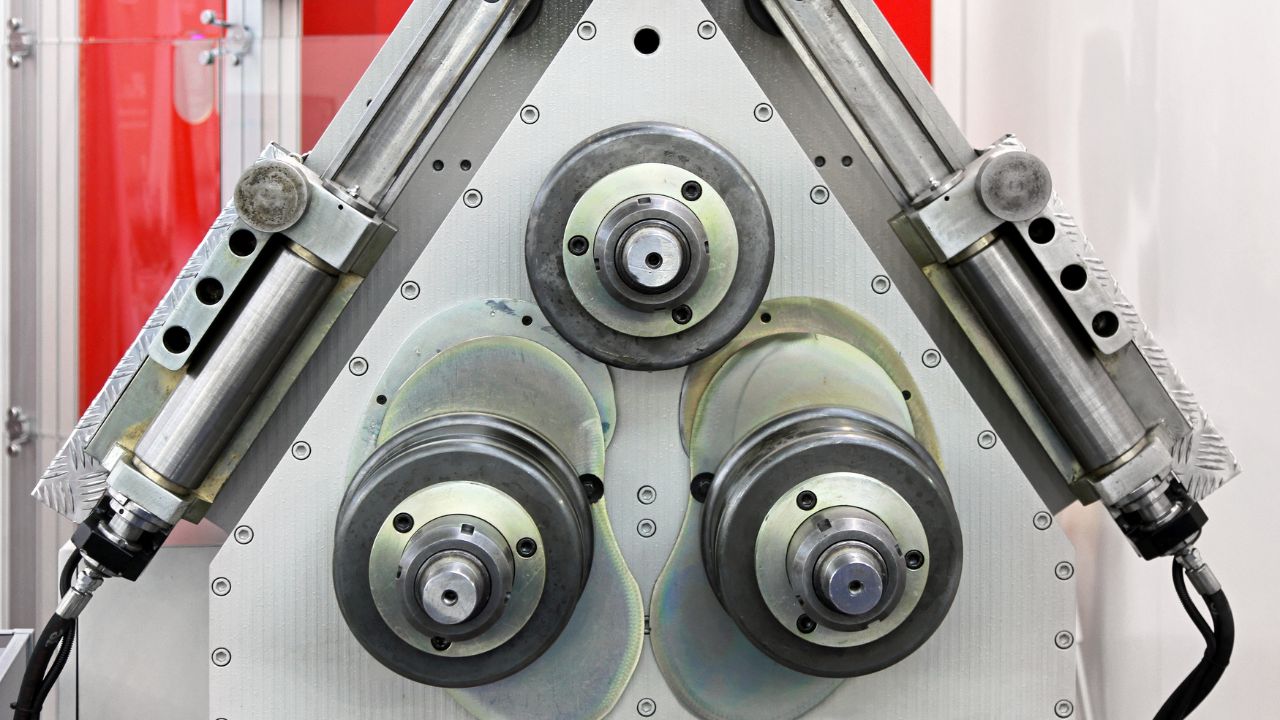
Pipe benders handle heavy-walled pipes and larger diameters. Most use ram bending or roll bending—simpler, more cost-effective processes with lower precision requirements. Tooling consists of basic forming dies and backup rollers.
Pipe bending materials are selected for strength-to-weight ratios, corrosion resistance, and temperature tolerance. Material choice depends on the fluids or gases being transported.
Core Differences in Design and Function
Pipes are measured by nominal inside diameter (ID) and wall thickness schedule. Tubes use exact outside diameter (OD) and specific wall thickness measurements. Pipe bender tooling is simple—forming dies and backup rollers. Tube bender tooling is complex—bend die, clamp die, pressure die, wiper die, and mandrel.
Pipes transport fluids and gases. Tubes serve structural applications requiring precise dimensions and superior finish quality. Tube bending maintains smooth internal surfaces critical for fluid flow applications. Pipe bending offers cost savings for less precision-critical work.
Applications of Tube and Pipe Benders in Industry
Tube and pipe bending serve distinct industrial sectors. Tube bending meets high-precision demands across automotive, aerospace, medical, and architectural applications. Pipe bending supports infrastructure and transport industries requiring durability and volume efficiency.
Industries that Rely on Tube Bending Services
Automotive manufacturers use tube bending for exhaust systems, roll cages, chassis components, fuel lines, hydraulic lines, and suspension systems. Aerospace applications include hydraulic systems, fuel delivery lines, cooling systems, and structural supports that withstand extreme temperatures, pressures, and vibrations. Medical device fabrication demands precision tube bending for surgical instruments, diagnostic systems, and hospital furniture—often requiring tolerances within ±0.1 mm.
Additional tube bending applications span marine shipbuilding for hydraulic systems, manufacturing for industrial conveyor belts, and construction for structural elements, handrails, and decorative architectural features. Each sector requires exact dimensional control and superior surface finish.
Industries that Rely on Pipe Bending Services
Oil and gas operations use pipe bending to create continuous pipelines that transport resources over vast distances. Modern bending techniques produce fewer welds, reducing potential leak points and enhancing safety and system integrity. HVAC systems rely on pipe bending for efficient installation and operation.
Pipe bending excels in high-volume production. The simpler, more cost-effective process handles heavy-walled pipes and larger diameters efficiently. Large-scale operations benefit from faster throughput and lower tooling complexity compared to precision tube bending.
CNC Tube Benders vs. CNC Pipe Bender: Which is Right for Your Project?
Project requirements determine equipment selection. CNC tube benders deliver precision for complex assemblies. CNC pipe benders provide cost efficiency for high-volume operations. Match equipment capabilities to tolerance demands, production volume, and application type.
Advantages of CNC Tube Benders
CNC tube benders achieve tolerances as precise as ±0.25 mm for aerospace and ±0.1 mm for medical applications. Real-time measurement and feedback systems ensure perfect fit and function within complex assemblies. The rotary draw process maintains smooth internal finishes, prevents collapse or wrinkling, and enables tight radii bending.
Custom fabrication benefits from rigorous quality controls. Materials undergo testing to verify properties. Certification and traceability requirements mandate detailed documentation from raw material sourcing through final inspection—critical for applications where slight deviations compromise system integrity.
Advantages of CNC Pipe Benders
CNC pipe benders excel in large-scale operations handling heavy-walled pipes and larger diameters. Ram bending and roll bending processes are simpler and faster than rotary draw methods, increasing throughput for high-volume manufacturing.
Cost-effectiveness stems from reduced complexity. Robust tooling uses basic forming dies and backup rollers rather than multi-component die sets. This simplicity lowers equipment costs and speeds production for applications without extreme precision requirements.
When to Use CNC Tube Benders or Pipe Benders
Select tube benders when projects require precise dimensions, high-quality finishes, or structural applications. Tolerance demands of ±0.1 mm (medical) or ±0.25 mm (aerospace) necessitate tube bending equipment. Choose tube benders when exact outside diameter specifications are critical.
Use pipe benders for fluid and gas transport applications. Simpler projects with relaxed precision requirements benefit from pipe bending’s cost advantages. Pipe benders are optimal when nominal inside diameter specifications and schedule-based wall thickness suffice. High-volume production of less precision-critical components favors pipe bending efficiency.
How Laser Tube Cutting Enhances Tube and Pipe Bending Services
Laser tube cutting integration transforms bending workflows. Combined systems eliminate secondary operations, improve accuracy, and reduce production time. The technology enables complex geometries impossible with traditional methods.
Integration of Laser Tube Cutting with CNC Tube Bending
Integrated systems use shared data between laser cutters and CNC benders. Software unfolds bent designs, maps features onto straight tubes, then laser cuts with ±0.1mm accuracy. CNC benders use identical data to bend precisely—features land exactly where specified with no misalignment. This eliminates trial-and-error and delivers repeatable parts immediately.
5-axis laser systems enable cuts in any direction. They create tabs, slots, holes, mitre cuts, and bevels in single passes. Parts become assembly-ready directly from cutting—no secondary drilling, sawing, or machining required. Material waste drops through intelligent nesting. Production speeds increase with automated workflows supporting both small batches and high-volume runs.
Enhancing Pipe Bending with Laser Cutting
Laser integration streamlines pipe bending for infrastructure and industrial applications. 5-axis cutting heads follow pipe profiles to create complex joints, connection holes, and mounting features. This reduces welds in pipeline systems, minimizing potential leak points and improving system integrity.
Tilting laser heads cut tapered holes at angles up to 45°, eliminating post-bending drilling operations. Systems handle large-diameter pipes (up to 240mm) and lengths to 12 meters. Noncontact cutting requires minimal fixturing compared to traditional sawing or machining. The integrated process cuts before cold bending or roll bending—faster total production with fewer operations and no separate machines needed.
What to Consider When Choosing Between Tube and Pipe Bending Services?
Equipment selection depends on application type, tolerance demands, and production volume. Match service capabilities to project specifications. Consider material requirements, cost constraints, and precision needs.
Project Requirements: Material Type, Precision, and Volume
Application determines equipment choice. Pipes transport fluids and gases. Tubes serve structural applications requiring precise dimensions and superior surface finish. Medical devices demand ±0.1mm tolerances. Aerospace components require ±0.25mm precision. Components facing extreme temperatures, pressures, and vibrations need tube bending’s tighter control.
Material selection drives process decisions. Titanium, Inconel, high-strength stainless steel, and specialized aluminum alloys require tube bending’s mandrel-supported rotary draw process. Smooth internal surfaces critical for fluid flow applications necessitate tube bending. Pipe bending offers cost advantages—simpler tooling with forming dies and backup rollers versus tube bending’s complex multi-die systems (bend die, clamp die, pressure die, wiper die, mandrel). Choose pipe bending for less precision-critical work at lower cost. Select tube bending when dimensional accuracy and finish quality justify higher tooling investment.
The Role of CNC Technology in Bending Services
CNC technology enables precision unattainable with manual methods. CNC tube benders integrate real-time measurement and feedback systems for perfect fit within complex assemblies. Rotary draw benders use mandrel support to prevent tube collapse and wrinkling during bending. This achieves tolerances as precise as ±0.25mm for aerospace and ±0.1mm for medical applications.
CNC pipe benders automate high-volume production with consistent results. Computer control eliminates human error, speeds throughput, and reduces material waste. Both tube and pipe CNC systems support rapid changeover, flexible batch sizes, and integration with automated loading systems. CNC technology transforms both processes from labor-intensive operations into efficient, repeatable manufacturing solutions.
Get Expert Tube and Pipe Bending Services from CRD MFG, Inc.
CRD MFG, Inc. delivers precision tube and pipe bending solutions tailored to your specifications. Our advanced CNC bending equipment handles complex geometries, tight tolerances, and diverse materials—from titanium and Inconel to stainless steel and aluminum alloys.
Whether you need aerospace-grade ±0.1mm precision or cost-effective high-volume pipe bending, our experienced team matches the right equipment to your project requirements. We integrate laser cutting services for complete fabrication workflows, reducing lead times and eliminating secondary operations. Contact CRD MFG, Inc. today for a quote. Our engineering team will assess your project, recommend optimal bending processes, and deliver quality parts on schedule.