Tube laser cutting and waterjet technology represent two primary metal fabrication methods used across industrial manufacturing sectors. Each technology delivers distinct advantages in cutting precision, speed, and material compatibility. Understanding fundamental differences enables manufacturers to select equipment aligning with production volume, material specifications, and quality standards.
The global laser cutting market reached USD 6.85 billion in 2025 and is projected to grow to USD 18.43 billion by 2034. Waterjet cutting systems maintain a smaller but growing market valued at USD 1.0-1.86 billion in 2025. Both technologies integrate with CNC automation systems to improve efficiency, reduce material waste, and maintain consistent quality.
Key Takeaways
- Tube laser cutting delivers speeds of 20-70 inches per minute with precision of ±0.001 inches for optimal performance on materials up to 2 inches thick
- Waterjet technology operates at 1-20 inches per minute but handles materials exceeding 6 inches thick without heat distortion
- Laser cutting equipment costs range from USD 20,000 to USD 500,000+, with operating costs of USD 8-15 per hour
- Waterjet systems require a USD 60,000 to USD 700,000+ investment with operating costs of USD 15-30 per hour
- CNC automation integration reduces setup time by 40-60% and increases production output by 30-50% across both technologies
What Are Tube Laser Cutting and Waterjet Technologies?
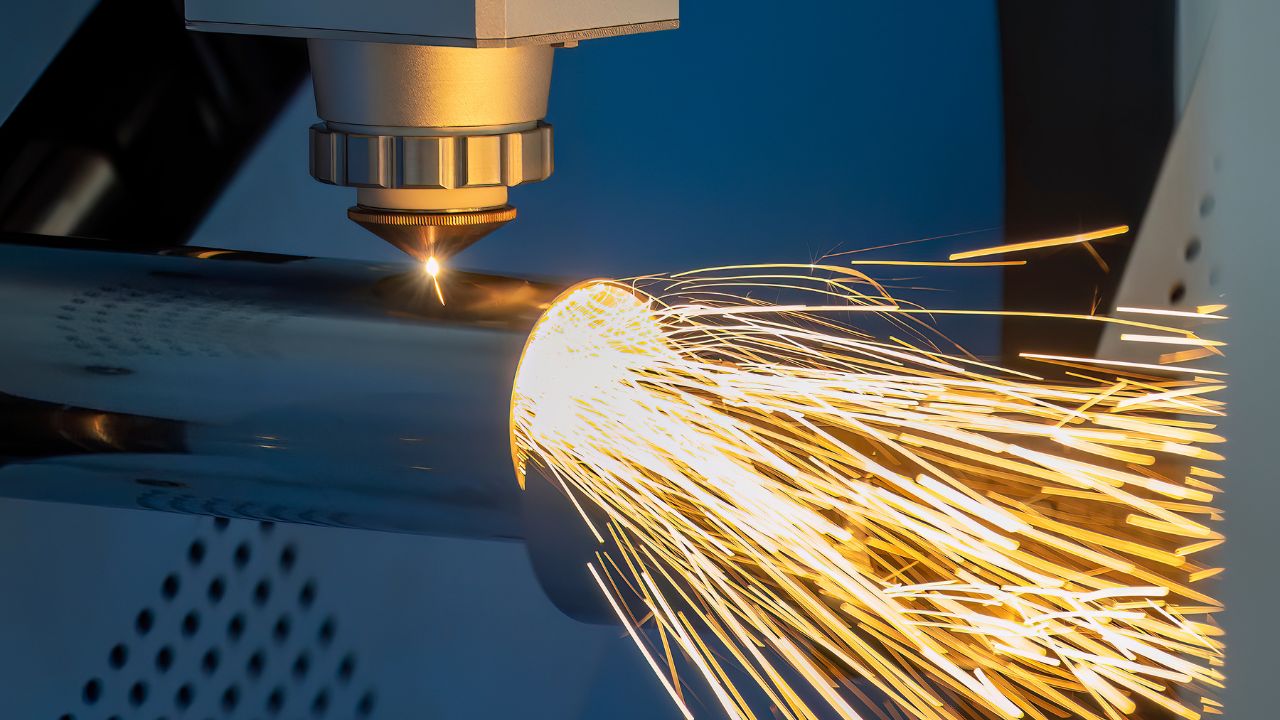
Tube laser cutting uses focused light energy to vaporize or melt material along programmed paths. Waterjet cutting employs high-pressure water streams mixed with abrasive particles to erode material through mechanical action. Both systems operate under computer numerical control for the precise execution of complex cutting patterns.
These metal fabrication methods differ fundamentally in their physical cutting mechanisms and thermal impact. Laser systems generate heat-affected zones while waterjet maintains cold cutting throughout. Each approach suits different material types, thickness ranges, and precision requirements.
How Does Tube Laser Cutting Work?
Fiber laser cutting operates at a 1.064 micrometer wavelength with 25-30% energy conversion efficiency. CO2 laser cutting functions at a 10.6 micrometer wavelength with 10-15% efficiency for processing non-metallic materials. The focused laser beam melts or vaporizes material, while the assist gas removes molten metal from the kerf.
Fiber lasers dominate current installations with over 70% market share due to superior speed and efficiency. CO2 systems maintain a 20-25% market share for specialized applications. Both technologies integrate with multi-axis CNC controls for complex three-dimensional cutting operations.
How Does Waterjet Cutting Operate?
Abrasive waterjet uses pressure of 55,000-90,000 PSI with garnet or aluminum oxide abrasive particles. Pure waterjet operates at 40,000-60,000 PSI without abrasives for soft materials. The high-velocity stream erodes material through mechanical abrasion rather than thermal energy.
Abrasive systems account for approximately 85% of industrial waterjet installations for metal cutting. Pure waterjet serves specialized sectors, including food processing and gasket manufacturing. Both configurations deliver cold cutting without thermal distortion or heat-affected zones.
What Materials Are Compatible with Each Technology?
Laser cutting processes steel, stainless steel, aluminum, copper, brass, and various alloys with optimal results. The technology also cuts non-metals, including acrylic, wood, and certain composites, depending on the laser type. Material compatibility varies between fiber and CO2 systems based on wavelength absorption characteristics.
Waterjet cuts virtually any material, including metals, stone, ceramics, glass, and composites. The cold cutting process prevents thermal damage in heat-sensitive materials and composites with different melting points. This universal material compatibility makes waterjet technology ideal for aerospace components and specialized manufacturing.
What Are the Key Differences Between Tube Laser Cutting and Waterjet Cutting?
Primary differences between tube laser cutting and waterjet technology involve speed, precision, material thickness, and operating costs. Laser systems deliver faster cutting speeds with tighter tolerances for materials under 2 inches thick. Waterjet excels in processing thick materials exceeding 6 inches without heat distortion.
Equipment costs vary significantly, with laser systems ranging from USD 20,000 to over USD 500,000. Waterjet installations require USD 60,000 to USD 700,000+, depending on system size. These capital investment differences influence technology selection based on production volume and specifications.
How Do Cutting Speed and Precision Compare?
Laser cutting speed reaches 20-70 inches per minute with precision of ±0.001 inches. Waterjet cutting speed ranges from 1-20 inches per minute with precision of ±0.003 inches. The speed differential makes laser cutting significantly more productive for high-volume thin material applications.
Laser kerf width measures 0.004-0.008 inches compared to the waterjet kerf of 0.040-0.060 inches. This narrower kerf reduces material waste and enables tighter nesting patterns. Laser systems also provide superior edge quality, requiring less secondary finishing.
What Are the Differences in Material Thickness and Heat Impact?
Laser cuts materials up to 1-2 inches thick with optimal efficiency. Waterjet cuts materials exceeding 6 inches thick while maintaining consistent quality. The cold cutting process eliminates heat-affected zones and thermal distortion completely.
Laser cutting generates minimal heat-affected zones in most metals but may cause warping in thin materials. Waterjet maintains material properties throughout cutting with no thermal stress or metallurgical changes. This distinction makes waterjet essential for aerospace applications and heat-sensitive composites.
How Do Equipment and Operating Costs Differ?
Laser equipment costs range from USD 20,000 for entry systems to over USD 500,000 for premium installations. Waterjet equipment requires USD 60,000 to USD 700,000+, depending on pressure capacity. Entry-level CNC tube systems cost USD 150,000-300,000 while premium systems exceed USD 750,000-2,000,000.
Laser operating costs average USD 8-15 per hour, including electricity, consumables, and maintenance. Waterjet operating costs reach USD 15-30 per hour primarily due to abrasive consumption and pump maintenance. These hourly cost differences significantly impact the total cost of ownership.
How Do Laser and Waterjet Cutting Fit Into Metal Fabrication Automation?
Both laser and waterjet technologies integrate with comprehensive CNC automation systems for improved production efficiency. Computer Numerical Control encompasses CNC mills, lathes, machining centers, and specialized equipment. Automation reduces setup time by 40-60% while increasing production output by 30-50%.
Modern fabrication cells combine cutting systems with rotary draw-bending machines featuring CNC control. Integration software coordinates material handling, cutting, bending, and quality inspection within single workflows. This approach minimizes labor requirements while maintaining consistent quality.
What Are the Roles of CNC Bending Software and Tube Fabrication Systems?
CNC bending software enables offline programming, simulation, and optimization before production. Basic software packages cost USD 5,000-15,000 while enterprise solutions require USD 500-2,000 monthly subscriptions. Bend-Tech PRO CAD/CAM software represents industry-standard solutions for tube bending programming and simulation.
Glenn Metalcraft achieved 14 hours saved per production cycle with 35% labor cost reduction through automation. A setup time reduction of 40-60% occurs with properly implemented CNC bending software solutions. These efficiency gains enable manufacturers to process more orders with existing capacity.
How Does Automation Enhance Cutting Efficiency and Quality?
Material scrap reduction reaches 20-40% with automated nesting and optimization algorithms. Production output increases 30-50% through reduced setup time and continuous operation. Labor cost reduction of 20-40% results from minimized manual handling.
Energy consumption decreases 10-20% with automated systems through optimized cutting parameters. Poor data costs companies USD 15 million annually on average. Automated systems capture real-time production data for continuous improvement and quality control analysis.
Which Industries Benefit Most from Each Technology?
Automotive manufacturers rely on laser cutting for precise body components and exhaust system fabrication. Aerospace sectors depend on waterjet technology for composite materials and thick aluminum structural components. HVAC manufacturers utilize both technologies depending on material thickness and volume.
Electronics production favors laser cutting for thin materials and intricate circuit board components. Medical device manufacturing employs both technologies, with laser preferred for stainless steel instruments and waterjet for specialized components. Multiple industries integrate these technologies within comprehensive fabrication workflows.
What Factors Influence Technology Selection in Metal Fabrication?
Technology selection depends on production volume, material specifications, precision requirements, and capital investment. High-volume operations with thin materials favor laser cutting for speed and precision advantages. Specialized applications involving thick materials or heat-sensitive composites require waterjet technology.
Regional factors, including labor availability, energy costs, and technical expertise, influence adoption patterns. Urban manufacturing centers demonstrate 70-75% adoption rates for advanced automation compared to 45-50% in rural locations. These variations reflect differences in workforce availability and capital access.
How Do Production Volume and Complexity Affect Choice?
High production volumes exceeding 1,000 units annually justify laser cutting investment through faster cycle times. Complex geometries requiring intricate features benefit from the laser precision of ±0.001 inches. Low-volume specialized production may favor waterjet despite slower speeds when material thickness exceeds laser capabilities.
Part complexity influences programming time and setup requirements for both technologies. CNC automation requires 18-36 month payback periods based on production volume. Manufacturers must evaluate total production requirements, including secondary operations.
What Is the Impact of Labor Availability and Capital Budget?
New UAW contract increases vehicle costs by USD 500-900 by 2028, driving automation adoption. Labor shortages in manufacturing push companies toward automated solutions despite higher initial capital requirements. Workplace injury costs reach USD 167 billion annually in the United States.
Capital budgets determine equipment selection between entry-level systems and premium fully automated production cells. Equipment longevity of 10+ years requires long-term planning for technology evolution. Maintenance costs consume 2-5% of equipment cost annually, including consumables, repairs, and preventive service.
How Do Regional and Demographic Preferences Shape Adoption?
Urban manufacturing adoption reaches 70-75% for advanced automation compared to rural adoption of 45-50%. Millennials represent 35% of technology decision-makers, while Generation X accounts for 45% and Baby Boomers 20%. Younger decision-makers demonstrate higher comfort with digital interfaces and cloud-based systems.
Asia Pacific investment typically ranges from USD 50,000 to 250,000 compared to the North America range of USD 100,000 to 500,000 per system. Regional preferences reflect different labor costs, energy prices, and production volume requirements. Europe emphasizes precision and sustainability, while Asia Pacific prioritizes cost-effectiveness and high-volume capability.
How Do Market Trends and Growth Projections Affect Laser and Waterjet Cutting?
The laser cutting market grows at 12% CAGR from USD 6.85 billion in 2025 to USD 18.43 billion by 2034. Waterjet cutting machines expand from USD 1.0-1.86 billion in 2025 to USD 2.39-3.6 billion by 2030. These growth rates reflect increasing automation adoption and expanding manufacturing capacity.
Market expansion driven by electric vehicle manufacturing, aerospace component production, and electronics miniaturization. The industrial automation and control systems market is projected to grow to USD 435.24 billion by 2030 at 10.5% CAGR. This broader automation trend supports continued investment in both technologies.
What Are the Current Market Sizes and Growth Rates?
The laser cutting market reached USD 6.85 billion in 2025 with projected expansion to USD 18.43 billion by 2034. The market demonstrates 12% CAGR, reflecting strong demand across the automotive and electronics sectors. Fiber laser systems capture over 70% market share while CO2 lasers maintain 20-25% share.
Waterjet cutting machines valued at USD 1.0-1.86 billion in 2025 project growth to USD 2.39-3.6 billion by 2030. Waterjet market grows at a CAGR of 6.72-8.5% with steady expansion in aerospace and composite applications. The smaller market size reflects specialized applications and slower cutting speeds.
Which Regions Lead in Technology Adoption?
Asia Pacific holds 37.60% of the laser cutting market share valued at USD 2.58 billion in 2025. North America maintains 28.00% market share, while Europe accounts for 19.40% of global installations. China projects a USD 1.37 billion laser market by 2026, with the United States reaching USD 1.4 billion.
Regional leadership reflects manufacturing capacity concentration in each geographic area. Japan projects USD 0.55 billion while India reaches USD 0.44 billion by 2026. Germany and the United Kingdom represent the primary European markets with projected values of USD 0.33 billion and USD 0.29 billion, respectively.
How Are Industry Consolidation and Emerging Technologies Shaping the Market?
Fiber laser technology captures 70%+ market share compared to the CO2 laser at 20-25%. OMAX holds 35-40% waterjet market share, while ESAB maintains 25-30%, and Flow International captures 20-25%. This concentration reflects consolidation trends and established brand preferences.
Equipment depreciation costs range from USD 20,000 to 100,000 annually, depending on system value. Larger manufacturers acquire specialized technology companies for vertical integration. Partnerships between equipment makers and software providers drive comprehensive automation solutions.
What Are the Operational Considerations for Implementing Tube Laser and Waterjet Cutting?
Operational considerations include maintenance requirements, safety protocols, programming complexity, and consumable supply chain management. Safety considerations with laser hazards require proper enclosures, interlocks, and operator training. Ongoing consumable costs include lenses and mirrors for laser systems.
Abrasive supply chain dependency affects waterjet operations with garnet or aluminum oxide requirements. Maintenance costs average 2-5% of equipment cost annually. These operational factors significantly impact the total cost of ownership beyond the initial capital investment.
What Are Maintenance and Safety Requirements?
Laser systems require regular optics cleaning, mirror alignment, and assist gas supply management. Waterjet systems need pump maintenance, nozzle replacement, and abrasive handling upkeep. Both technologies demand comprehensive operator training covering equipment operation, maintenance, and emergency shutdown.
Safety protocols must address laser eye protection, proper ventilation, and electrical safety. Waterjet operations require high-pressure system safety training, proper abrasive handling, and noise protection. Regulatory compliance includes OSHA workplace safety standards and industry-specific requirements.
How Do Setup Time and Programming Software Influence Productivity?
A setup time reduction of 40-60% occurs with advanced CNC bending software integration and offline programming. Poor data costs companies USD 15 million annually, requiring accurate programming and quality control. Modern CAD/CAM software enables rapid program changes between different part specifications.
Programming software interfaces with machine controllers for seamless file transfer and real-time adjustments. Simulation capabilities prevent collisions and validate programs before production, reducing scrap and equipment damage. These tools become essential for maintaining competitive productivity.
What Are the Typical ROI and Payback Periods?
CNC automation requires 18-36 month payback periods based on production volume and labor savings. Equipment depreciation costs range from USD 20,000 to 100,000 annually. Annual benefits include labor savings of USD 50,000-200,000 plus material waste reduction of USD 10,000-50,000.
Total annual costs encompass equipment depreciation, maintenance, software licenses, training, and consumables totaling USD 35,000-155,000. Five-year ROI typically reaches 150%-300% for properly implemented systems with adequate volume. These financial metrics guide capital investment decisions.
What Are the Advantages and Limitations of Tube Laser and Waterjet Cutting Technologies?
Both technologies deliver distinct advantages and limitations based on application requirements. Understanding these characteristics enables informed decision-making for equipment selection and process optimization. Manufacturing efficiency depends on matching technology capabilities to specific material requirements and production volumes.
High capital investment requirements represent common challenges across both implementations. Complex maintenance requirements demand skilled technical personnel and comprehensive training. Equipment longevity of 10+ years requires long-term strategic planning and periodic technology upgrades.
What Benefits Does Tube Laser Cutting Provide for Metal Fabrication?
Tube laser cutting delivers multiple advantages, including superior speed of 20-70 inches per minute for thin materials. Exceptional precision of ±0.001 inches enables intricate designs and tight tolerances. Minimal material waste results from narrow kerf widths of 0.004-0.008 inches for optimized nesting.
Lower operating costs of USD 8-15 per hour provide competitive advantages in high-volume production. Fast processing speeds enable shorter lead times and increased capacity. Excellent edge quality reduces or eliminates secondary finishing for many applications.
What Are the Strengths of Waterjet Cutting in Specialized Applications?
Waterjet cutting provides cold cutting without heat-affected zones or thermal distortion. Exceptional material thickness capability exceeding 6 inches suits specialized aerospace and structural applications. Universal material compatibility, including metals, stone, ceramics, and composites, eliminates multiple equipment requirements.
No secondary finishing requirements for many applications due to excellent edge quality. Heat-sensitive materials and composites with different melting points can be processed safely without thermal damage. Absence of toxic fumes or hazardous byproducts improves workplace safety and environmental compliance.
What Are the Common Disadvantages to Consider?
High capital investment requirements range from USD 60,000 to over USD 700,000 for waterjet systems. Complex maintenance requirements demand skilled personnel and a comprehensive spare parts inventory. Longer payback periods for low-volume operations may exceed 36 months.
Systems require skilled programming personnel familiar with CAD/CAM software and CNC operations. Equipment longevity of 10+ years requires long-term planning for technology changes. Operating costs, including consumables, maintenance, and energy, significantly impact the total cost of ownership.
Comparative Technology Insights and Strategic Recommendations for Tube Laser vs. Waterjet Cutting in Metal Fabrication
Tube laser cutting excels in high-volume production of thin materials requiring exceptional speed and precision. Waterjet technology serves specialized applications involving thick materials, composites, and heat-sensitive components. Manufacturers must evaluate material specifications, production volume, precision requirements, and capital availability when selecting technologies.
The optimal approach often involves integrating both technologies within comprehensive fabrication facilities for maximum flexibility. This multi-technology strategy enables processing diverse material types and thickness ranges within a single workflow. Capital investment decisions should consider 10+ year equipment lifecycles and evolving market requirements.
CRD MFG delivers integrated tube laser cutting and fabrication solutions through advanced equipment and comprehensive project management. Modern manufacturing requires strategic technology selection aligned with specific production requirements. Partnering with experienced fabrication specialists ensures optimal equipment selection and implementation for sustained competitive advantages.
Get Expert Guidance on Your Tube Cutting Project
Choosing between tube laser cutting and waterjet can stall a project when specs are tight and a wrong call means scrapped material or missed deadlines. CRD MFG, Inc. helps you match the right method to your part before production starts, with laser tube cutting, CNC tube bending, robotic welding, and full assembly handled under one roof in Placentia, California. You work with one dedicated project manager from quote to delivery, so you are never chasing updates across departments or absorbing last-minute surprises. Contact us to request a quote and talk through your material, thickness, and tolerance requirements.
