
Key Takeaways
- Rotary draw bending captures 39.1% of market share and delivers exceptional precision for tight-radius bends less than 1D
- Mandrel bending prevents tube collapse using internal steel rods during bending operations on thin-walled materials
- Roll bending gradually shapes tubes through adjustable rollers for large-radius structural applications
- CNC bending machines range from $15,000 entry-level systems to $1,000,000+ aerospace-grade equipment
- All-electric CNC systems reduce energy consumption by 50% compared to traditional hydraulic pressure systems
CNC tube benders revolutionize metal fabrication through Computer Numerical Control systems that automate complex bending tube operations. These pipe processing machines eliminate manual setup errors and deliver consistent results across high-volume production runs.
The global tube and pipe benders market reached USD 1.40 billion in 2025 and projects growth to USD 2.23 billion by 2033. CNC bending machines now dominate precision manufacturing sectors where tight tolerances and complex geometries drive equipment selection decisions.
What Are CNC Pipe Bending Machines and Their Purpose?
CNC pipe bending machines automate tube fabrication using programmable controllers that execute precise bending sequences without manual intervention. The CNC tube bending machine segment alone reached USD 3.1 billion in 2026 and continues expanding as manufacturers transition from hydraulic to all-electric systems.
All-electric machinery utilizes servo motors instead of traditional hydraulic pressure systems for cleaner operation and reduced maintenance. The market grows at a CAGR of 6.0% as automotive and aerospace industries demand repeatable precision across thousands of identical components.
How Does Rotary Draw Bending Work?
Rotary draw bending clamps the tube against a rotating bend die while a pressure die applies force along the outer surface. The tube is drawn around a fixed-radius die for precise geometry control throughout the entire bending radius.
This method captures 39.1% of market share because it delivers dimensional accuracy unmatched by compression bending or manual techniques. Rotary draw systems handle tight radii and complex multi-plane bends required in modern automotive and aerospace applications.
What Are the Advantages and Limitations of Rotary Draw Bending?
Rotary draw bending achieves tight radii less than 1D compared to compression bending’s poor accuracy and limited capability. This precision makes rotary draw the preferred method for exhaust systems, fuel lines, and structural components requiring exact specifications.
The technology requires specific tooling for each bend geometry, which increases initial setup costs and extends lead times for new configurations. However, manufacturers with high production volumes recover these investments rapidly through reduced scrap rates and eliminated rework.
Which Materials Are Compatible with Rotary Draw Bending?
Rotary draw bending processes stainless steel, carbon steel, aluminum, and high-strength aerospace alloys with consistent results across production runs. The method accommodates various material specifications, including thin-walled tubes that collapse under less controlled bending methods.
Both heat-supported and cold-forming procedures work with rotary draw systems, depending on material properties and bend requirements. Cold forming dominates production environments because it maintains material strength properties without introducing thermal distortion.
How Is Mandrel Bending Performed?
Mandrel bending inserts a solid or articulated steel rod inside the tube before the bending operation begins to prevent collapse and wrinkling. This internal support maintains cross-sectional integrity as CNC bending machines draw the tube around the die.
The mandrel travels through the tube during the bend and withdraws after completion of each operation. Fluid transfer lines and thin-walled aerospace components require mandrel support to maintain internal diameter consistency throughout the bend.
What Benefits and Challenges Are Associated with Mandrel Bending?
Mandrel bending produces superior bend quality compared to standard bending methods that allow wall thinning and ovality. This technology eliminates internal deformation that restricts fluid flow or compromises structural integrity in critical applications.
Increased setup time requirements and precise mandrel selection present operational challenges that extend cycle times versus non-mandrel operations. Proper lubrication between the mandrel and tube interior prevents surface damage while ensuring smooth mandrel withdrawal after each bend.
What Materials and Applications Require Mandrel Bending?
Fluid transfer lines need mandrel bending to prevent ovality that reduces flow capacity and creates pressure inconsistencies. Hydraulic systems, brake lines, and coolant passages depend on consistent internal diameters that only mandrel support can guarantee.
Aerospace applications require exotic alloys with zero margin for error in dimensional accuracy or surface finish. Titanium and Inconel tubing for aircraft fuel systems demand mandrel-supported bending to meet AS9100 quality standards.
What Is Roll Bending and When Is It Used?
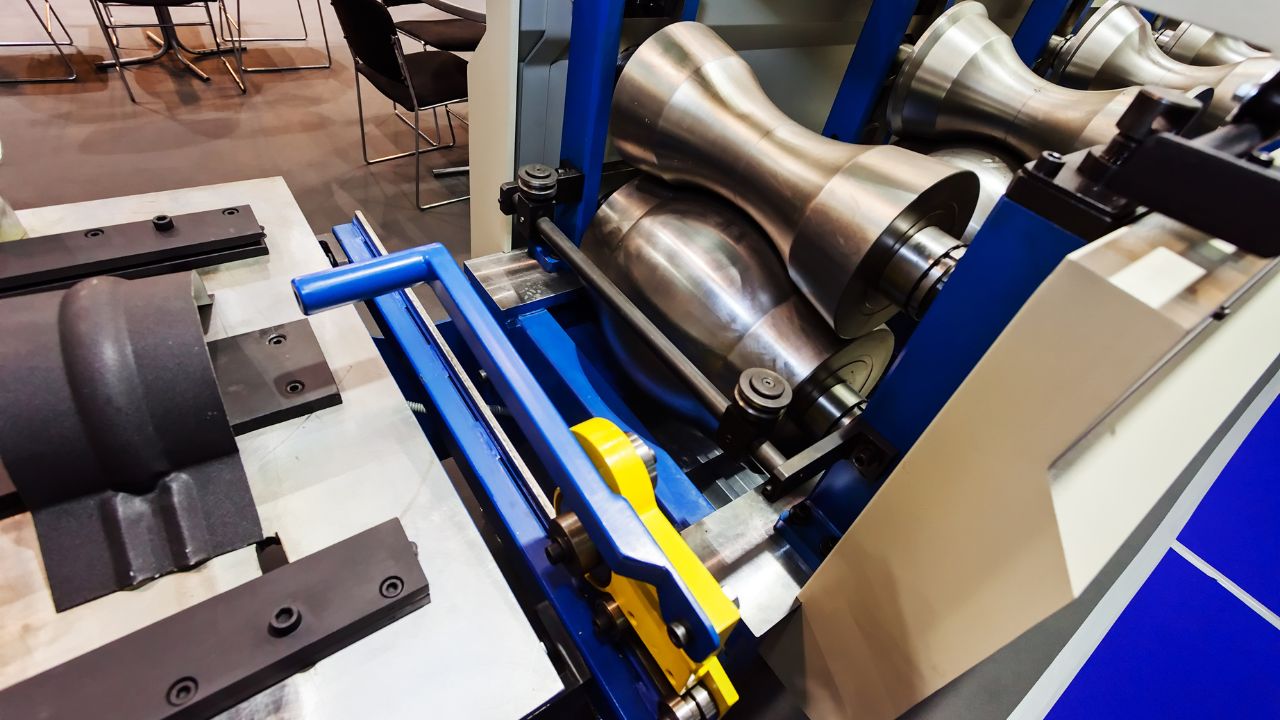
Roll bending passes the tube through three or four adjustable rollers that gradually apply pressure to achieve the desired curvature. The tube moves through a series of rollers for gradual pressure application rather than drawing around a fixed die.
Structural applications use roll bending for large-radius curves in architectural metalwork, handrails, and infrastructure projects. This method excels when bending radii exceed 3D and tight tolerances are less critical than achieving smooth, consistent curves.
How Does Roll Bending Compare to Other Methods?
Roll bending processes operate more slowly than rotary draw bending because material removal occurs incrementally across multiple roller passes. Each pass slightly increases curvature until the operator achieves the target radius through measurement and adjustment.
The method often requires trial-and-error adjustments that extend setup time compared to programmed CNC systems with simulation software. However, roll bending offers flexibility to process various tube sizes without changing expensive dedicated tooling, making it a practical option alongside precision tube bending methods for projects that prioritize large-radius curves over tight repeatability.
What Are the Key Differences Between Rotary Draw, Mandrel, and Roll Bending Machines?
Rotary draw bending delivers the highest precision for tight-radius bends, while mandrel bending prevents collapse in thin-walled tubes. Roll bending handles large-radius curves efficiently but sacrifices the dimensional control required for high-tolerance assemblies.
Equipment pricing reflects capability differences, with budget equipment ranging $15,000 to $50,000 for small shops and prototyping. Mid-range equipment costs $150,000 to $500,000 for medium manufacturers requiring automated loading and 3D simulation features, while premium equipment exceeds $500,000 for aerospace and high-volume precision applications with multi-axis capabilities.
How Do Consumer Priorities Influence CNC Pipe Bending Machine Selection?
Precision and accuracy represent paramount concerns for 37.5% of buyers evaluating CNC tube benders for production environments. Cost efficiency ranks second at 27.5% as manufacturers calculate Total Cost of Ownership rather than focusing solely on purchase price.
Production speed accounts for 22.5% of decision factors, while material compatibility represents 17.5% for shops processing diverse alloy specifications. These priorities shift based on industry sector, with aerospace emphasizing precision and automotive prioritizing production throughput.
What Industry Segments Drive Demand for Different Bending Technologies?
The automotive sector represents 38.5% of the market and drives demand for high-speed rotary draw systems, processing exhaust components, and chassis reinforcements. Aerospace and defense account for 22.3% of market share, requiring premium CNC bending machines capable of processing exotic alloys.
Construction and infrastructure represent 18.7% of demand, with applications favoring roll-bending equipment for architectural metalwork and structural frames. Electric vehicle battery cooling systems require complex tubular components, while EV structural frames need lightweight tubular components produced through advanced bending tube technologies.
How Do Cost and Total Cost of Ownership Affect Purchasing Decisions?
Initial purchase price represents 45% of the Total Cost of Ownership across a machine’s operational lifecycle. Tooling and dies account for 15% of TCO, while installation represents 12%, and ongoing maintenance constitutes 12% of long-term expenses.
Most fabricators recover investment within 12 to 24 months through reduced labor costs, minimized scrap, and increased throughput versus manual operations. All-electric systems deliver energy savings up to 50% compared to hydraulic systems while reducing maintenance intervals and eliminating fluid contamination risks.
The Strategic Role of CNC Pipe Bending Machines in Modern Manufacturing
CNC pipe bending technology transforms metal fabrication through automation that eliminates human error and delivers consistent precision across production runs. The Asia-Pacific region accounts for 42.5% of market share, driven by rapid industrialization and concentrated automotive manufacturing in China and India.
Advanced CNC systems provide superior ROI versus manual alternatives through reduced labor costs and integrated simulation software that minimizes setup time. Laser tube cutting combined with precision bending creates complete tubular assemblies from raw material to finished component within integrated manufacturing cells.
Selecting the right bending technology requires evaluating application requirements against equipment capabilities, including bending radius limits, material compatibility, and production volume demands. Manufacturers who invest in appropriate CNC bending machines gain competitive advantages through faster lead times, lower per-unit costs, and consistent quality that meets increasingly stringent industry standards.
CRD MFG delivers comprehensive tube bending solutions that address complex fabrication challenges from prototype development through high-volume production. Our integrated approach combines advanced equipment capabilities with application expertise to optimize manufacturability and cost efficiency across diverse project requirements.
Ready to optimize your tube bending operations with precision CNC technology? Explore our CNC tube bending services to discover how advanced automation and expert process engineering deliver superior results for demanding applications, from certified aerospace tube fabrication services to high-volume production runs.
