
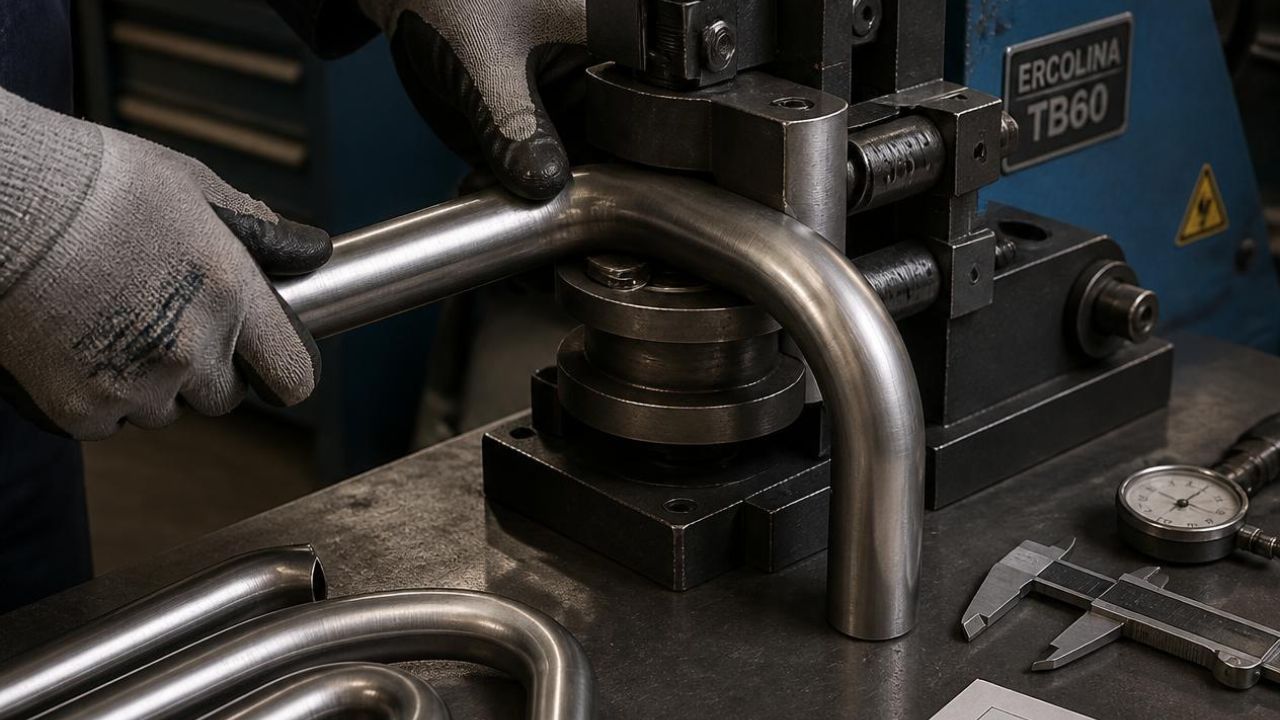
The tubing fabrication process transforms raw tubes into functional components through bending, cutting, forming, and assembly operations. Modern manufacturers depend on these processes to produce hydraulic lines, exhaust systems, structural frames, and specialized assemblies. Each step requires precise control to maintain dimensional accuracy and material integrity.
Advanced fabrication combines mechanical processes with digital controls to achieve tight tolerances and consistent results. Manufacturers integrate CNC bending machines, laser cutting systems, and automated quality inspection into unified production lines. This integration reduces manual handling, minimizes setup time, and ensures repeatable accuracy across large production volumes.
Key Takeaways
- Tubing fabrication encompasses bending, cutting, forming, and joining metal tubes into functional assemblies for multiple industries
- CNC rotary draw benders deliver ±0.1° accuracy and reduce scrap by 85% compared to manual methods
- Springback compensation through predictive algorithms prevents costly rework and ensures dimensional accuracy
- Equipment selection depends on precision requirements, automation level, material capabilities, and cost of ownership
- The global tube bending market will grow from USD 4.661 billion in 2024 to USD 7.874 billion by 2035
What Is Tubing Fabrication and Assembly?
Tubing fabrication is the systematic process of shaping, cutting, forming, and joining metal tubes into finished components. Operations include precision tube bending, end forming, notching, punching, welding, and surface treatment. Each technique serves specific design requirements while maintaining structural integrity and dimensional specifications.
Assembly brings individual fabricated tubes together through welding, brazing, or mechanical fastening. This phase requires careful alignment and sequencing to ensure proper fit and performance. Quality control checkpoints verify completed assemblies meet engineering specifications before shipment.
What Materials Are Commonly Used in Tubing?
Manufacturers select materials based on strength requirements, corrosion resistance, weight constraints, and cost considerations. Steel dominates heavy-duty applications requiring high tensile strength. Aluminum alloys provide excellent strength-to-weight ratios for aerospace and automotive applications where mass reduction improves efficiency.
Specialized alloys address extreme operating conditions. Titanium offers superior corrosion resistance and maintains strength at elevated temperatures for aerospace hydraulic systems. Copper excels in thermal transfer applications, while DOM (drawn over mandrel) steel delivers uniform wall thickness for precision hydraulic components. Inconel withstands extreme heat and corrosive environments in turbine systems and chemical processing equipment.
What Are the Primary Objectives of Tubing Fabrication?
The primary objective is to produce dimensionally accurate components that perform reliably under specified operating conditions. Fabricators must achieve tight bend radii without wall thinning, maintain consistent outside diameters, and prevent surface defects. These requirements ensure proper assembly fit and long-term mechanical performance.
Secondary objectives include optimizing production efficiency and minimizing material waste. Manufacturers implement automated bending sequences, reduce setup changeover time, and eliminate secondary operations. Material selection for tube bending directly impacts fabrication success by balancing mechanical properties with formability and cost factors.
What Industries Rely on Tubing Assembly?
Automotive manufacturers depend on tube assemblies for exhaust systems, hydraulic brake lines, chassis structural components, and fuel delivery networks. These applications require high-volume production with consistent quality and crash-test compliance. Automated CNC bending ensures repeatable accuracy across thousands of identical parts per production shift.
Aerospace applications demand extreme precision for hydraulic control lines, structural airframe tubes, and pressurized fuel systems. Construction sectors utilize tube assemblies for scaffolding frames, structural support systems, and architectural features. Industries that rely on custom pipe bending span from medical device manufacturing to heavy equipment production.
How Do Different Tube Bending Methods Compare?
Tube bending methods differ in precision capability, production speed, automation level, and material compatibility. Manual benders suit low-volume prototype work and basic shapes with relaxed tolerances. Hydraulic systems handle heavier materials and larger diameters but require operator skill for consistent results.
CNC-controlled benders represent the highest tier in accuracy, repeatability, and production throughput. These systems use programmable motion control to execute complex multi-plane bends with minimal human intervention. Achieving part consistency with CNC tube bending eliminates variation between production batches and reduces quality rejection rates.
What Is Rotary Draw Bending and When Is It Used?
Rotary draw bending is a mechanical process using a fixed-radius die to control bend geometry with high accuracy. The tube clamps against a rotating bend die while a pressure die applies force as the assembly rotates. This method provides full control over bend radius, angle, and wall integrity.
Manufacturers specify rotary draw bending when tight-radius bends (less than three times the diameter) require precise dimensional control. Applications include aerospace hydraulic lines, automotive exhaust systems, and medical device tubing. The process prevents tube collapse through mandrel support and maintains consistent wall thickness through the bend zone.
How Do Manual, Hydraulic, and CNC Benders Differ in Function?
Manual benders operate through lever-action or ratchet mechanisms requiring physical force to shape tubes. These tools achieve ±2° to 5° accuracy with bend times ranging from 5 to 15 seconds. They handle ¼” to ⅞” tube diameters and cost between $200 and $4,000.
Hydraulic benders use pressurized fluid to generate a bending force for larger tubes and thicker walls. These systems deliver ±1° to 2° accuracy with 3 to 8 second cycle times for tubes from ½” to 4″ diameter. CNC benders provide ±0.1° accuracy with 1 to 3 second cycle times across ¼” to 6″ diameter ranges. Pricing spans $11,000 to $55,000 for hydraulic units and $20,000 to over $150,000 for CNC systems.
What Are the Advantages and Limitations of Each Process?
Manual benders excel at low-cost prototyping but restrict material choices to soft metals like copper and aluminum. These tools lack digital control and depend on operator skill for dimensional consistency. Production volume remains limited due to physical fatigue and slow cycle times.
Hydraulic benders offer partial automation with increased power for heavy steel and DOM tubing applications. CNC machines eliminate operator variation and reduce scrap by 85% through precise control algorithms. Production speed increases by 400% compared to manual methods, though CNC systems require high initial capital investment. Choosing a CNC pipe bender involves evaluating these tradeoffs against production volume and quality requirements.
What Are Key Considerations in Tubing Fabrication Equipment Selection?
Equipment selection begins with defining precision requirements, production volume targets, and material compatibility needs. Manufacturers must balance initial investment against long-term operational costs, including maintenance, tooling, and labor. Decision frameworks prioritize factors that directly impact part quality, throughput efficiency, and total cost of ownership.
Secondary considerations include floor space requirements, power consumption, operator training complexity, and software integration capabilities. Equipment must accommodate current production needs while providing scalability for future growth. Flexible tooling systems reduce changeover time when switching between different tube sizes and bend geometries.
How Does Precision Impact Tubing Fabrication Quality?
Precision ranks as the highest priority factor with a 95% importance score in equipment selection decisions. Dimensional accuracy determines whether bent tubes fit properly during assembly and function correctly under operating loads. Tight tolerances prevent leaks in hydraulic systems and ensure proper alignment in structural applications.
Understanding and compensating for springback remains critical because elastic recovery leads to rejected parts without proper control. Inadequate springback control increases scrap rates, causes poor fit-ups during assembly, and necessitates costly rework. Modern CNC systems compensate automatically through predictive algorithms that adjust bend angles based on material properties.
What Role Does Automation Play in Modern Tube Bending?
Automation features score 80% importance as manufacturers seek to reduce labor costs and improve consistency. Automated feed systems, digital controls, and programmable sequences eliminate manual handling between bending operations. These capabilities reduce cycle time and remove human error from production.
Technological advancements, including Industry 4.0 integration and predictive diagnostics, score 88% importance among decision factors. Smart controls enable real-time process monitoring, automatic tool offset adjustment, and data collection for quality tracking. Connected equipment provides production analytics that identify bottlenecks and optimize workflow efficiency.
How Do Material Capabilities Influence Equipment Choice?
Material capabilities score 75% importance because equipment must handle the specific alloys and dimensions required for target applications. Some benders work exclusively with soft materials, while others accommodate high-strength steel and exotic alloys. Tube diameter range, wall thickness capacity, and mandrel support options determine which applications each machine can address.
Equipment compatibility with custom tube manufacturing materials determines production versatility and market reach. Manufacturers serving multiple industries require flexibility to process aluminum, steel, stainless steel, titanium, and specialty alloys. This capability reduces equipment redundancy and maximizes return on capital investment.
How Do Consumer Preferences Influence Tubing Fabrication Technology?
Consumer demand for automation and precision drives the rapid adoption of CNC-controlled systems over manual equipment. Manufacturers prioritize technologies that deliver consistent quality, reduce labor dependency, and enable faster production cycles. Market analysis shows clear preference shifts toward equipment offering digital integration and predictive quality controls.
Industry 4.0 connectivity has become a critical selection factor as manufacturers implement smart factory initiatives. Equipment providing real-time data collection, remote monitoring, and predictive maintenance capabilities commands premium pricing. These features reduce unplanned downtime and optimize overall equipment effectiveness.
Why Is Automation a Leading Priority for Manufacturers?
Manufacturers prioritize automation to eliminate operator variation and achieve consistent dimensional accuracy across production runs. Automated systems execute identical bending sequences without fatigue, distraction, or skill variation between shifts. This consistency reduces quality inspection requirements and lowers scrap rates.
Automated tube assembly steps reduce labor costs while increasing throughput capacity and production flexibility. Digital controls enable rapid program changeover between different part numbers without manual die adjustments. This capability supports small-batch production and just-in-time manufacturing strategies increasingly demanded by automotive and aerospace customers.
How Do Cost and Maintenance Affect Equipment Decisions?
Cost of ownership scores 82% importance as manufacturers evaluate total lifecycle expenses beyond the initial purchase price. Maintenance costs, spare parts availability, energy consumption, and tooling expenses accumulate significantly over equipment lifespan. Buyers compare these factors against expected production volume to calculate realistic payback periods.
Hydraulic systems require regular fluid changes, seal replacement, and pressure system maintenance. CNC electric benders reduce ongoing maintenance through simplified mechanical systems and eliminate hydraulic fluid disposal costs. Lower maintenance requirements reduce equipment downtime and improve production reliability.
What Environmental Factors Are Driving Equipment Innovation?
Environmental impact scores 68% importance as sustainability initiatives influence equipment purchasing decisions. All-electric CNC benders eliminate hydraulic fluid leakage risks and reduce energy consumption compared to older hydraulic systems. These improvements meet corporate environmental goals and reduce regulatory compliance complexity.
Energy-efficient designs lower operating costs while supporting green manufacturing certifications required by aerospace and automotive supply chains. Waste reduction through improved precision and lower scrap rates conserves raw materials and decreases disposal expenses. Manufacturers increasingly value equipment delivering both environmental benefits and operational cost savings.
What Are the Step-by-Step Processes Involved in Tubing Fabrication and Assembly?
The fabrication sequence begins with material inspection and preparation, including cutting tubes to specified lengths. CAD/CAM programming transfers design specifications into machine-readable instructions. This digital workflow enables rapid prototyping and eliminates manual setup errors during production.
Bending operations proceed according to programmed specifications with continuous monitoring of bend angles and dimensional accuracy. Post-bend operations include end forming, hole punching, notching, and deburring to prepare tubes for assembly. Final steps involve welding, brazing, or mechanical fastening to create complete assemblies ready for quality inspection.
How Is Tube Bending Programmed and Executed?
CAD/CAM programming integration allows rapid prototyping by translating 3D models directly into bending machine instructions. Software calculates bend sequences, predicts material behavior, and optimizes tooling configurations automatically. This digital approach eliminates manual programming errors and reduces setup time.
Software-based design modifications eliminate the need for custom tooling changes when engineering requirements evolve. Operators load programs from central databases, verify setup parameters, and execute automated bending sequences. Real-time monitoring systems track actual versus programmed dimensions throughout production runs.
What Quality Assurance Techniques Ensure Precision?
Quality assurance for bent tube assemblies combines in-process monitoring with post-production dimensional verification and functional testing. In-line laser measurement systems verify bend angles in real-time using non-contact scanning technology. These systems detect deviations immediately and trigger automatic program adjustments before producing defective parts.
Coordinate measuring machines and optical comparators provide detailed dimensional analysis of completed assemblies against CAD specifications. Pressure testing validates joint integrity for hydraulic and pneumatic applications. Statistical process control tracks dimensional trends across production batches to identify process drift before quality issues occur.
How Is Springback Compensated During Bending?
Springback refers to elastic recovery when the material tries to return to its original shape after the release of the bending force. This causes the final bend angle to open slightly compared to the die angle used during forming. The magnitude depends on material properties, tube diameter, wall thickness, and bend radius.
CNC systems use auto-compensation algorithms that adjust programmed bend angles to account for predicted springback behavior. Predictive springback modeling analyzes material properties and bend geometry to calculate required overbend amounts. These calculations ensure finished parts match design specifications after elastic recovery occurs.
How Do Demographic and Regional Trends Shape Tubing Fabrication?
Business size significantly influences equipment adoption patterns across the manufacturing sector. Large corporations invest in state-of-the-art CNC systems to support high-volume production and complex geometries. Small to medium enterprises balance capability needs against budget constraints by selecting cost-effective automation solutions.
Regional demand patterns reflect local industrial strengths, infrastructure development rates, and manufacturing sector maturity. North American markets emphasize precision and automation to maintain a competitive advantage despite higher labor costs. Asian markets prioritize production volume and cost efficiency to serve rapidly expanding construction and automotive sectors.
Which Business Sizes Adopt Which Technologies?
Large corporations prioritize state-of-the-art equipment, including multi-axis CNC benders and custom automated solutions. These organizations possess capital budgets supporting six-figure equipment investments and dedicated engineering teams. They require maximum flexibility, precision, and throughput to serve demanding aerospace and automotive customers.
SMEs seek cost-effective options without compromising quality by selecting entry-level CNC systems or advanced hydraulic benders. These businesses balance capability requirements against budget limitations while maintaining competitive quality standards. Flexible financing and modular equipment designs enable gradual technology adoption as production volumes grow.
How Do Regional Markets Differ in Tubing Fabrication Demand?
North America holds approximately 45% market share, driven by established automotive, aerospace, and construction industries. This region emphasizes precision manufacturing, advanced materials, and stringent quality standards. Regulatory requirements and safety certifications influence technology adoption toward higher-capability equipment.
The Asia-Pacific region represents the fastest-growing market, fueled by rapid industrialization and infrastructure development in China and India. These markets prioritize production volume and cost efficiency while gradually adopting advanced automation. European markets maintain a significant presence through regulatory support for sustainability initiatives and advanced engineering applications.
What Industry Segments Drive Tubing Fabrication Growth?
The global tube bending market reached USD 4.661 billion in 2024 and is projected to reach USD 7.874 billion by 2035. This represents a compound annual growth rate of 4.88% driven by expanding automotive production and aerospace development. Steel-bending machines represent the largest current segment serving heavy industrial and construction applications.
Aluminum segment growth accelerates as the fastest-expanding material category, driven by vehicle lightweighting initiatives and aerospace applications. Electric vehicle production increases demand for specialized battery cooling tubes and lightweight structural components. Medical device manufacturing and renewable energy infrastructure add emerging growth segments requiring precision tube-bending capabilities.
What Are the Cost Implications and ROI of Tubing Fabrication Equipment?
Equipment investment costs vary dramatically across manual, hydraulic, and CNC technology tiers based on automation level and precision capability. Manual benders represent an entry-level investment from $200 to $4,000, suitable for prototyping and low-volume production. These tools minimize capital requirements but limit production capacity and material compatibility.
Mid-range hydraulic systems require $11,000 to $55,000 investment, providing increased power without full automation. Premium CNC benders demand $20,000 to over $150,000, depending on axis count, tube capacity, and software capabilities. The ROI of precision tube fabrication calculations must account for reduced scrap, faster cycle times, and lower labor costs.
How Do Pricing Tiers Vary Across Equipment Types?
Manual tube benders serve budget-conscious buyers requiring basic forming capability for copper and aluminum materials. These tools cost $200 to $800 for basic construction and up to $4,000 for robust industrial models. Limited automation restricts production volume but eliminates electrical and software complexity.
Hydraulic benders occupy the mid-market segment from $11,000 to $55,000, offering increased power for thicker materials. CNC tube benders span $20,000 for entry-level systems to over $150,000 for advanced multi-axis machines. Premium systems include integrated laser cutting services, automatic material handling, and Industry 4.0 connectivity.
What Is the Expected Payback Period for CNC Benders?
CNC machines achieve payback in 12 to 18 months for operations performing 1,000 or more bends monthly. This calculation accounts for reduced scrap rates, faster production cycles, and lower labor costs. High-volume manufacturers realize faster returns through maximized equipment utilization and reduced quality rejection rates.
Return on investment improves through operational efficiency gains, including 85% scrap reduction and 400% production speed increases. Labor cost savings accumulate as automated systems replace multiple manual operators. Additional value derives from reduced quality inspection requirements and improved customer satisfaction through consistent part quality.
How Do Efficiency Gains Affect Overall Costs?
Precision tube bending reduces total production costs through minimized material waste and the elimination of secondary operations. Accurate first-pass bending eliminates rework loops that consume labor hours and delay delivery schedules. Automated systems maintain consistent quality without operator fatigue affecting dimensional accuracy.
Energy-efficient CNC systems reduce operating expenses through lower power consumption compared to hydraulic alternatives. Reduced maintenance requirements, lower ongoing ownership costs, and minimized unplanned production downtime. These cumulative efficiency improvements create competitive advantages through faster delivery times and lower unit costs.
Tubing Fabrication and Assembly: Integrating Technology, Precision, and Market Needs
Modern tubing fabrication combines advanced CNC control systems with material science understanding to produce components meeting demanding specifications. The transition from manual processes to automated precision bending enables manufacturers to achieve tight tolerances while reducing costs. Integration of CAD/CAM programming, real-time quality monitoring, and predictive springback compensation delivers consistent results across high-volume production.
Market growth projections confirm increasing demand for precision tube bending across automotive, aerospace, and industrial sectors. Manufacturers investing in advanced fabrication capabilities position themselves to capture emerging opportunities in electric vehicles, renewable energy, and lightweight structural applications. Companies like CRD MFG, Inc. demonstrate how integrated fabrication services deliver value through single-source manufacturing solutions.
Bring Your Tube Assembly Project to One Team
Chasing production updates across multiple vendors slows your timeline and invites spec errors. CRD MFG, Inc. handles CNC tube bending, laser tube cutting, robotic welding, and full assembly under one roof, with a dedicated project manager who advocates for your project from first quote to final inspection. You get one point of contact, accurate timelines, and parts built to your exact specifications. Explore advanced tube fabrication capabilities that combine CNC accuracy with flexible production scalability.
