
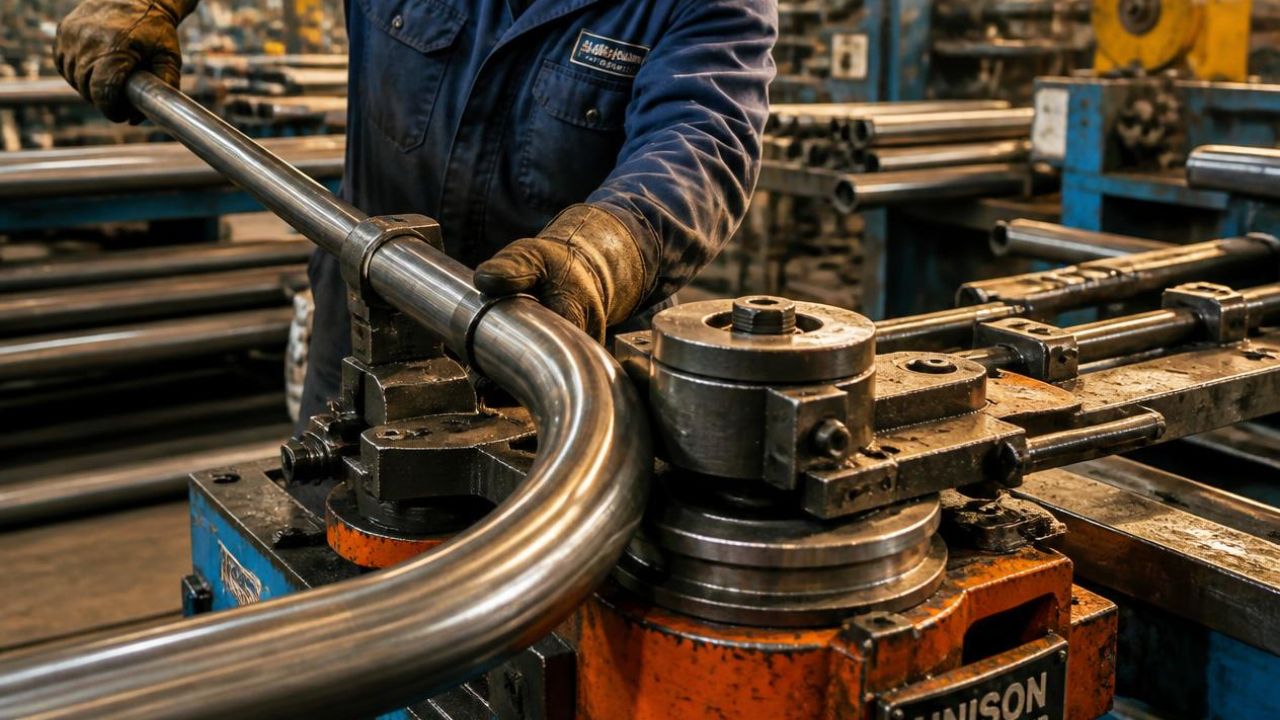
CNC pipe bending machines transform straight tubes into complex geometries with precision manual methods cannot match. Equipment selection requires balancing tolerance requirements, material characteristics, production volume, and bending method against capital investment and operational costs. Modern machines range from $1,000 manual units to $154,000 advanced CNC systems with servo-electric drives and multi-axis control.
The global CNC tube bending market reached $425 million in 2024 and is projected to reach $605 million by 2032. Equipment selection decisions hinge on matching CNC tube bender capabilities to specific industry demands, from aerospace hydraulic lines requiring ±0.25° angular tolerance to structural framing where ±1° proves acceptable.
Key Takeaways
- CNC pipe bending machines achieve angular tolerances from ±0.5° standard to ±0.25° for aerospace applications
- Servo-electric drives deliver 95% mechanical efficiency compared to 80% for hydraulic systems
- Rotary draw bending provides highest precision for tight-radius work while roll bending suits large-diameter curves
- Material springback ranges from 0.3° for copper to 3.5° for titanium on 90° bends
- ROI payback periods span 12–24 months depending on production volume and part complexity
What Defines CNC Pipe Bending and Its Key Performance Metrics?
CNC pipe bending uses computer-controlled positioning to rotate or form tubes around fixed dies with repeatable accuracy. Key performance metrics include angular tolerance, centerline radius capability, ovality control, and material-specific springback compensation. Standard industrial work tolerates ±1° to ±2° angular deviation, while CNC bending accuracy in aerospace applications tightens to ±0.25° with positional control within ±0.010 inches.
Production throughput and setup time directly affect ROI, with CNC machines completing setups in 1–2 minutes versus 10–30 minutes manually. Modern servo-driven multi-function benders maintain angular consistency within ±0.1° across production runs.
What Are the Critical Tolerances and Accuracy Standards for Pipe Bending?
Angular tolerances define acceptable deviation from programmed bend angles. General CNC equipment with maintained tooling achieves ±0.5° standard tolerance, tightening to ±0.25° with advanced servo-electric controls and real-time feedback. Automotive exhaust and roll-cage work typically specifies ±0.5° angular and ±0.030 inch positional tolerance.
Medical applications demand ±0.25° angular and ±0.015 inch positional precision, while aerospace hydraulic systems require ±0.25° angular and ±0.010 inch positional control. Ultra-precision setups using 5–10 times standard tonnage achieve ±0.1° to ±0.25° angular tolerance with ±0.05–0.15 millimeter positional accuracy.
How Do Centerline Radius and Ovality Affect Bending Quality?
Centerline radius measures bend radius at the tube’s neutral axis and determines bending difficulty. The tightest practically achievable CLR equals approximately 1× tube diameter, below which mandrel support becomes mandatory to prevent collapse. Design-for-manufacturing guidance recommends a minimum bend radius of 1.5× tube outside diameter to avoid excessive wall thinning.
Ovality describes the percentage difference between the maximum and minimum diameter after bending, caused by compression and tension. Thin-wall precision specifications limit ovality to 1.5% of outside diameter, while general fabrication accepts approximately 5%. ASME B31.1 permits 8% maximum difference between maximum and minimum diameter for ferrous piping at 5D+ radius.
What Material Factors Influence Springback and Wall Thinning?
Springback measures elastic angular recovery after bend forces release, varying by material yield-to-modulus ratio. Copper C122 exhibits 0.3° springback on 90° bends at 3D centerline radius, while stainless 304 shows 2.0° recovery. Titanium presents 2.5° to 3.5° springback, requiring aggressive overbend compensation.
Wall thinning concentrates at the bend extrados where material stretches under tension. Data shows 18% wall thinning at 3D bends, 12.5% at 5D bends, and 8% at 10D bends. ASME B31.3 requires post-bend minimum wall thickness to satisfy pressure-design formulas.
How Do Different CNC Pipe Bending Methods Compare?
Types of CNC pipe bending machines employ distinct mechanical principles suited to specific radius ranges and precision requirements. Rotary draw clamps the tube and rotates it around a fixed bend die with a pressure die at the tangent point, delivering the highest dimensional control. Roll bending passes tubes through three adjustable rollers to create gradual curves, while compression bending clamps the tube against a fixed former as a pressure die sweeps around it.
Rotary draw achieves tightest tolerances and repeatability, preferred for aerospace hydraulic lines and automotive exhaust systems. Roll bending excels at large-diameter structural framing and architectural work where sweeping curves exceed rotary-draw capability, capturing approximately 30% market share versus rotary draw’s 35–45%.
What Are the Mechanisms and Applications of Rotary Draw, Roll, and Compression Bending?
Rotary draw bending secures the tube in a rotating clamp die while a stationary bend die defines the radius. A pressure die applies force at the tangent point to prevent flattening, with optional mandrel and wiper die minimizing ovality and surface imperfections. This method delivers precision suitable for tight multi-plane bends in aerospace fuel lines and automotive roll cages.
Roll bending feeds the tube through three rollers arranged in a pyramid or offset configuration, incrementally curving material by adjusting roller positions. Compression bending fixes one tube end and sweeps a moving pressure die around a stationary former, offering lower tooling cost for general fabrication where dimensional precision requirements relax.
When Is Induction (Hot) Bending Preferable for Pipe Work?
Induction bending applies localized electromagnetic heating at 1600° to 2200°F to soften a narrow band before bending. Manufacturers offer induction capacity from 2-inch to 64-inch diameter with wall thickness up to 5 inches, exceeding cold-bending machine limits. This method serves energy sector tube bending requirements for oil and gas pipelines, power plant piping, and large-diameter structural applications.
Induction bending produces controlled bends in heavy-wall pipe that would buckle or require excessive tonnage when cold-formed. Heat-affected zones require post-bend heat treatment to restore material properties and meet ASME code requirements.
How Do Mandrel Types Impact Bending Precision and Repeatability?
Mandrels provide internal support during bending to prevent tube collapse and control ovality on thin-wall or tight-radius bends. Plug mandrels suit thicker walls and larger radii, typically in tubing 3/8 inch diameter and smaller. Ball or disc mandrels accommodate tighter bends and thinner materials by articulating through the bend zone, ideal for multi-radius and complex-geometry work.
Form mandrels serve thicker-wall tubes at average radii where collapse risk remains moderate. Below 1× tube diameter centerline radius, mandrel insertion becomes mandatory regardless of wall thickness.
What Specifications Should You Prioritize When Selecting a Bending Machine?
Machine specifications directly determine which tube sizes and geometries you can produce within tolerance. CNC tube benders span 12 millimeters to 250 millimeters outside-diameter capacity, with BLM GROUP’s electric series up to 150 millimeters. AMOB eMOB series handles 5–225 millimeters, while Unison’s electric range spans 4–275 millimeters outside diameter.
Tonnage, axis count, and drive type govern precision, cycle time, and energy consumption for application matching. High-volume standardized parts return investment in approximately 12 months through labor and scrap reduction, while high-mix operations see 18–24 month payback driven by setup-time savings.
How Do Tonnage, Axis Count, and OD Capacity Affect Machine Suitability?
Tonnage determines maximum tube diameter and wall thickness a machine can bend against material yield strength. Five-axis CNC configurations provide common mid-tier capability with X-linear, Y-bend angle, Z-rotation, T-carriage, and booster-assist axes. Advanced machines like AMOB eMOB 225 employ 11 servo-driven axes for complex geometries and multi-stack tooling changeovers.
Axis positioning precision directly impacts final part tolerance, with modern equipment achieving ±0.1 millimeter on linear axes and ±0.1° on rotational axes.
What Are the Differences Between Hydraulic and Servo-Electric Drives?
Hydraulic systems transmit bending force through pressurized fluid, delivering mechanical efficiency below 80% due to pump losses and heat generation. Servo-electric drives use ball-screw or direct-drive mechanisms, achieving mechanical transmission efficiency exceeding 95%, roughly doubling processing efficiency. Energy consumption in all-electric machines drops 20–40% compared to hydraulic equivalents.
Noise levels differ substantially, with modern CNC pipe bending machines featuring servo-electric drives operating at 55–60 decibels versus louder hydraulic pump noise. Servo-electric systems excel in precision small-batch and high-mix aerospace and medical work, while hydraulic machines remain cost-effective for high-tonnage structural applications.
The comparison below highlights how hydraulic and servo-electric drives differ on efficiency, noise, and typical application fit.
| Drive Type | Mechanical Efficiency | Noise Level | Typical Fit |
| Hydraulic | Below 80% | Higher, pump-driven | High-tonnage structural work |
| Servo-Electric | Above 95% | 55-60 decibels | Precision small-batch, aerospace, medical |
How Does Production Volume Influence Equipment Investment and ROI?
Equipment cost spans approximately $1,000 for manual benders to $154,000 and beyond for advanced CNC systems. ROI payback periods typically fall between 12 and 24 months depending on production volume and part complexity. High-volume standardized parts achieve approximately 12-month payback through labor savings and scrap reduction.
High-mix low-volume operations realize 18–24-month ROI driven by setup-time reduction and programming flexibility that enables profitable small-batch runs. Capital investment decisions must account for future capacity needs, as multi-stack tooling and all-electric platforms provide greater flexibility when product mix expands.
Which Bending Methods and Machines Best Fit Specific Industry Applications?
Industry applications impose distinct material, tolerance, and code requirements that dictate equipment selection. Aerospace tube assemblies demand AS9100 traceability, titanium and Inconel capability, and tolerances to ±0.25° angular and ±0.010 inch positional for hydraulic systems operating at 3,000–5,000 psi. Automotive production prioritizes high-volume repeatability in mild steel, aluminum, and stainless for exhaust systems, roll cages, and brake lines.
HVAC fabrication requires high-throughput small-diameter copper and aluminum bending with minimal operator skill requirements. Oil and gas infrastructure needs large-diameter capacity up to 56 inches and compliance with ASME B31.4, B31.8, and B31.3 wall-thinning limits.
The table below summarizes tolerance and method benchmarks across the industries CNC pipe bending equipment most commonly serves.
| Industry | Angular Tolerance | Positional Tolerance | Preferred Method |
| Aerospace | ±0.25° | ±0.010 in | Rotary draw with mandrel and wiper die |
| Medical | ±0.25° | ±0.015 in | Rotary draw, Class 100 cleanroom |
| Automotive | ±0.5° | ±0.030 in | Rotary draw or compression bending |
| HVAC | General fabrication | Not specified | All-electric small-radius, coil-fed |
| Oil and Gas | ASME B31.4/B31.8/B31.3 limits | Up to 56 in diameter | Induction bending |
| Structural/Architectural | General fabrication | Not specified | Roll bending |
What Are the Unique Requirements of Aerospace, Automotive, and Medical Sectors?
Aerospace applications specify titanium grades 5 and 9, Inconel 625 and 718, and stainless 321 and 347 materials. Hydraulic tube assemblies must withstand 3,000–5,000 psi operating pressure across temperature ranges from −65°F to +275°F while maintaining ±0.25° angular and ±0.010 inch positional tolerance. Rotary draw with mandrel and wiper die on all-electric servo machines provides required precision.
Medical sector cleanroom capability to Class 100 standards combines with ±0.25° angular and ±0.015 inch positional tolerance for stainless and exotic-alloy instrument tubing. Automotive exhaust and roll-cage production uses rotary draw for mass-produced complex bends, while compression bending serves lower-tolerance high-volume applications where cost sensitivity outweighs precision.
How Are HVAC, Oil & Gas, and Structural Applications Served by CNC Machines?
HVAC fabrication relies on copper, aluminum, and coated-steel tubing in small to medium diameters with high throughput demands. All-electric small-radius benders such as BLM Smart-One handle tubes up to 0.86 inch diameter in coil-fed automated cells that minimize operator intervention, maximizing production efficiency.
Oil and gas infrastructure uses induction bending for large-diameter carbon-steel and high-strength-alloy pipe following ASME code requirements. Roll bending serves architectural and structural framing with sweeping curves in thick-wall large-diameter pipe where aesthetic appearance and general dimensional accuracy outweigh tight-tolerance requirements.
How Do Material Types and Quality Standards Shape Equipment Choice?
Material selection for precision tube bending drives machine specification because springback, wall thinning, and required tonnage vary substantially by alloy. Stainless 304 carries a material factor approximately 3.5 times that of cold-rolled steel, reflecting higher yield strength and elastic modulus. CNC machines must store material-specific compensation tables or integrate real-time laser measurement.
Quality standards including AS9100, IATF 16949, ASME B31.x, and FDA ISO 13485 mandate traceability, inspection protocols, and post-bend verification procedures. ASME B31.3 requires post-bend minimum wall thickness to meet pressure-design formulas.
How Are Technological Advances Revolutionizing Tube and Pipe Bending?
Servo-electric drive technology eliminates hydraulic pumps and fluid systems, achieving mechanical transmission efficiency exceeding 95% versus below 80% for hydraulic machines. Modern all-electric positioning precision reaches below 0.05 millimeter per axis move, enabling ±0.05° bend-angle repeatability. BLM Dynamo machines demonstrate ±0.1 millimeter linear positioning and ±0.1° rotational positioning tolerance representative of contemporary CNC capability.
All-electric machines captured 32% of new tube-bending installations as manufacturers prioritize sustainability mandates and IoT-enabled process monitoring. CNC machines overall are expected to reach 85% of new installations by 2025.
What Are the Latest Developments in Servo-Electric Bending Machines?
BLM GROUP launched the Smart-One all-electric small-radius tube bender in North America in February 2025 for HVAC and automotive applications. The ELECT150 showcased at TUBE & WIRE 2024 handles up to 150 millimeter diameter tubes, bending a 110 millimeter tube to a 90 millimeter average radius fully electrically. BLM’s June 2026 TechForward event previewed AI-driven automatic calculation of bending parameters and integrated coil-to-tube machines.
Unison presented its largest all-electric machine, the Breeze 80 millimeter, at MACH 2026 alongside the EvBend 2000 handling up to 50 millimeter diameter. AMOB released the eMOB 225 in November 2025 with 11 servo-driven axes handling 8-inch tubes, incorporating multi-stack tooling and proprietary automatic springback compensation software.
How Do Multi-Stack Tooling and Automated Changeovers Improve Efficiency?
Multi-stack tooling mounts multiple bend-die sets on one bending head for automatic radius changeover within a single production cycle. Schwarze-Robitec reports 70% setup-time reduction from multi-stack configurations, particularly valuable for large dies requiring crane-assisted manual handling. CNC tube bending setup times of 1–2 minutes versus 10–30 minutes for manual tooling changes directly improve equipment utilization.
High-volume throughput benchmarks include Pines vertical compression benders at 1,000–1,500 bends per hour and BLM 832S-VGP at up to 1,200 bends per hour. Fully robotic cells achieve approximately 700 pipes per hour while maintaining consistent quality.
What Role Do Integrated Laser Measurement and Simulation Software Play?
Real-time laser measurement systems mounted on bend dies compare actual angles against programmed references during production for closed-loop correction. Vision Components VC nano 3D-Z laser profiler uses blue high-power laser triangulation to measure reflective metal surfaces, feeding deviation data directly to CNC controllers. Unison’s Opt2Sim Scan proprietary 3D measuring device provides understanding and compensating for springback by feeding scanned dimensions into machine correction algorithms.
Simulation software enables virtual bend-sequence optimization before physical production, reducing scrap through first-time-right programming. Springback-prediction algorithms achieve relative error below 5.79% using variable-curvature tube models, with documented case studies showing $1,000 per month scrap-cost savings for shops producing 2,000 bent tubes monthly.
What Impact Does Industry 4.0 Have on CNC Pipe Bending Operations?
Embedded IoT sensors in modern CNC benders enable predictive maintenance by flagging component wear before failure occurs. Remote diagnostics and production-metrics analytics feed manufacturing execution systems and enterprise resource planning software. BLM GROUP’s MES platform centralizes work-order scheduling, production tracking, and AI-driven optimization with direct interconnection to customer ERP systems.
Closed-loop CNC feedback repeatability of ±0.1 millimeter across production runs supports quality requirements in aerospace and medical sectors. Industry 4.0 integration transforms tube bending from isolated equipment operation into data-driven manufacturing cells.
How Are IoT and Machine Monitoring Systems Enhancing Productivity?
IoT sensors monitor axis loads, tool wear, and cycle times to detect deviations before quality suffers. Machine monitoring systems alert operators to maintenance needs based on actual operating hours and stress cycles rather than fixed schedules, reducing unplanned downtime and extending tooling life.
Production-metrics analytics compare actual throughput against theoretical capacity to identify bottlenecks and optimization opportunities. Pines vertical compression benders achieve 1,000–1,500 bends per hour, while BLM 832S-VGP systems reach up to 1,200 bends per hour in high-volume standardized-part production.
What Are the Trends in Digital Integration and Predictive Maintenance?
CNC machines are projected to represent 85% of new tube-bending equipment installations by 2025. The global CNC tube bending market reached $425 million in 2024 with projections to $605 million by 2032, while the broader pipe and tube bending machine market stands at $4.95 billion in 2025 with projections to $7.99 billion by 2035, representing approximately 4.9% compound annual growth.
Digital twin technology creates virtual replicas of physical bending processes for offline programming, collision detection, and cycle-time estimation. Transfluid t project 5.0 software introduces cloud data storage and product databases covering complete tube assemblies.
How Are Manufacturers Leveraging AI for Bending Parameter Optimization?
AI algorithms analyze material springback patterns from production data to refine compensation tables automatically rather than relying on manual trial-and-error. CNC-stored material libraries apply angle-by-angle corrections conditionally based on alloy, temper, and wall thickness. Real-time laser measurement feedback enables dynamic overbend calculation, adjusting for actual springback observed during the current production run.
BLM’s June 2026 TechForward preview demonstrated AI-driven automatic calculation of bending parameters that select optimal tooling, sequence, and compensation values from part geometry alone, reducing programming time and eliminating operator experience dependency.
How Has the Evolution of CNC Bending Technology Shaped Current Capabilities?
Rotary draw bending captured 35–45% market share through greater precision for tight-radius multi-plane work in aerospace and automotive sectors. Roll bending holds approximately 30% market share, serving architectural, structural, and large-diameter pipeline applications. Precision and tolerance capability receive approximately 95% importance ratings from manufacturing decision-makers.
Unison Ltd, founded in 1973, pioneered all-electric tube bending technology in the 1990s, with the 30th anniversary of the world’s first all-electric tube bender marked in 2024. BLM GROUP showcased Industry 4.0 MES platforms and AI-driven CAD/CAM tools at TUBE & WIRE 2024.
What Are the Milestones in Tube Bender Innovation Since the 1970s?
Unison Ltd and CML International, both founded in 1973, established foundations for modern CNC tube bending equipment. The 1990s introduction of all-electric drive systems eliminated hydraulic complexity and improved positioning precision below 0.05 millimeter per axis. Unison launched the Synergy HBM hybrid multi-stack tube bending range in 2021, combining servo-driven positioning with hydraulic actuation.
BLM GROUP’s 2024 TUBE & WIRE demonstrations of ELECT150 all-electric machines and MES integration marked inflection points in Industry 4.0 adoption. AMOB’s November 2025 launch of eMOB 225 with 11 servo axes and 219 millimeter capacity extended fully electric capability into previously hydraulic-dominated large-diameter territory.
Which Manufacturers Lead in All-Electric and Hybrid CNC Solutions?
BLM GROUP offers Smart-One for small-radius work up to 0.86 inch diameter and ELECT150 handling up to 150 millimeters fully electrically. Unison’s Breeze 80 millimeter represents its largest all-electric machine, complemented by EvBend 2000 up to 50 millimeters and EvBend 1000 for copper tubes to 22 millimeters. The Synergy HBM hybrid line combines servo positioning with hydraulic actuation.
AMOB manufactures eMOB 225, an all-electric machine handling 8-inch tubes with 11 servo axes and CH 350 CNC for 114–355 millimeter outside diameters. These manufacturers pushed all-electric machines to 32% of new installations, with hybrid configurations capturing an additional 18.7% share.
How Do Recent Product Launches Reflect Market and Application Needs?
BLM ELECT150 demonstrates extreme tight-radius capability by bending 110 millimeter tube to a 90-millimeter average radius electrically, addressing automotive exhaust manifold and industrial heat-exchanger demands. Unison Breeze 80 millimeter extends all-electric precision into medium-diameter territory previously requiring hydraulic tonnage. The EvBend 2000 handles up to 50 millimeters, and EvBend 1000 processes 22 millimeter copper target HVAC refrigerant lines and plumbing assemblies.
AMOB eMOB 225 with 219 millimeter capacity and 11 servo axes addresses heavy industrial applications where precision and traceability requirements previously accepted hydraulic limitations. Market demand for energy efficiency, noise reduction, and IoT integration drives manufacturers toward all-electric and hybrid solutions.
Selecting CNC Pipe Bending Machines: Balancing Precision, Application, and Technology Integration
Successful machine fit requires matching CNC pipe bending machine specifications to tolerance demands, material characteristics, and production volume simultaneously. Aerospace and medical sectors justify premium all-electric servo machines through ±0.25° tolerance requirements and material traceability mandates, while structural fabrication achieves profitability with compression or roll bending at lower capital investment. Application matching drives ROI by eliminating capability gaps while avoiding over-specification that inflates equipment cost.
Industry 4.0 integration transforms isolated equipment into data-driven manufacturing cells providing predictive maintenance, production analytics, and quality traceability. CRD MFG leverages advanced CNC bending technology alongside comprehensive fabrication services to deliver precision tube assemblies from prototype through production volumes. The convergence of servo-electric drives, real-time measurement, AI-driven parameter optimization, and IoT monitoring establishes new baselines for precision, efficiency, and reliability.
Partner With CRD MFG, Inc. for Precision Tube Bending
Evaluating CNC pipe bending machines is one path to precision tube assemblies. Working with an established fabricator is another. CRD MFG, Inc. operates CNC tube bending, laser tube cutting, and robotic welding equipment from its Placentia, California facility, serving aerospace, automotive, medical, HVAC, motorsports, oil and gas, and industrial manufacturing programs without the capital cost of new machinery.
A single dedicated project manager oversees each project from specification review through final inspection, so tolerance requirements and delivery dates stay on track. Faro Arm and VTube inspection equipment verify dimensional accuracy on every run, from one-off prototypes to full production volumes. The same inspection rigor applies across our advanced CNC machining services and robotic welding operations. Call CRD MFG, Inc. at (714) 871-3300 or request a quote to discuss tolerance requirements, materials, and production volume for your next tube bending project.
Frequently Asked Questions About CNC Pipe Bending Machines
Q1. What tolerance can a CNC pipe bending machine hold?
Standard industrial CNC pipe bending holds ±0.5° to ±1° angular tolerance, while advanced servo-electric machines with real-time feedback tighten to ±0.25° and, in ultra-precision setups, ±0.1°. Aerospace hydraulic lines and medical instrument tubing typically require the ±0.25° angular and ±0.010 to ±0.015 inch positional range. General structural framing and roll-bent architectural work tolerate wider deviation, often up to ±1°. Tolerance requirements should be confirmed against the applicable industry code before selecting a machine or a fabrication partner.
Q2. How much does a CNC pipe bending machine cost?
Equipment cost ranges from approximately $1,000 for manual benders to $154,000 or more for advanced all-electric CNC systems with multi-axis control. Mid-tier five-axis machines fall between these extremes, with pricing driven by tonnage, outside-diameter capacity, and servo-electric versus hydraulic drive type. ROI payback typically spans 12 to 24 months, with high-volume standardized parts recovering investment faster than high-mix, low-volume production. Shops evaluating capital investment should weigh setup time, tooling changeover, and expected production mix alongside the purchase price.
Q3. What is the difference between rotary draw and roll bending?
Rotary draw bending clamps the tube and rotates it around a fixed bend die, delivering the tightest tolerances and the highest dimensional control for aerospace hydraulic lines and automotive exhaust systems. Roll bending passes the tube through three adjustable rollers to create gradual, large-radius curves, suited to structural framing and architectural work where sweeping curves exceed rotary-draw capability. Rotary draw holds an estimated 35-45% market share on precision work, while roll bending captures approximately 30% on large-diameter, lower-tolerance applications. The choice comes down to required radius, tolerance, and part geometry.
Q4. When does a bend require a mandrel?
A mandrel becomes mandatory once the centerline radius drops below approximately 1x the tube diameter, since unsupported tube walls collapse or wrinkle at that tightness regardless of wall thickness. Plug mandrels support thicker walls and larger radii, typically on tubing 3/8 inch diameter and smaller, while ball or disc mandrels articulate through tighter, multi-radius bends on thinner material. Form mandrels serve thicker-wall tubes at moderate radii where collapse risk is lower. Material type, wall thickness, and centerline radius should all factor into the mandrel selection for a given application.
Q5. Should a manufacturer buy CNC bending equipment or outsource tube bending?
The decision depends on production volume, part mix, and how often tolerance or material requirements change. High-volume, standardized parts on a stable design often justify in-house equipment, with a 12-month payback typical for that profile. Manufacturers with variable part mix, occasional aerospace or medical-grade tolerance needs, or infrequent large runs frequently find that outsourcing to a fabricator with existing CNC bending, laser cutting, and inspection capability avoids the capital outlay and tooling changeover time. CRD MFG, Inc. supports both prototype quantities and full production runs for manufacturers weighing that decision.
