
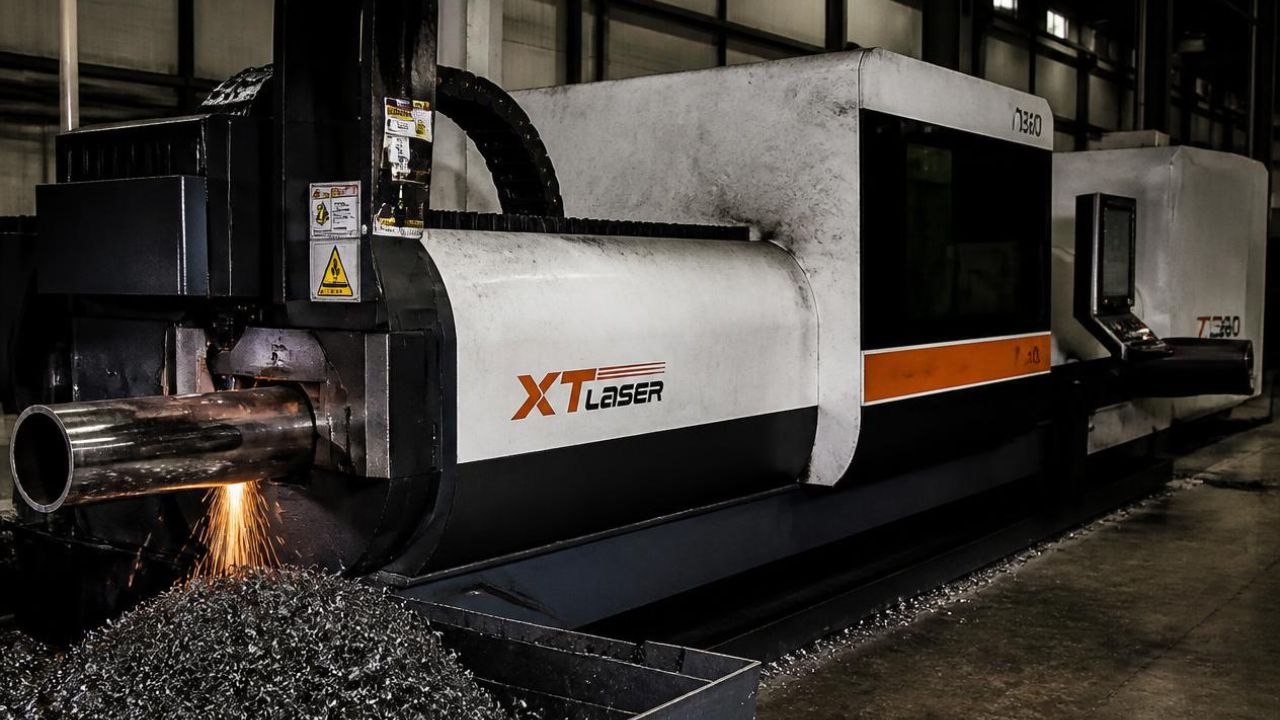
Tube laser cutting removes material using focused laser energy with precision across production runs. Modern systems integrate automated loading with advanced CNC controls for efficient metal tube processing. Manufacturers rely on this method to produce complex cuts that traditional sawing or milling cannot achieve.
The process employs three primary laser types optimized for different materials and applications. Fiber lasers dominate industrial metal cutting due to superior beam quality and speed. Understanding these variables helps manufacturers match system capabilities to specific fabrication requirements.
Key Takeaways
- Tube laser systems cut round, square, rectangular, oval, and special profiles with outer diameters from 1.5 to 16 inches
- Fiber lasers (0.5-12kW) dominate metal cutting, while CO₂ and diode lasers serve specialized applications
- Material thickness limits reach 3/4 inch with precision tolerances of ±0.05-0.1mm for industrial applications
- Laser power requirements scale from 1-2kW for thin materials to 6kW+ for heavy-duty fabrication
- Global laser cutting equipment market grows at 12% CAGR, reaching projected USD 18.43 billion by 2034
What Is Tube Laser Cutting and How Does It Work?
Tube laser cutting uses a concentrated beam to melt or vaporize material along programmed paths. The focused energy creates precise cuts without physical tool contact or deformation. CNC systems control beam positioning in multiple axes while rotating the tube for complete profile access. Assist gases in evacuating molten material and preventing oxidation.
The technology integrates optical systems, motion control, and material handling for automated production. Laser power, focal position, and cutting speed adjust automatically based on material type and thickness. Real-time monitoring maintains consistent quality across extended runs, reducing operator intervention while maintaining dimensional accuracy.
What Tube Shapes and Profiles Can Be Cut?
Tube laser systems process round, square, rectangular, oval, and special-shaped profiles without tooling changes. The shape versatility accommodates standard structural sections and custom extruded geometries in a single setup. Chuck designs adapt to different cross-sections using adjustable clamps or programmable gripping systems.
Specialized fixtures support non-standard shapes, including triangular, hexagonal, and asymmetric profiles. Systems with profile recognition software automatically detect geometry and adjust cutting parameters. Custom profile libraries store optimized settings for frequently processed shapes to reduce programming time.
What Laser Types Are Used in Tube Cutting?
Fiber lasers serve as the industry standard for metal cutting on steel, stainless steel, aluminum, copper, and titanium. Their wavelength absorption characteristics enable efficient processing of reflective materials with minimal maintenance. Fiber laser power ranges from 0.5kW for thin-walled tubing to 12kW for heavy structural sections, delivering superior edge quality and faster speeds than alternatives.
CO₂ lasers suit non-metals like wood and acrylic, or thin metals requiring lower power density. Their 40W to 6kW range serves specialized applications where fiber laser investment cannot be justified. Diode lasers address light industrial or hobbyist applications on thin organics with 5W to 100W output.
What Are the Advantages and Limitations of Tube Laser Cutting?
Tube laser precision reaches ±0.05-0.1mm compared to traditional methods with lower dimensional control and larger kerf widths. This accuracy reduces secondary operations and improves assembly fit. High processing speeds minimize cycle times while automated material handling eliminates manual positioning errors, producing clean edges that often require no deburring.
High initial capital investment creates barriers for smaller fabrication shops. Equipment costs range from USD 20,000 for entry-level units to over USD 500,000 for automated production cells. Skilled CNC programmers are needed for efficient cutting paths and nesting strategies. Ongoing maintenance costs include cutting gases, consumable optics, and periodic calibration.
How Do Tube Sizes and Material Thickness Influence Laser Cutting?
Material dimensions directly determine required laser power and processing speed. Thicker walls demand higher energy density to achieve complete penetration without excessive heat input. Tube diameter affects rotational dynamics and toolpath complexity during multi-sided operations.
Processing parameters automatically adjust based on real-time thickness measurements from integrated sensors. Larger diameter tubes require extended focal lengths to maintain beam quality across the entire cutting envelope. Material thickness limits define the maximum wall gauge achievable at acceptable speeds.
What Are the Typical Size Ranges for Tube Laser Systems?
Tube laser outer diameter range spans 1.5 to 16 inches across industrial equipment configurations. Standard systems accommodate tubes from 38mm to 406mm without specialized tooling. Heavy-duty models extend this range for structural applications.
Material thickness limits reach up to 3/4 inch for high-power fiber laser systems processing carbon steel. Stainless steel and aluminum are typically processed at slightly reduced maximum thicknesses due to thermal conductivity differences. Thin-walled tubes below 0.5mm require precise focal control to prevent edge warping from heat concentration.
How Does Material Thickness Affect Laser Power Requirements?
A 1-2kW laser proves sufficient for thin materials below 3mm, requiring high-speed processing with minimal heat input. These lower-power systems serve electronics enclosures and decorative applications, prioritizing speed.
3-6kW systems handle standard industrial applications, processing structural tubing from 3mm to 10mm wall thickness. These mid-range configurations balance investment cost against practical production capabilities. 6kW+ systems handle heavy-duty applications, including thick-walled pipe and large structural sections exceeding 10mm.
What Materials Are Suitable for Tube Laser Cutting?
Materials processed include steel, stainless steel, aluminum, copper, and titanium across varied alloy compositions. Carbon steel cuts efficiently due to favorable absorption characteristics and predictable thermal behavior. Stainless steel requires nitrogen assist gas to prevent oxidation and maintain clean edges. Aluminum demands a higher power density to overcome the thermal conductivity that rapidly dissipates heat.
Copper and brass present challenges from high reflectivity that can damage optical components without proper wavelength selection. Modern fiber lasers overcome these limitations through shorter wavelengths that improve metal absorption. Titanium processes cleanly but requires inert shielding to prevent atmospheric contamination. Material compatibility guides help manufacturers optimize parameters for specific alloys.
How Does Tube Laser Cutting Compare to Other Fabrication Methods?
Tube laser cutting delivers superior precision and geometric flexibility compared to mechanical cutting and forming processes. Traditional methods rely on physical tooling that limits design complexity and requires setup time between profile changes. Laser systems adjust cutting paths through software modifications without mechanical reconfiguration, reducing lead times and enabling cost-effective small-batch production.
Comparing laser cutting advantages clarifies when the technology provides maximum value. Integration of multiple processes optimizes manufacturing efficiency across complete assemblies.
What Are the Differences Between CNC and Hydraulic Tube Bending?
CNC tube bender accuracy reaches ±0.05 degrees through closed-loop servo control and automated springback compensation, ensuring consistent bend angles across production runs without manual adjustment. CNC cycle times achieve 2 seconds per bend for simple geometries through optimized motion profiles.
Hydraulic accuracy ranges from ±2-5 degrees depending on operator skill and material consistency. Manual setup introduces variability that CNC systems eliminate through programmed positioning. CNC benders achieve 180-degree bends while hydraulic systems typically limit to 120 degrees or less. CNC tube bender diameter range spans 6.35mm to 150mm with prices from USD 10,000 to over USD 100,000.
When Is Orbital Welding Required After Cutting?
Industries using orbital welding include semiconductor, pharmaceutical, and aerospace, where weld purity prevents contamination risks. These sectors demand repeatable weld quality that manual methods cannot consistently deliver. Orbital welding precision maintains ±0.1mm consistency compared to manual welding variability exceeding several millimeters.
Orbital welding cycle times range from 5-60 minutes per weld, depending on diameter and thickness. Automated parameter control ensures consistent heat input throughout the complete rotation. The orbital welding systems market grows at 8% CAGR, driven by expanding semiconductor and bioprocessing capacity. Precision tube welding methods help manufacturers select appropriate joining techniques.
What Are the Operational and Cost Implications?
Fiber laser prices range from USD 20,000 for basic systems to over USD 500,000 for fully automated production cells. Initial investment includes machine cost, installation, operator training, and facility modifications. CO₂ laser prices span USD 500 to USD 100,000, depending on power output. Diode laser prices start at USD 300 for hobbyist units and reach USD 10,000 for light industrial models.
Hydraulic bender prices range from USD 5,000 for manual units to USD 50,000 for programmable systems. Orbital welding equipment costs between USD 8,000 for basic power supplies and over USD 30,000 for advanced systems. Operating costs include consumables, maintenance, and energy consumption, varying based on production volume.
How to Select the Right Tube Laser Cutting Machine?
Equipment selection requires matching system capabilities to current production needs and anticipated future requirements. Undersized machines limit processing capacity while oversized systems waste capital on unused features. Manufacturers must evaluate material types, dimension ranges, and annual volume projections before specifying equipment.
Software capabilities determine programming efficiency and producible geometry complexity. Setup time considerations affect batch changeover efficiency for custom fabrication. Comprehensive evaluation prevents costly retrofits or premature equipment replacement.
How to Match Tube Profiles and Laser Power?
Selecting laser power based on material thickness requirements prevents underpowered systems that cannot process planned production materials. A 2kW system handles thin-walled tubing but proves inadequate for structural sections exceeding 6mm wall thickness. Manufacturers should specify 20-30% excess capacity to accommodate future material expansion.
Determining tube diameter and material capacity requirements establishes the physical envelope needed for planned production. Systems handling 16-inch diameter tubes require significantly larger work envelopes and more robust rotational drives. Capacity planning should include dimensional specifications for anticipated product line extensions over equipment lifetime.
What Cutting Precision and Software Features Matter?
Evaluating cutting accuracy requires understanding both static positioning resolution and dynamic path-following performance. Specification sheets list ideal accuracy, but real-world performance depends on machine bed stability during acceleration. High-quality linear guides and rigid construction maintain specified tolerances across extended operation.
Assessing software capability for drawing imports ensures compatibility with existing CAD systems and file formats. Native support for common formats reduces conversion errors and simplifies workflow integration. Path optimization algorithms automatically sequence cuts to minimize rapid positioning moves and reduce cycle times. Advanced nesting features maximize material utilization by intelligently arranging multiple parts within available tube lengths.
What Are the Key Considerations for Total Cost of Ownership?
Calculating the total cost of ownership requires including tooling and maintenance expenses beyond the initial equipment purchase. Tooling sets for different tube diameters range from USD 5,000 to USD 15,000 per diameter configuration. Periodic replacement of consumable optics, nozzles, and protective windows adds recurring costs throughout equipment lifetime.
Energy consumption varies significantly between laser types, with fiber lasers offering superior electrical efficiency compared to CO₂ systems. Operating costs include assist gases, with nitrogen and oxygen consumption varying based on material and thickness. Comprehensive TCO analysis over five to seven years reveals true equipment economics beyond initial acquisition costs.
What Are the Technical Specifications and Performance Metrics?
Technical specifications define equipment capabilities and establish performance expectations for production planning. Cutting speed, positional accuracy, and material capacity directly impact throughput and quality. Understanding the relationship between specifications and real-world performance prevents unrealistic production expectations.
Performance metrics enable objective comparison between competing equipment models. Repeatability measures consistency across multiple identical cuts, while accuracy defines absolute dimensional conformance. Precision tolerances for complex geometries vary based on design features and processing parameters.
What Are Typical Cutting Speeds and Accuracy Levels?
Cutting speed varies from 2 to 30 seconds per linear meter depending on material type, thickness, and required edge quality. Thin carbon steel processes faster than reflective aluminum at equivalent thickness due to superior laser absorption. Complex geometries with frequent direction changes reduce average speeds compared to straight-line cuts.
Positional accuracy of ±0.05-0.1mm represents achievable performance for properly maintained industrial systems. Accuracy degrades with increased cutting speed as dynamic positioning errors accumulate during rapid motion. Temperature variation affects mechanical components, requiring thermal compensation for critical dimensional applications.
How Do Different Laser Sources Affect Quality?
Fiber laser sources produce superior edge quality on metals through improved beam characteristics and stable power delivery. Shorter wavelengths create narrower kerf widths that preserve more base material and reduce heat-affected zones. Consistent power output maintains uniform cutting speed and edge finish across extended production runs.
CO₂ laser wavelengths suit organic materials but require higher power levels for equivalent metal cutting performance. Edge oxidation occurs more readily without a properly controlled assist gas composition. Technology comparisons between laser and plasma cutting highlight performance differences across cutting methods.
What Maintenance and Consumables Are Required?
Scheduled maintenance includes optical cleaning, alignment verification, and mechanical component lubrication to maintain specified performance. Protective windows require periodic replacement based on operating hours and observed degradation. Cutting nozzles represent the primary consumable, with replacement frequency dependent on material type and processing intensity.
Assist gas consumption constitutes a high ongoing operational cost for high-volume production. Nitrogen usage ranges from 0.5 to 2.0 cubic meters per hour based on cutting parameters and material thickness. Regular calibration and preventive maintenance prevent unexpected downtime and maintain consistent part quality.
How Do Workforce Trends Impact Tube Laser Cutting Technology Use?
Generational workforce shifts influence equipment purchasing as manufacturers adapt to changing operator preferences. Younger workers prioritize intuitive interfaces and automated systems that reduce manual intervention. Baby Boomer retirements create knowledge gaps that advanced equipment must compensate for through simplified operation.
Equipment manufacturers respond by developing systems with touchscreen interfaces, cloud connectivity, and remote monitoring capabilities. These features appeal to digitally native operators while providing management with real-time production visibility. Workforce demographics now significantly influence equipment design priorities alongside traditional performance specifications.
How Are Generational Preferences Shaping Equipment Features?
Millennials represent 35% of the manufacturing workforce and demonstrate a strong preference for data-driven performance monitoring. This cohort values equipment providing detailed analytics supporting continuous improvement. Generation Z represents 25% of the workforce with expectations for smartphone-like interfaces and instant digital access.
Gen Z prioritizes workplace flexibility at 38% and meaningful work at 41%, according to recent workforce surveys. Equipment selection increasingly considers features supporting remote operation and reducing repetitive manual tasks. Advanced automation appeals to younger workers while compensating for declining numbers of experienced operators.
What Are the Differences Between SME and Enterprise Adoption?
SMEs face capital cost barriers limiting access to advanced tube laser systems exceeding USD 100,000. These smaller operations often rely on manual equipment or job shop services rather than in-house automation. Equipment leasing models improve access by spreading costs across predictable monthly payments. Large enterprises demonstrate high adoption rates driven by volume requirements, justifying capital investment.
Enterprise manufacturers leverage economies of scale to justify multi-station production cells with integrated material handling. Their purchasing decisions prioritize long-term reliability over initial cost. SMEs typically operate single machines requiring maximum flexibility across diverse small-batch production requirements.
How Does Automation Affect Operator Roles?
Automation transforms operator responsibilities from manual machine control to supervisory roles, monitoring multiple systems simultaneously. Modern systems automate routine decisions, enabling less experienced personnel to achieve consistent results. This shift reduces dependence on scarce skilled labor while improving production consistency.
Automated loading systems eliminate heavy lifting and repetitive positioning tasks that contribute to operator fatigue. Operators transition to higher-value activities, including program optimization, preventive maintenance, and quality verification. Remote monitoring enables centralized oversight of distributed production equipment.
What Procedural Steps Are Involved in Tube Laser Cutting Operations?
Production operations follow standardized sequences, ensuring consistent quality and efficient material utilization. Proper material handling prevents surface damage affecting cutting quality. Programming efficiency directly impacts production throughput by minimizing non-cutting time between parts.
Operational procedures incorporate safety protocols protecting operators from laser radiation, moving machinery, and material handling hazards. Standard work instructions document proven methods, ensuring new operators achieve experienced performance rapidly. Structured procedures distinguish professional manufacturing environments from ad-hoc fabrication approaches.
How Is Material Loading and Positioning Managed?
Automated loading systems transport tubes from storage racks to machine chucks without manual handling of heavy materials. Robotic arms or conveyor systems reduce operator physical demands while improving positioning repeatability. Manual loading remains common for smaller systems processing lighter tubes at lower volumes.
Positioning accuracy depends on chuck clamping force, tube straightness, and rotational indexing precision throughout cutting. Integrated measurement systems verify tube diameter and detect material defects before initiating cutting. Automatic length measurement prevents programming errors that could damage tooling or produce scrap.
What Are the Programming and CNC Control Requirements?
CNC programming requires translating CAD geometry into machine-specific toolpaths, accounting for material properties and cutting parameters. Software imports DXF or STEP files, automatically generating cutting sequences optimized for minimum cycle time. Programmers select appropriate laser power, cutting speed, and assist gas settings based on material thickness.
Control systems coordinate multi-axis motion, laser power modulation, and assist gas delivery throughout complex cutting sequences. Real-time sensors monitor cutting quality, automatically adjusting parameters to maintain consistent edge characteristics. Operators interface with touchscreen displays, providing intuitive access to production data and machine diagnostics.
How Is Quality Control Maintained During Production?
First article inspection verifies that initial production parts meet dimensional and quality specifications before proceeding with batch production. Operators measure critical dimensions using precision instruments, comparing results against engineering drawings. Statistical process control tracks dimensional variation across production runs, identifying trends requiring parameter adjustment.
Automated vision systems inspect edge quality and detect defects, including incomplete cuts or excessive dross formation. Periodic calibration maintains equipment accuracy within specified tolerances throughout extended production campaigns. Documentation traces material certifications, process parameters, and inspection results for critical applications.
Advances and Strategic Outlook on Tube Laser Cutting Capabilities
The global metal fabrication equipment market reached USD 68.30 billion in 2024 and is projected to grow to USD 94.53 billion by 2032. This expansion reflects increasing demand for precision manufacturing across automotive, aerospace, and industrial sectors. Laser cutting equipment demonstrates exceptional growth at 12% CAGR, significantly exceeding broader market averages.
Laser cutting machines valued at USD 6.85 billion in 2024 project reaching USD 18.43 billion by 2034. This dramatic growth reflects declining equipment costs and expanding application versatility. Fiber laser technology improvements continue to reduce power consumption while increasing achievable cutting speeds and material capabilities.
Tube laser cutting capabilities continue expanding through higher power sources, improved automation, and enhanced software integration. Systems now process thicker materials at faster speeds while maintaining sub-millimeter accuracy across complex geometries. Integration with robotic material handling enables lights-out production for standardized components. Selecting appropriate welding methods complements laser cutting to create complete fabrication solutions.
The technology democratizes access to precision fabrication for smaller manufacturers through declining equipment costs and improved usability. Cloud-based programming tools enable remote job setup and production monitoring from any internet-connected device. Strategic equipment investments increasingly focus on flexible systems supporting diverse production requirements rather than dedicated high-volume configurations.
CRD MFG, Inc. demonstrates how advanced tube laser cutting integrates with complementary fabrication technologies for complete manufacturing solutions. Combined capabilities spanning laser cutting, CNC bending, and precision welding enable single-source production from concept through finished assembly.
Get Precise Tube Laser Cutting Without the Secondary Operations
Sourcing complex tube profiles that arrive out of tolerance, with rough edges that need deburring, or split across multiple vendors, slows your whole production schedule. CRD MFG, Inc. cuts round, square, rectangular, and custom tube profiles in a single setup using infrared fiber laser systems with CNC control, holding tight tolerances on materials up to 3/4 inch thick. Our laser tube cutting eliminates secondary sawing, drilling, and deburring, and pairs directly with our CNC tube bending solutions, robotic welding, and in-house inspection so your parts move from cut to finished assembly under one roof. A dedicated project manager handles your job from quote to delivery, so you always know where your parts stand. Explore our laser tube cutting services to discover how precision fabrication capabilities support your manufacturing requirements.
